
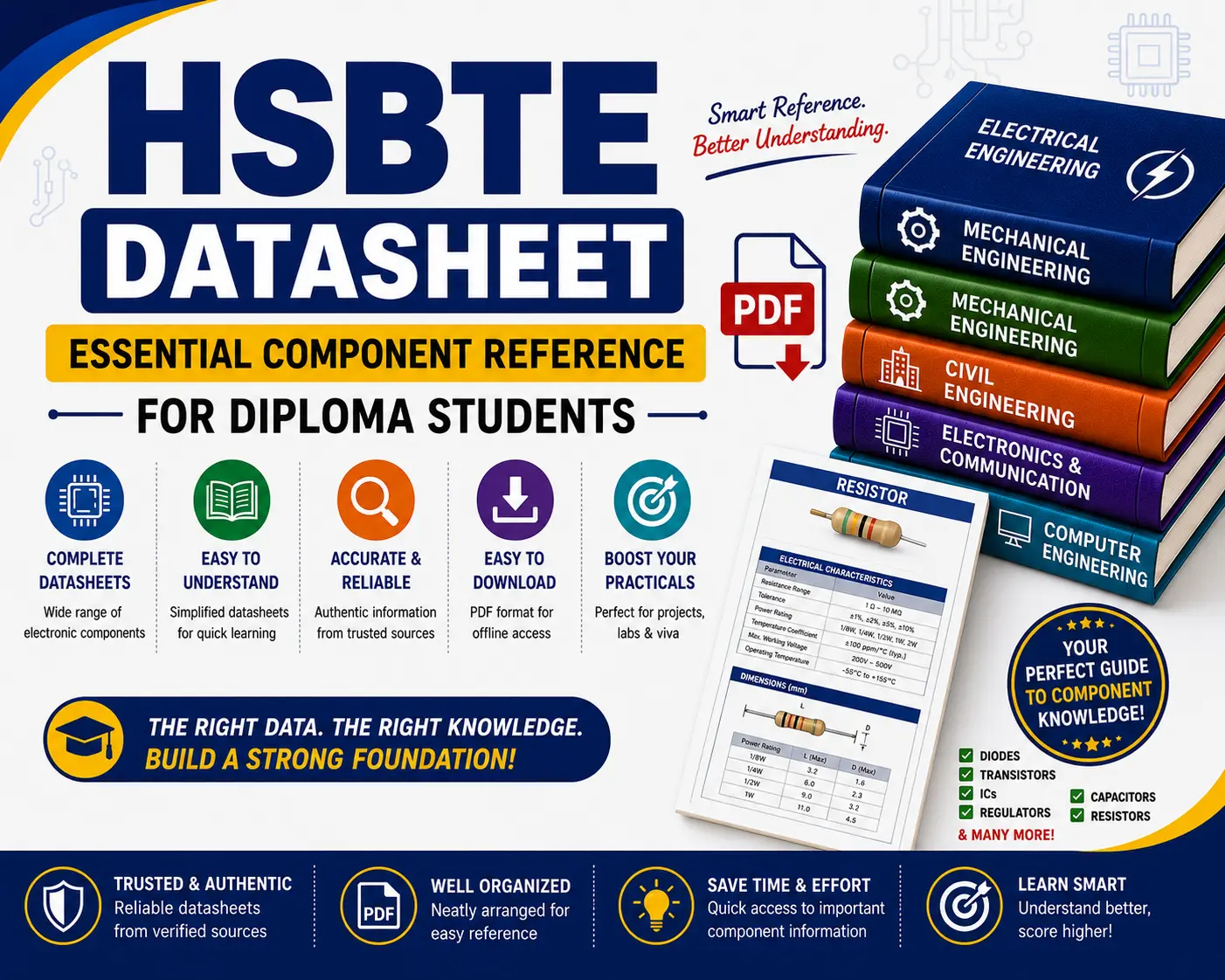
Access HSBTE datasheet references for diploma students. Learn pin configurations, ratings and specifications for electronics and electrical components. Welcome to the Poly Notes Hub, a leading destination for HSBTE Diploma Engineering Notes.
Author Name: Arun Paul.
HSBTE Datasheet – Essential Component Reference for Diploma Students
Understanding how to read and apply a datasheet is equally as crucial for diploma students studying electronics, electrical, and related engineering areas at the Haryana State Board of Technical Education as mastering theory. An HSBTE datasheet reference helps students connect classroom concepts to real-world components utilized in lab experiments, practical exams, and final-year projects. Even simple circuit-building chores might be complicated and time-consuming if you don’t understand the datasheet.
What Is a Datasheet and Why It Matters
A datasheet is a technical document produced by component manufacturers that provides complete information about a particular electronic or electrical component. This covers data on voltage and current ratings, pin configurations, operating temperature range, and functional performance under various conditions. For polytechnic students, datasheets serve as a link between theoretical information gained in class and the practical use of components on a breadboard or circuit board.
Having quick access to accurate datasheets helps students in several ways:
- Understand exact pin configuration before wiring any component
- Verify voltage and current ratings to avoid damaging components during experiments
- Select the correct component substitute when the original part is unavailable
- Complete lab practicals and project reports with accurate technical details
- Build confidence while working independently on circuit design tasks
📍 Our Official Website: www.polynoteshub.co.in
Commonly Used Datasheets in Diploma Courses
Diploma students, particularly those in the Electronics and Electrical Engineering areas, commonly work with standard components throughout their courses. This comprises transistors, diodes, integrated circuits (such as the 555 timer and op-amps), microcontrollers, sensors, and many types of relays. Each of these components has its own datasheet, which includes pin numbers, functional descriptions, and suggested working conditions. Having a ready reference to these regularly used datasheets saves time during lab sessions, as quick judgments are frequently required while building up circuits.
How to Read a Datasheet Effectively
HSBTE Datasheets might appear intimidating owing to the quantity of technical detail they contain, but focusing on a few essential elements makes them much easier to understand. Students should pay special attention to:
- Pin diagram and pin description, which shows the exact function of each terminal
- Absolute maximum ratings, which indicate the safe operating limits of the component
- Electrical characteristics table, covering voltage, current, and power specifications
- Functional description, explaining how the component behaves in a circuit
- Package and dimension details, useful for physical circuit layout planning
Once students become familiar with this structure, reading any new component’s datasheet becomes significantly faster, even for parts they have never used before.
Using Datasheets During Practical Exams and Projects
During practical exams, students are frequently requested to accurately identify components and connect them according to circuit specifications. A thorough comprehension of datasheets enables students to swiftly verify pin numbers and ratings without hesitation, which is beneficial during oral or practical examination. Similarly, while working on final-year projects, datasheets are essential for selecting the proper components, estimating power needs, and troubleshooting circuits that do not perform as planned.
Datasheets and Theory – Why Both Matter Together
While notes and syllabus content describe how components work in theory, datasheets provide the exact practical specifications required to design and test circuits. Relying solely on theoretical knowledge without consulting datasheets frequently results in improper connections or component breakage during lab work. By combining conceptual comprehension from notes with exact datasheet reference, students gain a comprehensive, practical understanding of how components operate in real-world situations.
Conclusion
A thorough understanding of datasheets is a crucial practical ability for all diploma students, particularly those studying Electronics and Electrical Engineering. Learning to read pin diagrams, ratings, and functional descriptions accurately allows students to approach lab experiments, practical exams, and project work with significantly better precision and confidence, bridging the gap between classroom theory and real-world circuit implementation.