
India’s electronics industry is expanding quickly, and new investment is finally moving beyond device assembly into multilayer boards, HDI, flexible PCB and copper-clad laminate. That makes India a more credible PCB sourcing option than it was a few years ago. It does not, however, make the Indian and Chinese supply bases interchangeable.
For engineering and procurement teams, the useful comparison is not which country is “better.” It is where each manufacturing base has enough process depth, material access and production scale for the actual board being purchased. A two-layer industrial control board, a 12-layer impedance-controlled backplane and a rigid-flex medical assembly do not create the same sourcing decision.
Scope note: The trade data in this article uses HS 853400, which covers bare printed circuits. It does not include populated PCB assemblies, complete electronic products or every domestic transaction.
The scale gap is not subtle
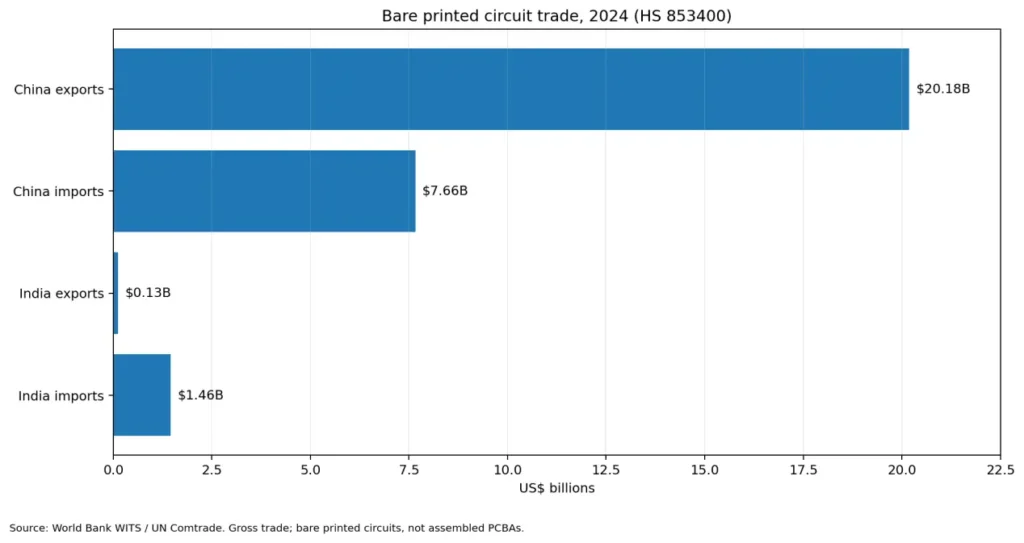
World Bank WITS data based on UN Comtrade reports that China exported US$20.183 billion of printed circuits in 2024. India exported US$125.3 million. On the same customs classification, China’s export value was about 161 times India’s.
The import side tells an equally important story. India imported US$1.459 billion of bare printed circuits in 2024, including US$1.033 billion from China. In other words, China supplied about 70.8% of India’s reported PCB imports. China itself imported US$7.662 billion of printed circuits, reflecting the two-way trade that occurs inside Asia’s highly integrated electronics supply chain.
This is not simply a labor-cost difference. It reflects decades of accumulated investment in plating lines, drilling and imaging equipment, specialty materials, chemical supply, tooling, test laboratories, process engineering and nearby electronics assembly.
What China’s scale changes on the factory floor
Prismark estimated that mainland China accounted for roughly 53% of global PCB production by value in 2022 and now projects its share at approximately 60% in 2026. That concentration creates practical advantages that are difficult to reproduce with one new plant or incentive program.
A Chinese buyer can usually source standard FR-4, high-Tg laminates, heavy copper, metal-core materials, Rogers-type RF materials, flexible materials and a wide range of surface finishes from a large regional network. The same ecosystem supports laser drilling, via filling, sequential lamination, controlled-depth routing, impedance testing, flying probe, automated optical inspection and volume electrical test.
That does not mean every Chinese PCB factory can reliably build every design. The supplier pool includes everything from low-cost double-sided board shops to advanced HDI and substrate manufacturers. The advantage is breadth: a buyer has more opportunities to find a plant already running a similar stack-up, feature size and annual volume.
India is moving from demand growth to capacity building
India’s electronics production reached ₹13.11 lakh crore in FY2025–26, according to the Government of India, up 15.8% from the previous fiscal year. Until recently, much of that growth occurred in final products and assembly while the component base remained dependent on imports.
The Electronics Component Manufacturing Scheme, notified in April 2025, was designed to address that gap. Its original outlay was ₹22,919 crore, approximately US$2.7 billion, over a six-year period. PCB-related target segments include multilayer boards, HDI, modified semi-additive process, flexible PCB and upstream materials.
The first approvals included projects for multilayer PCB, HDI and India’s first domestic copper-clad laminate facility. The government projected that the approved units could eventually meet 20% of domestic PCB demand and 100% of domestic CCL demand. A second approval tranche added nine multilayer PCB manufacturers.
These are meaningful developments, particularly because laminate availability and scale are central to PCB economics. Still, an approved investment is not the same as a fully qualified production line. New Indian PCB plants need equipment installation, process transfer, customer validation, yield learning and stable material supply before they can be treated as substitutes for mature overseas capacity.
Capability comparison for real PCB programs
| Requirement | China | India | Practical sourcing view |
| Single- and double-sided FR-4 | Very broad supplier base and strong price competition | Established local capability | Both can be viable; India becomes attractive when assembly and end use are local |
| Standard 4–8 layer multilayer | Mature at prototype and volume scale | Available, with new capacity being added | Audit the exact line, monthly capacity and material source in either country |
| High layer count and complex sequential lamination | Large qualified supplier pool | Available from selected suppliers, but the pool is smaller | China normally offers more process history and more competitive bidding |
| HDI, microvias, via-in-pad and filled vias | Widely available across multiple technology tiers | A strategic investment area under ECMS | India is developing quickly; validate released capability rather than announced capability |
| Flexible and rigid-flex PCB | Broad material, tooling and production ecosystem | Domestic capability exists, with fewer sources | Supplier qualification matters more than country label |
| RF, high-speed and specialty laminates | Better access to materials and experienced stack-up engineering | Possible for selected programs, often with imported materials | Check approved laminate source, storage, plasma treatment and impedance data |
| Very high volume | Deep automation and extensive installed capacity | Growing, especially around electronics manufacturing clusters | China remains the lower-risk default for many global high-volume launches |
The table describes the shape of the supplier markets, not a guarantee about an individual factory. A well-run Indian multilayer plant can outperform a poorly controlled Chinese shop. Country selection narrows the search; process qualification makes the decision.
PCB cost is not a labor-rate comparison
Labor matters, but it is rarely the dominant explanation for a PCB quotation. Copper foil, laminate, prepreg, solder mask, gold, chemicals, drill wear, equipment depreciation, energy, wastewater treatment, test coverage and yield all contribute to cost. Complex boards are particularly sensitive to scrap because a defect discovered after several lamination, drilling and plating cycles carries the cost of every previous operation.
India may be commercially strong for a standard board delivered into an Indian EMS plant, especially when local logistics, inventory and program requirements are considered. The calculation changes when the factory imports laminate, specialty chemistry or drill tools in smaller volumes. Lower labor cost can then be offset by material cost, lower utilization or yield learning.
China usually offers more price competition because several suppliers may already operate the required process at meaningful scale. That does not guarantee the lowest landed cost. Freight, duties, payment terms, inventory policy, engineering changes and the cost of supplier management still need to be included.
Lead time depends on where the supply chain starts
China’s quick-turn advantage comes from nearby laminate distributors, drill and routing suppliers, chemistry support, tooling shops and a large pool of factories running similar work. Standard prototypes can often move from CAM review to fabrication without waiting for an unusual material or outsourced operation.
India can offer a different lead-time advantage when the customer, EMS facility and final market are all inside India. Domestic transport is simpler, engineering communication can be closer and replenishment does not cross an international border. The risk is that an imported laminate, surface-finish chemistry or specialist process may extend the schedule before fabrication begins.
For both countries, ask the supplier to separate factory cycle time from material procurement time. A quoted production time has little value when the laminate has not been reserved.
Quality is supplier-specific, not country-specific
ISO 9001, IATF 16949, AS9100, ISO 13485 and UL recognition are useful screening tools, but certificates alone do not prove that the proposed line can hold the required annular ring, plating thickness, impedance or registration. The purchasing specification and inspection evidence must match the board.
For a serious supplier audit, request:
- Current certificates and the exact certified manufacturing address
- UL file information where product safety requires it
- Capability data tied to the proposed process, not a marketing maximum
- Cross-sections from representative production or qualification coupons
- Copper thickness and hole-wall plating records
- Impedance measurement method and coupon design
- Electrical-test coverage and netlist source
- Material and lot traceability
- Yield, defect and corrective-action evidence for similar products
- Acceptance criteria aligned with the applicable IPC performance and acceptability documents
IPC-A-600 provides visual acceptability guidance for printed boards, while performance requirements are normally defined through the relevant IPC-6010 family specification and the customer drawing. UL recognition addresses specific safety-related constructions and materials; it should not be treated as a substitute for process capability.
Which country fits which project?
China is usually the stronger fit when
The board uses HDI, rigid-flex, high layer counts, specialty laminates, tight impedance structures or aggressive mechanical tolerances; the program must move quickly from prototype to volume; several qualified sources are needed; or global pricing depends on a dense upstream supply chain.
India can be the stronger fit when
The product is assembled and sold in India; local supply and shorter domestic replenishment are strategically important; the board is a standard single-, double- or four-layer design; the buyer can develop a long-term relationship with a specific qualified plant; or the program benefits from India’s expanding electronics manufacturing policy.
A dual-source strategy is often better than a country bet
For a stable product, one practical approach is to qualify a mature Chinese source for technical depth and global scale while developing an Indian source for local supply and regional resilience. This only works when both suppliers build to the same controlled stack-up, materials, test plan and change-control rules. Two nominally equivalent Gerber builds are not automatically interchangeable.
Sourcing decision matrix
| Project condition | Likely starting point | Reason |
| 1–4 layer industrial PCB for an Indian EMS plant | IndiaQuote China as benchmark | Local logistics can matter more than the bare-board unit price |
| 8–20 layer controlled-impedance production board | China | Broader qualified supplier base and more mature material ecosystem |
| HDI, via-in-pad, stacked microvia or mSAP | China todayIndia qualification project | Indian investment is increasing, but released capability must be verified line by line |
| Rigid-flex medical or aerospace board | Qualified supplier only | Process history, certification scope and traceability matter more than geography |
| High-volume consumer electronics | ChinaDual-source where justified | Scale, automation and upstream supplier density remain decisive |
| Local-content or India-focused supply-chain program | India | Domestic production may support logistics and program objectives, subject to actual rules |
Conclusion
India is becoming a more serious PCB manufacturing location, and the 2025–26 investment cycle is important because it includes multilayer boards, HDI and copper-clad laminate rather than only downstream assembly. Buyers should expect the Indian supplier base to become broader and technically stronger as these projects reach stable production.
For now, the two countries still serve different sourcing roles. India can be a sensible option for standard one- to four-layer boards, particularly when production and final assembly are local. China remains the more mature choice for higher layer counts, HDI, rigid-flex, specialty materials and programs where cost, speed and production scale all depend on a dense electronics ecosystem.
The right decision is not made from a country comparison table alone. It comes from matching the design to a factory that has already controlled the same materials, feature sizes, inspection methods and production risks—and then verifying that claim with evidence.