
In this note, we are going to know that What is Strain Gauge? and also the construction of a strain gauge and its types. Welcome to Poly Notes Hub, a leading destination for polytechnic engineering notes.
Author Name: Arun Paul.
What is Strain Gauge?
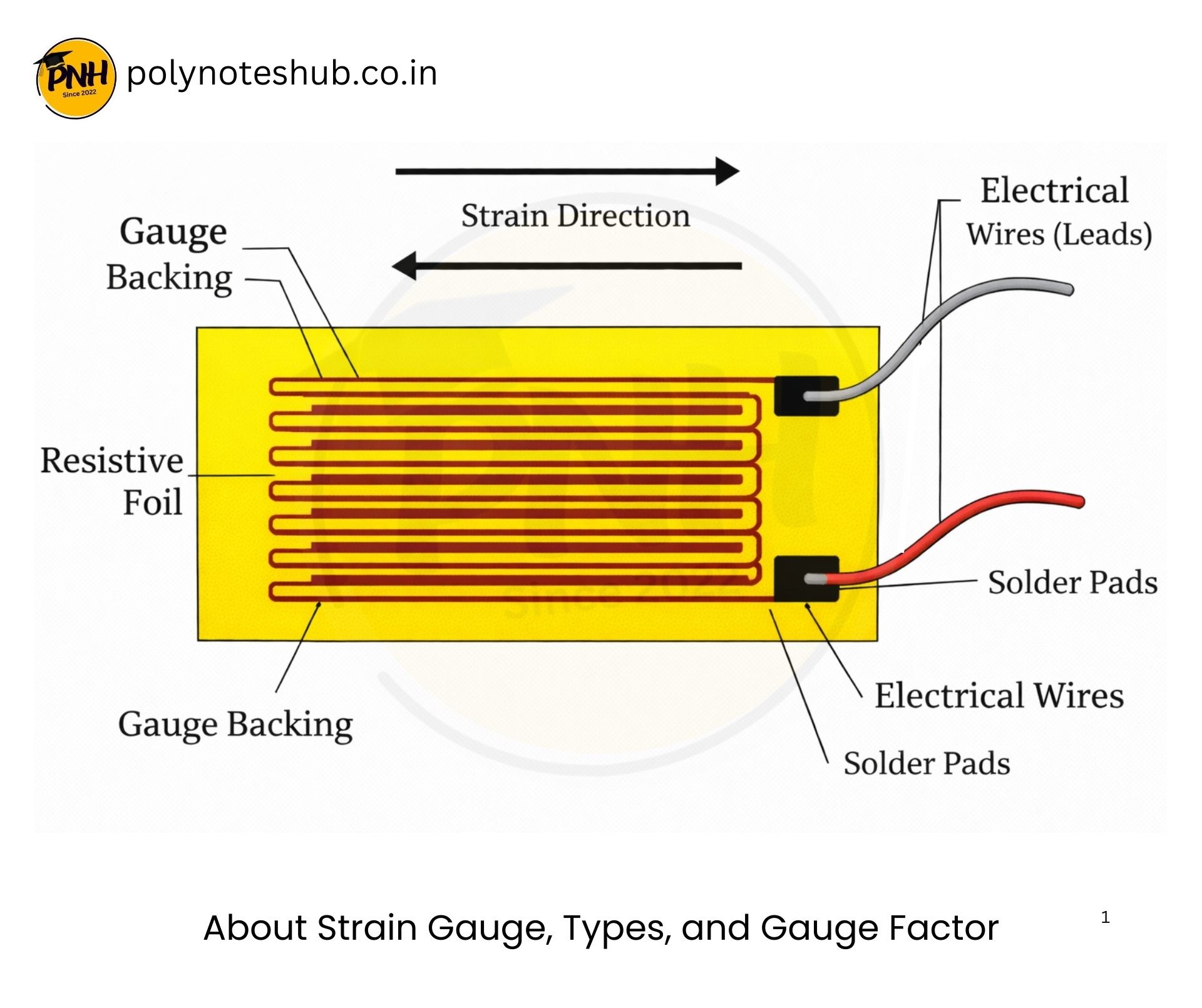
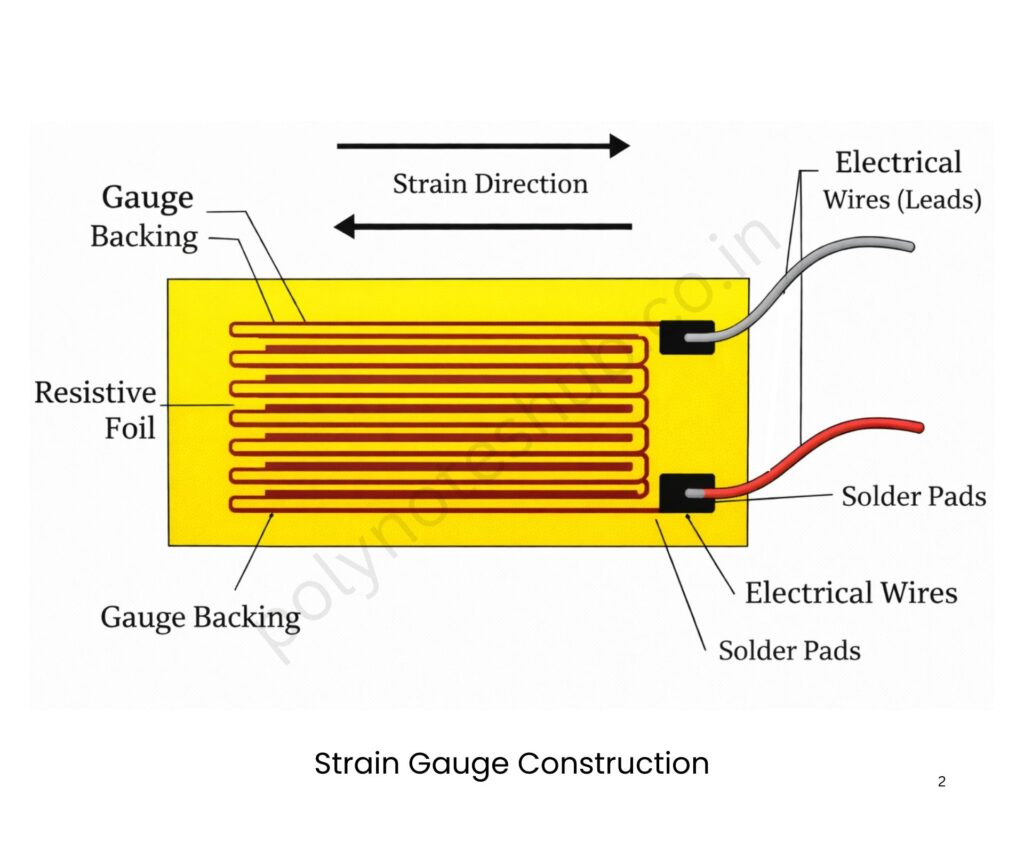
A strain gauge is a sensor that measures strain (or deformation) in an item. When a material is stretched or compressed, the strain gauge’s electrical resistance changes, which is used to measure strain.
Diagram of a Strain Gauge
Materials of Construction of Strain Gauge
Strain gauges are usually made from metallic alloys or semiconductor materials having stable electrical properties.
Common Materials
- Constantan (Copper–Nickel Alloy)
- Most commonly used
- Good stability
- Low temperature coefficient
- Nichrome (Nickel–Chromium Alloy)
- High resistivity
- Good corrosion resistance
- Karma Alloy
- Nickel–Chromium–Aluminium–Iron alloy
- Excellent temperature stability
- Platinum–Tungsten
- Used for high temperature applications
- Semiconductor Materials
- Silicon
- Germanium
Classification of Strain Gauges or Types of Strain Gauges
Strain gauges are mainly classified into the following types:
- Mechanical Strain Gauge: Measures strain using mechanical displacement.
- Electrical Strain Gauge: Measures strain by change in electrical resistance. There are three types of electrical strain gauges.
- Wire strain gauge
- Foil strain gauge
- Semiconductor strain gauge
- Optical Strain Gauge: Uses light interference to measure strain.
- Pneumatic Strain Gauge: Measures strain through changes in air pressure.