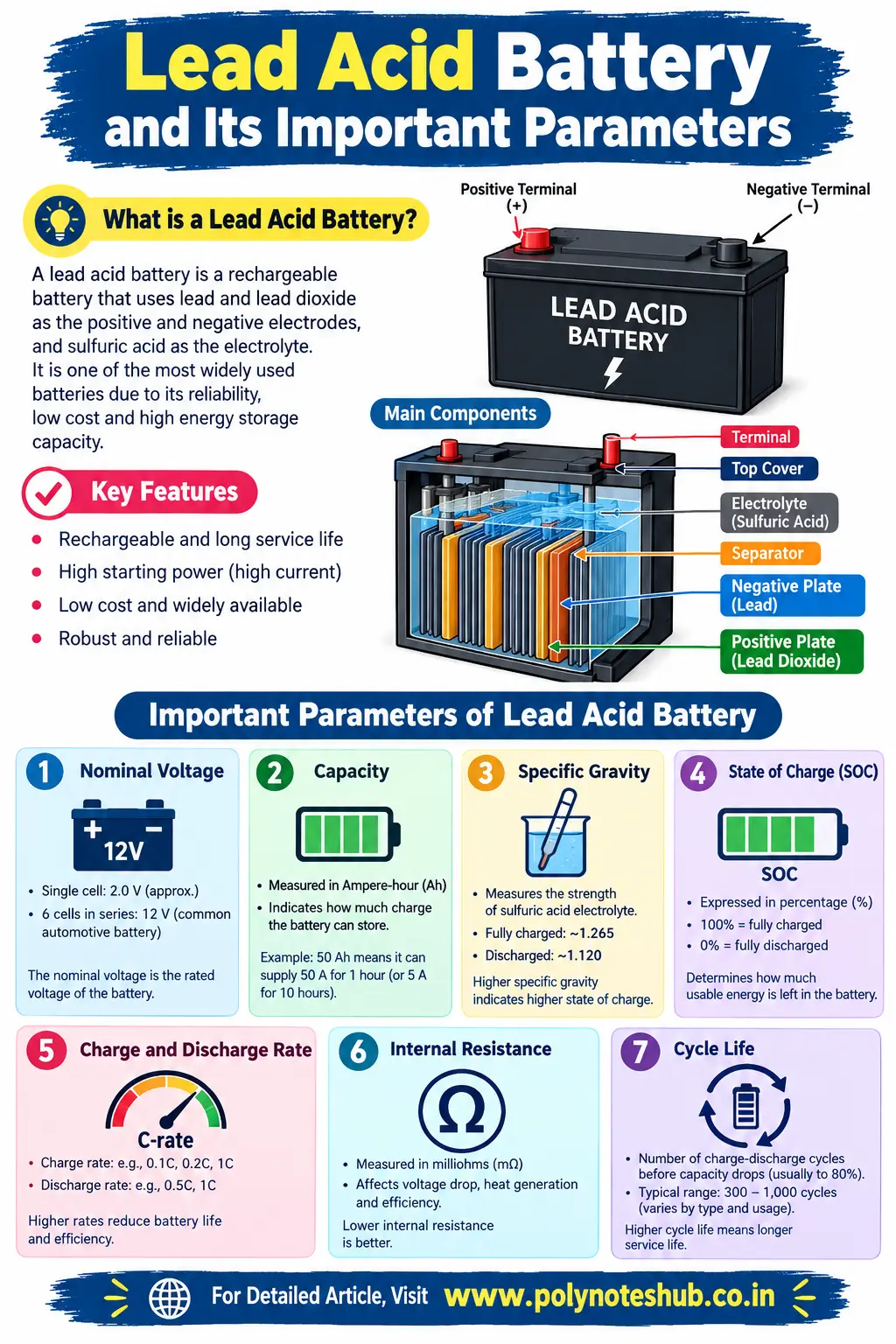
In this article, we will explain Lead Acid Battery’s constructional diagram, working principle, chemical reactions, types, applications, and important electrical parameters in a simple and easy to understand manner.
Author Name: Arun Paul.
About Lead Acid Battery
A lead acid battery is one of the oldest and most widely used types of rechargeable batteries in the world. Invented by Gaston Plante, this battery uses lead dioxide and sponge lead as electrodes along with dilute sulphuric acid as the electrolyte. Because of its low cost, high reliability, and ability to deliver high surge currents, the lead acid battery remains a popular choice for automobiles, power backup systems, and industrial applications even today.
A lead acid battery is a type of secondary battery, meaning it can be recharged after it has been discharged. It converts chemical energy into electrical energy through a reversible electrochemical reaction. The battery consists of lead dioxide as the positive plate, sponge lead as the negative plate, and sulphuric acid diluted with water as the electrolyte.
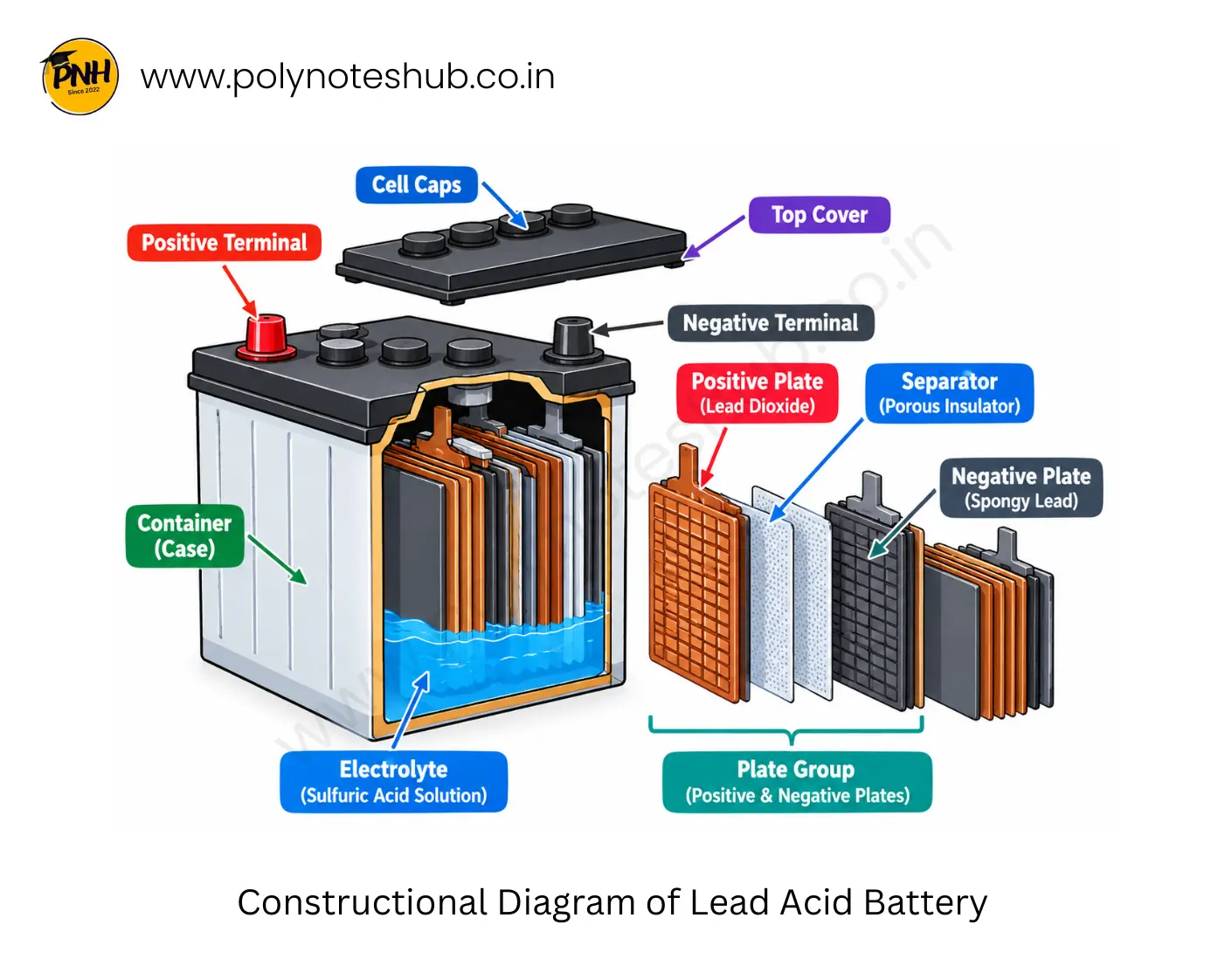
Construction of Lead Acid Battery (Internal Diagram)
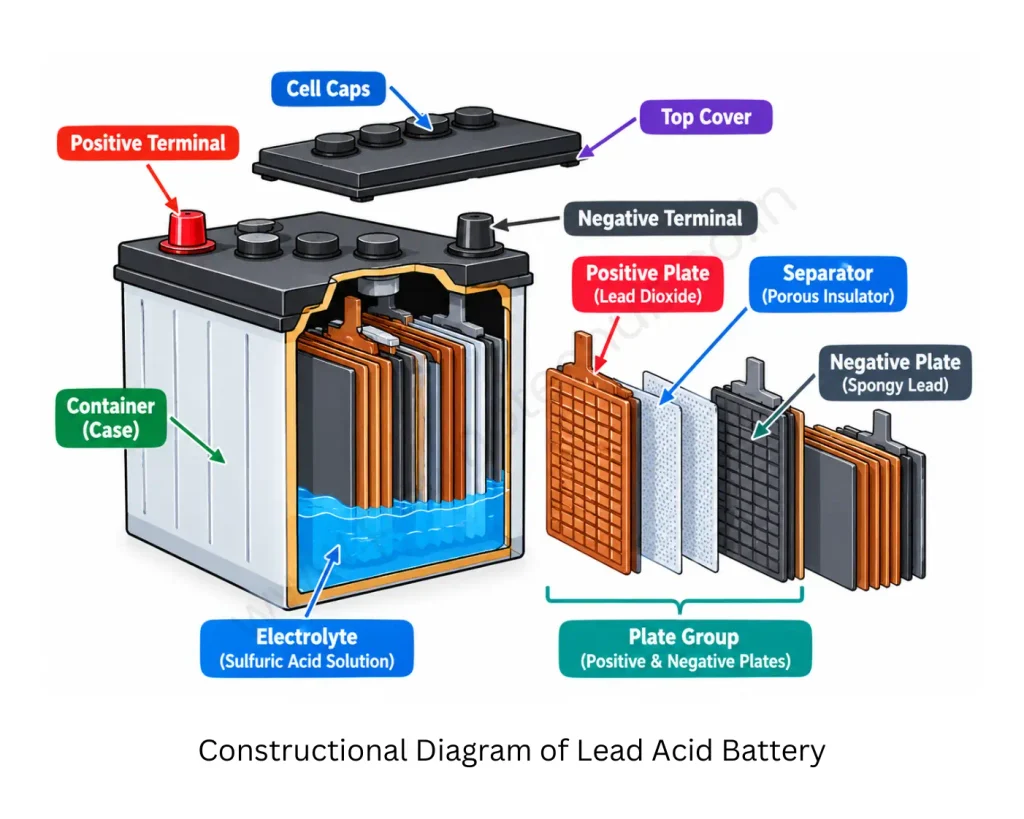
The construction of a lead acid battery involves several key components working together. Understanding each part helps in knowing how the battery stores and delivers electrical energy.
- Container: The container is usually made of hard rubber, polypropylene, or ebonite. It holds the plates, separators, and electrolyte, and must be resistant to acid corrosion.
- Positive Plate: The positive plate is made of lead dioxide (PbO2). It is chocolate brown in colour and acts as the cathode during discharge.
- Negative Plate: The negative plate is made of pure spongy lead (Pb). It is grey in colour and acts as the anode during discharge.
- Separators: Separators are thin insulating sheets placed between the positive and negative plates to prevent short circuits while allowing the flow of ions through the electrolyte.
- Electrolyte: The electrolyte used is dilute sulphuric acid (H2SO4) mixed with distilled water. The specific gravity of the electrolyte typically ranges between 1.2 and 1.28 when the battery is fully charged.
- Plate Grid: The grid provides mechanical support to the active material and also acts as a current collector. It is usually made of a lead-antimony or lead-calcium alloy for added strength.
- Vent Plugs: Vent plugs allow the escape of gases produced during charging, such as hydrogen and oxygen, and also allow topping up of distilled water.
- Terminals: Two terminals, positive and negative, are provided for external connections. The positive terminal is usually thicker than the negative terminal for identification.
📌 For such types of Articles, click on our other Technical Articles
Working Principle of Lead Acid Battery
The working of a lead acid battery is based on the reversible chemical reaction between lead, lead dioxide, and sulphuric acid. The process can be divided into two stages, discharging and charging.
- Discharging Process: During discharge, the battery supplies current to an external load. The chemical reaction taking place is as follows:
- At the positive plate: PbO2 + 3H+ + HSO4- + 2e- turns into PbSO4 + 2H2O
- At the negative plate: Pb + HSO4- turns into PbSO4 + H+ + 2e-
- Overall reaction during discharge: PbO2 + Pb + 2H2SO4 turns into 2PbSO4 + 2H2O
- As the battery discharges, both plates gradually convert into lead sulphate (PbSO4), and the sulphuric acid is consumed, causing the specific gravity of the electrolyte to drop.
- Charging Process: During charging, an external DC source reverses the chemical reaction, converting lead sulphate back into lead dioxide and sponge lead, while regenerating sulphuric acid.
- Overall reaction during charging: 2PbSO4 + 2H2O turns into PbO2 + Pb + 2H2SO4
- As charging continues, the specific gravity of the electrolyte increases back to its original value, indicating that the battery is fully charged.
Types of Lead Acid Battery
There are mainly two types of lead acid batteries used in different applications.
- Flooded Lead Acid Battery (Wet Cell): This is the traditional type where the electrolyte is in liquid form and requires periodic maintenance such as topping up with distilled water.
- Valve Regulated Lead Acid Battery (VRLA): This is a maintenance-free type that includes Absorbent Glass Mat (AGM) and Gel batteries. The electrolyte is either absorbed in a fibreglass mat or converted into a gel form, preventing spillage and reducing maintenance needs.
Uses of Lead Acid Battery
Lead acid batteries are used extensively across various sectors due to their affordability and reliability. Some common applications include:
- Automobile Batteries: Used in cars, trucks, and two-wheelers for starting the engine, lighting, and ignition (commonly known as SLI batteries).
- Uninterruptible Power Supply (UPS): Used as backup power source in homes, offices, and industries during power outages.
- Telecommunication Systems: Used to provide backup power for telecom towers and exchanges.
- Solar Power Systems: Used for storing energy generated from solar panels in off-grid and hybrid solar systems.
- Industrial Applications: Used in forklifts, material handling equipment, and emergency lighting systems.
- Railways and Signalling Systems: Used to power railway signalling equipment and emergency systems.
Important Parameters of Lead Acid Battery
To understand the performance and health of a lead acid battery, certain electrical and physical parameters must be known.
- Voltage: A single cell of a lead acid battery has a nominal voltage of about 2.1 volts. A standard 12 volt battery consists of six such cells connected in series.
- Capacity (Ampere Hour Rating): Capacity indicates how much current a battery can deliver over a specified time, usually expressed in ampere hours (Ah). For example, a 100 Ah battery can theoretically supply 5 amps for 20 hours.
- Specific Gravity: Specific gravity of the electrolyte indicates the state of charge of the battery. A fully charged battery typically has a specific gravity between 1.2 and 1.28, which drops as the battery discharges.
- Internal Resistance: Internal resistance affects how efficiently the battery can deliver current. A lower internal resistance generally means better performance, especially for high current applications.
- Charging Rate: Lead acid batteries are usually charged at a rate of C/10, meaning one-tenth of their rated capacity, although fast charging methods also exist.
- Efficiency: The overall efficiency of a lead acid battery, considering both charging and discharging losses, is typically around 70 to 85 percent.
- Battery Life Cycle: Lead acid batteries typically last between 300 to 500 charge-discharge cycles, depending on usage patterns, depth of discharge, and maintenance.
- Self-Discharge Rate: Lead acid batteries have a relatively low self-discharge rate, usually around 3 to 5 percent per month when stored properly.
Advantages of Lead Acid Battery
Below, we have listed some advantages of this battery –
- Low initial cost compared to other battery technologies
- High reliability and proven technology
- Ability to deliver high surge currents
- Easily recyclable
- Wide availability of spare parts and maintenance support
Disadvantages of Lead Acid Battery
Below, we have listed some disadvantages of this battery –
- Heavy weight compared to its energy output
- Lower energy density compared to lithium-ion batteries
- Requires regular maintenance in flooded types
- Limited number of charge-discharge cycles
- Produces harmful gases during overcharging