Learn everything about Nickel Metal Hydride battery including their construction, working principle, chemical reactions, types, uses, advantages, and key parameters explained in simple terms for students and engineers.
Author Name: Arun Paul.
About Nickel Metal Hydride Battery
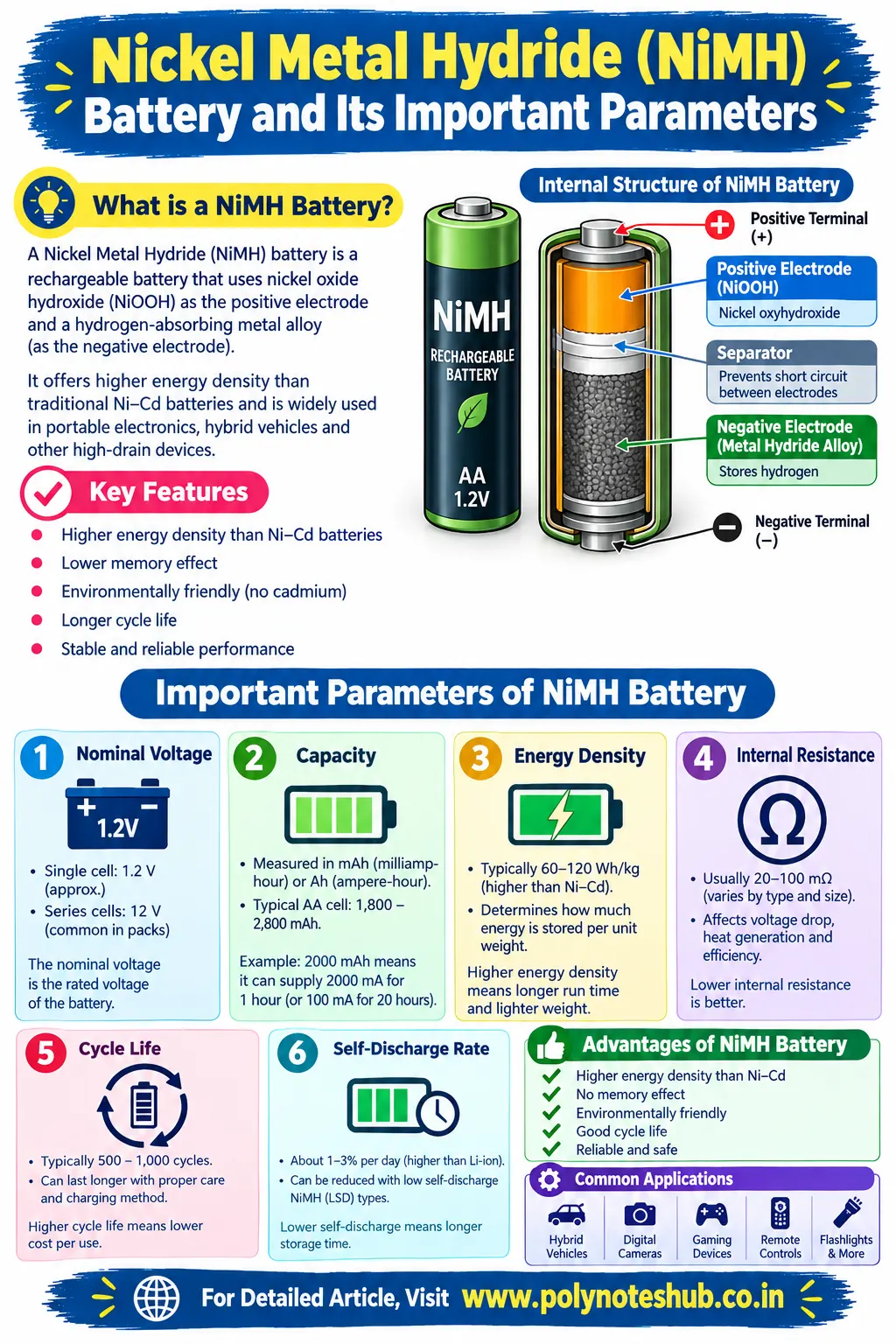
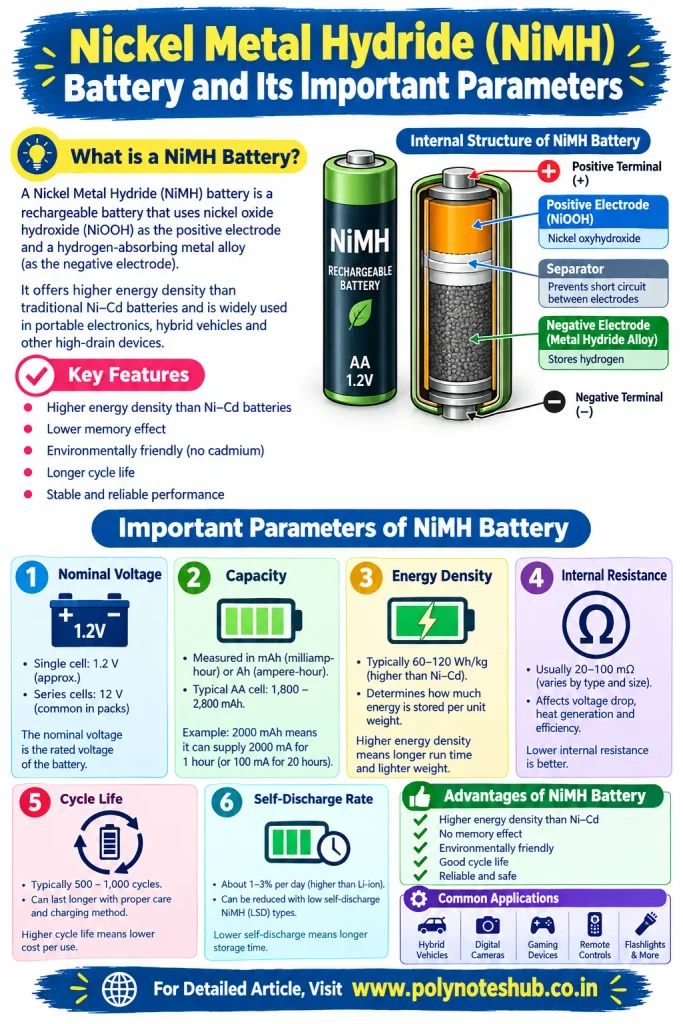
A Nickel Metal Hydride battery, commonly known as NiMH battery, is a type of rechargeable battery that was developed as an improved alternative to the Nickel Cadmium (NiCd) battery. It uses a hydrogen-absorbing alloy as the negative electrode instead of toxic cadmium, making it more environmentally friendly while offering higher energy density. NiMH batteries are widely used in consumer electronics, hybrid vehicles, and portable devices due to their good performance and safer chemical composition.
A Nickel Metal Hydride battery is a type of secondary battery that stores and releases electrical energy through a reversible electrochemical reaction between a nickel oxyhydroxide positive electrode and a hydrogen-absorbing metal alloy negative electrode, with an alkaline electrolyte facilitating ion movement between them.
Construction of Nickel Metal Hydride Battery
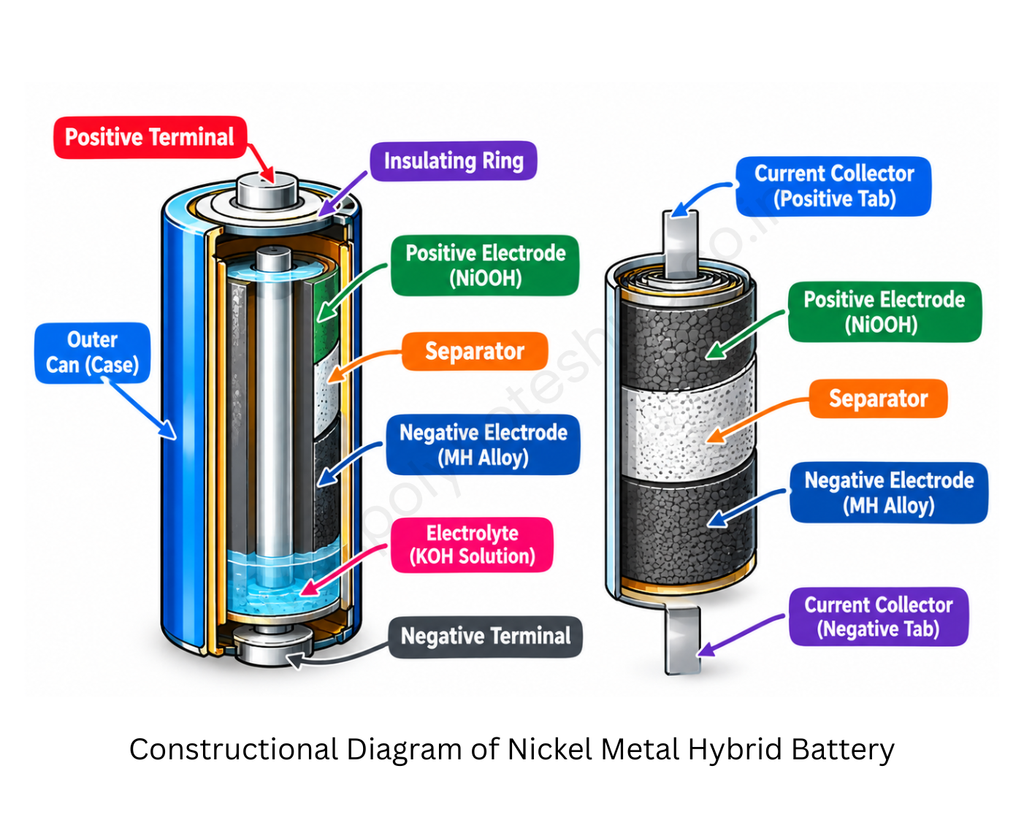
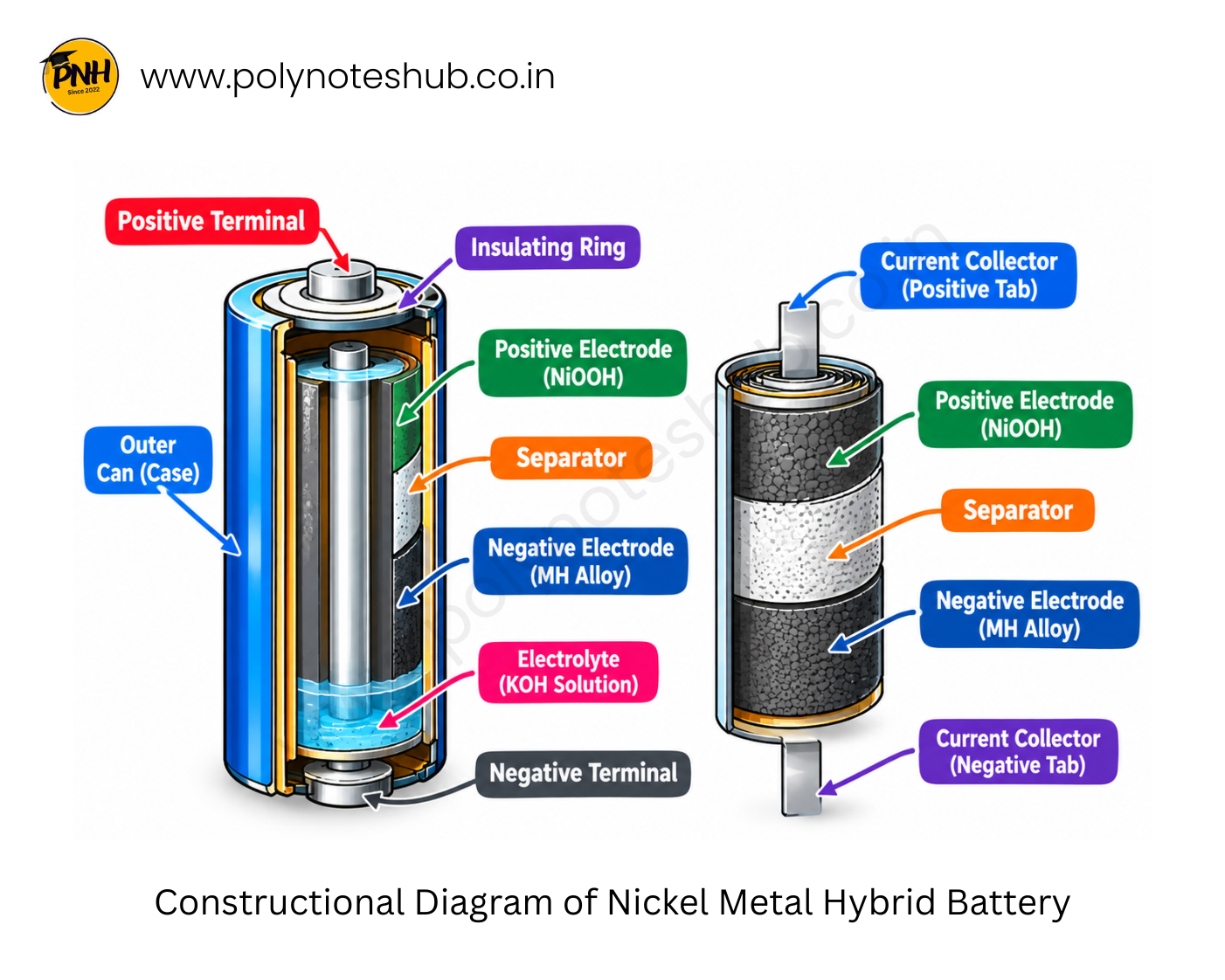
The construction of a NiMH battery involves several important components that work together to store and deliver electrical energy efficiently.
- Positive Electrode: The positive electrode is made of nickel oxyhydroxide (NiOOH), which acts as the cathode during discharge.
- Negative Electrode: The negative electrode is made of a hydrogen-absorbing metal alloy, typically a combination of rare earth metals and nickel, such as lanthanum-nickel or misch metal alloys. This alloy can absorb and release hydrogen atoms during the charge-discharge cycle.
- Electrolyte: The electrolyte used is an alkaline solution, usually potassium hydroxide (KOH), which allows the movement of hydroxide ions between the electrodes without being significantly consumed in the reaction.
- Separator: A separator made of non-woven fabric or synthetic polymer is placed between the positive and negative electrodes to prevent short circuits while allowing ionic conduction.
- Cell Casing: The casing is typically made of steel or a durable metal alloy that provides mechanical strength and protects the internal components from external damage.
- Safety Vent: A safety vent is included to release excess internal pressure that may build up due to gas generation during overcharging, preventing rupture or explosion.
- Current Collectors: Current collectors help in efficiently transferring electrons between the electrodes and the external circuit, improving overall battery performance.
📌 For more such types of articles, click on our Technical Articles
Working Principle of Nickel Metal Hydride Battery
The working of a NiMH battery is based on a reversible chemical reaction between nickel oxyhydroxide, a metal hydride alloy, and an alkaline electrolyte. The process can be divided into two stages, discharging and charging.
- Discharging Process: During discharge, the metal hydride at the negative electrode releases hydrogen atoms, which combine with hydroxide ions to form water while releasing electrons. At the same time, the positive electrode absorbs electrons and hydrogen ions, converting nickel oxyhydroxide into nickel hydroxide.
- At the positive electrode: NiOOH + H2O + e- turns into Ni(OH)2 + OH-
- At the negative electrode: MH + OH- turns into M + H2O + e-
- Overall reaction during discharge: NiOOH + MH turns into Ni(OH)2 + M, Here, M represents the metal alloy used in the negative electrode.
- Charging Process: During charging, an external DC source reverses the reaction. Nickel hydroxide at the positive electrode is converted back into nickel oxyhydroxide, while the metal alloy at the negative electrode absorbs hydrogen again to reform the metal hydride.
- Overall reaction during charging: Ni(OH)2 + M turns into NiOOH + MH
- This reversible absorption and release of hydrogen atoms by the metal alloy is the key feature that distinguishes NiMH batteries from other battery chemistries.
Types of Nickel Metal Hydride Battery
- Standard NiMH Battery: This type offers higher capacity but has a relatively higher self-discharge rate, making it suitable for devices used frequently.
- Low Self-Discharge NiMH Battery (LSD NiMH): Also known as pre-charged or ready-to-use batteries, these retain their charge for a much longer period when not in use, making them ideal for devices like remote controls and emergency flashlights.
Uses of Nickel Metal Hydride Battery
NiMH batteries are used in a wide range of applications due to their good energy density, safety, and rechargeability.
- Hybrid Electric Vehicles: Widely used in hybrid cars for storing and supplying energy to the electric motor alongside the internal combustion engine.
- Consumer Electronics: Used in devices such as digital cameras, cordless phones, remote controls, and portable gaming devices.
- Power Tools: Used in cordless power tools that require moderate to high current output.
- Medical Equipment: Used in portable medical devices due to their reliability and safety compared to older battery chemistries.
- Emergency Lighting and Backup Devices: Used in emergency lights and backup systems due to their long shelf life, especially in the low self-discharge variant.
- Rechargeable Household Batteries: Commonly used as AA and AAA rechargeable batteries for everyday household electronic devices.
Important Parameters of Nickel Metal Hydride Battery
- Voltage: A single cell of a NiMH battery has a nominal voltage of about 1.2 volts, which is slightly lower than a standard alkaline cell but sufficient for most applications after accounting for the flatter discharge curve.
- Capacity: Capacity is expressed in milliampere hours (mAh) and indicates how much charge the battery can store. Standard AA-sized NiMH batteries typically range from 1500 mAh to 2800 mAh.
- Energy Density: NiMH batteries typically offer an energy density of around 60 to 120 watt hours per kilogram, which is higher than Nickel Cadmium batteries but lower than lithium-ion batteries.
- Self-Discharge Rate: Standard NiMH batteries have a relatively high self-discharge rate of about 20 to 30 percent per month, while low self-discharge variants can retain most of their charge for up to a year or more.
- Charge Cycle Life: NiMH batteries typically offer 500 to 1000 charge-discharge cycles, depending on usage conditions and charging practices.
- Memory Effect: NiMH batteries exhibit a reduced memory effect compared to Nickel Cadmium batteries, meaning partial discharge before recharging has a much smaller impact on capacity over time.
- Operating Temperature Range: NiMH batteries generally perform well within a temperature range of 0 to 45 degrees Celsius, with performance degrading outside this range.
- Charging Method: NiMH batteries are commonly charged using constant current methods, with charge termination detected through negative delta voltage (NDV) or temperature rise sensing to prevent overcharging.
Advantages of Nickel Metal Hydride Battery
Below, we have listed some advantages of this type of battery –
- Higher energy density compared to Nickel Cadmium batteries
- Environmentally friendlier due to the absence of toxic cadmium
- Reduced memory effect compared to older nickel-based batteries
- Good performance across a wide range of discharge currents
- Widely available in standard household battery sizes
Disadvantages of Nickel Metal Hydride Battery
Below, we have listed some disadvantages of this type of battery –
- Higher self-discharge rate compared to lithium-ion batteries
- Lower energy density compared to lithium-ion batteries
- Performance can degrade at high temperatures
- Requires careful charge control to prevent overcharging damage
- Generally more expensive than Nickel Cadmium batteries of similar capacity