
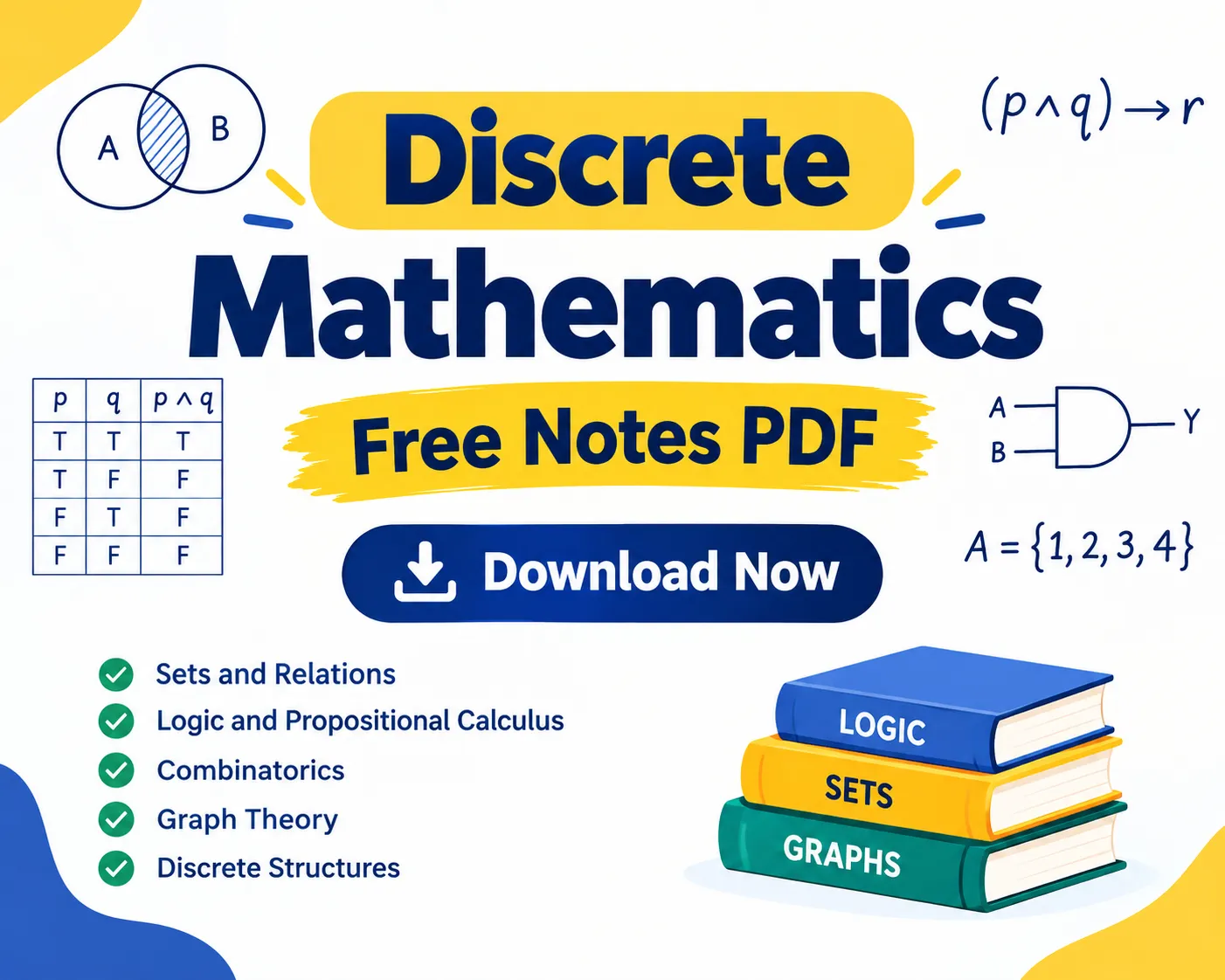
In this article, you will get the Discrete Mathematics Free Notes PDF of Computer Science syllabus. These Free Lecture notes will help you to understand Discrete Mathematics in a very easy manner.
Author Name: Arun Paul.
Download Discrete Mathematics Free Notes PDF of Computer Science Syllabus
Here we have listed all the chapters’ Free Notes PDFs of Discrete Mathematics. Also in the table, we have also listed all the topics that are covered in the particular chapter. If you are a computer science and technology branch student and searching for free notes on Discrete Maths, then you are in the right place. Click on the individual link chapter-wise and get the PDF.
Unit 1: Mathematical Logic
| Unit No. | Topics | Download Links |
|---|---|---|
| Unit 1 | 1.1 Statement and Notation 1.2 Connectives – Negation, Conjunction, Disjunction, Statement Formulas and Truth Tables, Conditional and Biconditional, Well-formed Formulas, Tautologies, Equivalence of Formulas, Duality Law, Tautological Implications 1.3 Normal Forms – Disjunctive and Conjunctive Normal Forms. 1.4 The Theory of Inference for the Statement Calculus – validity using truth tables, Rules of Inference, Consistency of premises, and the indirect method of proof 1.5 Predicate Calculus – Rules of precedence of logical operators Predicate (propositional) functions | Download Now |
Unit 2: Set Theory
| Unit No. | Topics | Download Link |
|---|---|---|
| Unit 2 | 2.1 Concept of Sets: Notation – Subset – Superset – Empty set – Universal set – Examples 2.2 Operation on Sets: Union – Intersection – Complementation – Difference – Symmetric difference – Problems relating simple set identities 2.3 Definition of power set – Cartesian product of finite number of sets – Simple problems 2.4 Cardinality of a set 2.5 Finite and infinite sets | Download Now |
Unit 3: Relation Between Two Sets
| Unit No. | Topics | Download Link |
|---|---|---|
| Unit 3 | 3.1 Relation Between Two Sets: Binary relation as a subset of Cartesian product 3.2 Reflexive, symmetric & transitive relations – Examples 3.3 Equivalence relation – Examples 3.4 Partition – problems | Download Now |
Unit 4: Functions
| Unit No. | Topics | Download Link |
|---|---|---|
| Unit 4 | 4.1 Functions: Definition of a function – Domain, Co-domain & Range of a function 4.2 Injective, surjective, and Bijective functions – Related problems | Download Now |
Unit 5: Matrix Theory
| Unit No. | Topics | Download Link |
|---|---|---|
| Unit 5 | 5.1 Elementary Transformations on a Matrix: Equivalent matrices – Definition of a submatrix of a matrix – Rank of a matrix (definition) – Echelon form of a matrix – Theorems on rank (statement only) – Evaluation of rank of a matrix – Problems 5.2 Adjoint of a square matrix – Definition of INVERSE of a matrix – Uniqueness of the inverse – Theorems on inverse of matrices – Problems 5.3 System of SIMULTANEOUS LINEAR EQUATIONS – Test of consistency; Solution of n Linear Equations in n unknowns – Problem, Solution of m Linear equations in n unknowns with mn – Problems. 5.4 Definition of Eigenvalues and Eigenvectors; Characteristic values and Characteristic vectors of a Matrix; Characteristic equation – relation between Characteristic Roots and characteristic vectors; nature of Characteristic Roots of special types of Matrices– The Process of finding the Eigenvalues and Eigenvectors –Theorems and Related problems. | Download Now |
Unit 6: Counting Techniques
| Unit No. | Topics | Download Link |
|---|---|---|
| Unit 6 | 6.1 PRINCIPLE OF INCLUSION AND EXCLUSION: Statement of the principle – Set-theoretic problems relating to the principle of inclusion and exclusion 6.2 MATHEMATICAL INDUCTION: Concept of Induction – Statement of the principle of Mathematical Induction – Application of the principle of Induction in various problems 6.3 RECURRENCE RELATION: Definition – Examples (Fibonacci series etc.) – Linear recurrence relations with constant coefficients – Homogeneous solutions – Particular solutions – Total solutions – Problems | Download Now |
Unit 7: Graph Theory
| Unit No. | Topics | Download Link |
|---|---|---|
| Unit 7 | 7.1 Introduction – Definition of a graph –Directed & Undirected graphs(Definition & Example); Basic Terminology – Loop, Multigraph, Pseudograph, Simple graph, Finite and Infinite graphs- Definition and examples; 7.2 Subgraph: spanning subgraph; removal of a Vertex and an edge-Induced subgraph- Definition &Example; 7.3 Graph Isomorphism – Definition and Examples; 7.4 Walk, Paths, Length, and Circuits –Definition and Examples; 7.5 Euler graphs –Euler path, Euler Circuit – Definition and examples; 7.6 Hamiltonian Graphs – Definition and example – Problems 7.7 Sequential Representation of Graphs 7.8 Linked Representation of Graphs 7.9 Traversal of Graphs 7.8 Shortest Path, Shortest path algorithm – Dijkstra’s algorithm, Floyd-Warshall algorithm – Problems. BFS algorithm-DFS 7.9 Application of Graph | Download Now |
Unit 8: Tree
| Unit No. | Topics | Download Link |
|---|---|---|
| Unit 8 | 8.1 Definition & properties of trees – Distance & centre in a tree ; 8.2 Rooted tree– Co Tree-definition & example; 8.3 Binary trees –Definition & Properties, Path length, Binary tree representation of general trees-Problems, Traversal. 8.4 Spanning tree – Branch of tree- chord- definition & properties; Spanning tree in a weighted graph 8.5 Algorithm for constructing Spanning tree – Graph theoretic algorithms – Minimal Spanning tree algorithm – Kruskal’s Algorithm -Problems | Download Now |
So, you can just now click on the above links to get the Free Notes PDFs of Discrete Mathematics. For more such type of Free Notes, Visit: www.polynoteshub.co.in