
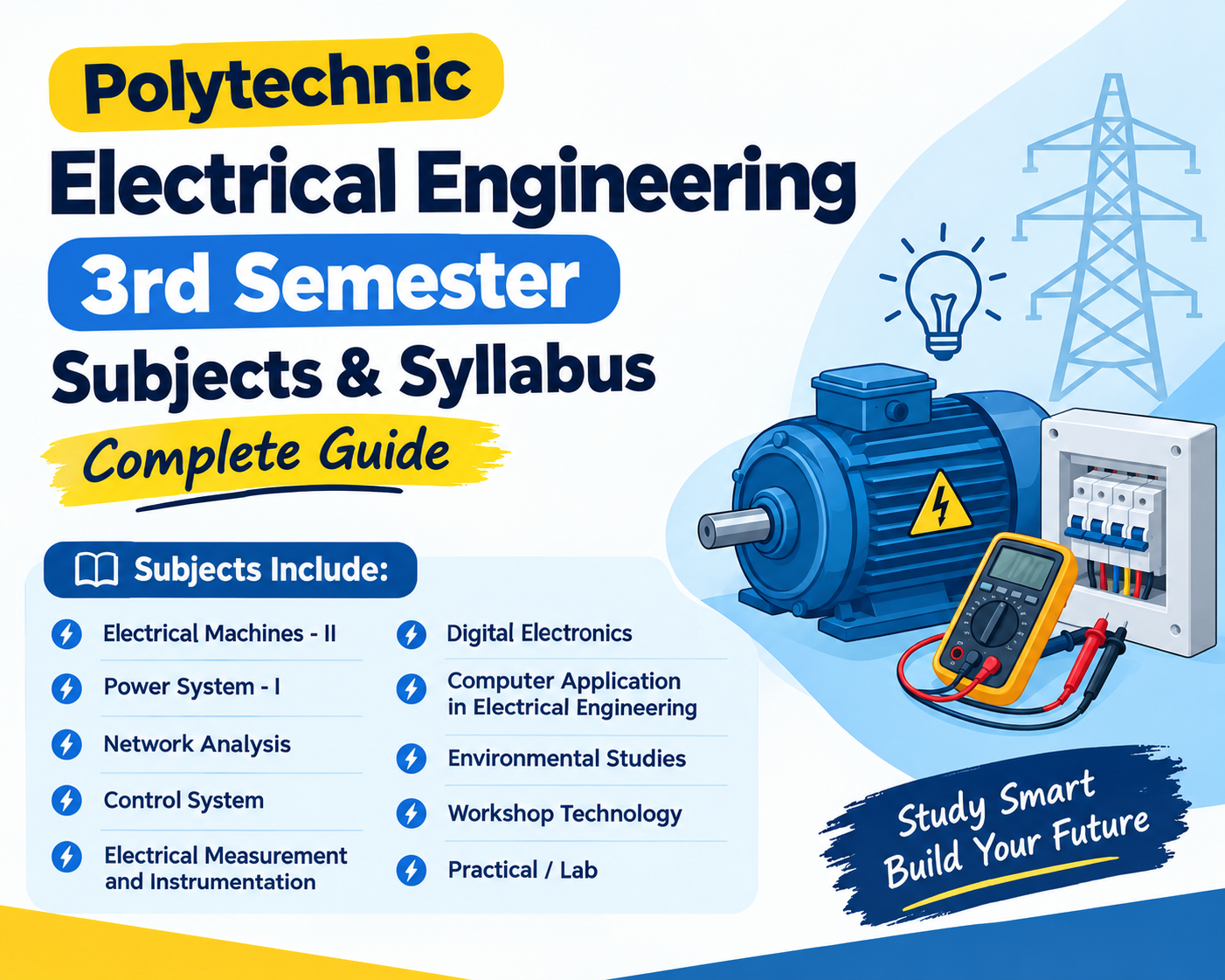
Complete list of Polytechnic Electrical Engineering 3rd semester subjects, syllabus breakdown, previous-year question papers, and study tips for 2nd year diploma students. Welcome to Poly Notes Hub, a leading destination for Polytechnic Electrical Engineering 3rd Semester Syllabus Free Notes.
Author Name: Arun Paul.
Introduction
If you have just stepped into your 2nd year of Diploma in Electrical Engineering, one of the most common questions on your mind is probably this: what subjects will I study in the 3rd semester, and how tough is the syllabus going to be? This guide answers exactly that, with a complete breakdown of subjects, credit structure, and preparation tips that most students search for online but rarely find in one place.
Whether you searched for “polytechnic electrical engineering 3rd semester subjects,” “polytechnic electrical engineering 2nd year subjects,” or “polytechnic electrical engineering me kon kon se subject hote hai,” this article covers all of it.
Polytechnic Electrical Engineering 3rd Semester Subjects & Syllabus
Complete List of Polytechnic Electrical Engineering 3rd Semester Subjects
Across WBSCTE, MSBTE, BTEUP, DTE Karnataka, SBTE Bihar, SCTE Assam, HSBTE Haryana, TNDTE Tamil Nadu, AP SBTET, DTE Kerala, SCTE&VT Odisha, PSBTE and IT Punjab, and other state boards, the 3rd semester Electrical Engineering syllabus generally includes:
Below, we have listed Polytechnic Electrical Engineering All Subjects and Free Notes of 3rd, 4th, 5th, and 6th Semesters –
| Subjects’ Name | Click on the Links to Get Free Notes |
|---|---|
| Electric Generation System | Read Now |
| Electrical and Electronic Measurement | Read Now |
| Analog Electronics | Read Now |
| Digital Electronics | Read Now |
| Power Electronics | Read Now |
| Special Electrical Machines | Read Now |
| Renewable Energy | Read Now |
| Switchgear and Protection | Read Now |
| Microcontroller and Its Applications | Read Now |
| Building Electrification | Read Now |
| Industrial Automation and Control | Read Now |
| Illumination Practices | Read Now |
| Electric Traction | Read Now |
| Energy Conservation and Audit | Read Now |
| Electric Vehicles | Read Now |
| Entrepreneurship and Start-Ups | Read Now |
| Engineering Economics and Project Management | Read Now |
Subject codes, exact nomenclature, and credit distribution can differ slightly between boards like WBSCTE, MSBTE, DTE Madhya Pradesh, DTE Rajasthan, DTE Chhattisgarh, DTE Himachal Pradesh, DTE Goa, JSBTE Jharkhand, and UBTER Uttarakhand, so always cross-check with your own polytechnic’s official syllabus document.
Applicable Across All Indian Polytechnic Boards
One good thing about the Polytechnic Electrical Engineering syllabus is that it remains largely uniform across state boards, with only minor variations in subject codes, credit weightage, or elective options. This guide applies broadly to students studying under:
WBSCTE, West Bengal (West Bengal State Council of Technical and Vocational Education and Skill Development)
MSBTE, Maharashtra (Maharashtra State Board of Technical Education)
BTEUP, Uttar Pradesh (Board of Technical Education, Uttar Pradesh)
DTE, Karnataka (Directorate of Technical Education, Karnataka)
SBTE, Bihar (State Board of Technical Education, Bihar)
SCTE, Assam (State Council for Technical Education, Assam)
HSBTE, Haryana (Haryana State Board of Technical Education)
TNDTE, Tamil Nadu (Directorate of Technical Education, Tamil Nadu)
AP SBTET, Andhra Pradesh (State Board of Technical Education and Training, Andhra Pradesh)
DTE, Kerala (Directorate of Technical Education, Kerala)
SCTE&VT, Odisha (State Council for Technical Education and Vocational Training, Odisha)
PSBTE and IT, Punjab (Punjab State Board of Technical Education and Industrial Training)
DTE, Madhya Pradesh (Directorate of Technical Education, Madhya Pradesh)
DTE, Rajasthan (Directorate of Technical Education, Rajasthan)
DTE, Chhattisgarh (Directorate of Technical Education, Chhattisgarh)
DTE, Himachal Pradesh (Directorate of Technical Education, Himachal Pradesh)
DTE, Goa (Directorate of Technical Education, Goa)
JSBTE, Jharkhand (Directorate of Technical Education, Jharkhand)
UBTER, Uttarakhand (Uttarakhand Board of Technical Education, Roorkee)
If your state board is not listed here, your syllabus will still follow the same broad pattern, since most boards align their diploma engineering curriculum with common AICTE-recommended guidelines.
Why the 3rd Semester Matters So Much
The 3rd semester marks the shift from foundation-level subjects to core electrical engineering concepts. Students often find this semester noticeably tougher than the first two, mainly because subjects like Electrical Circuit Theory and Electrical Machines introduce heavy mathematical and conceptual depth for the first time. Getting your basics right here directly affects how comfortably you handle 4th and 5th semester subjects later.
Recommended Study Approach for 3rd Semester
Prioritize Electrical Machines-I and Electrical Circuit Theory early in the semester, since both require consistent practice rather than last-minute revision. Treat lab work as exam preparation, not a separate task, since many theory concepts become clearer once you see them applied practically.
Use standard reference books alongside your syllabus notes rather than relying on a single source
Form small study groups for numerical-heavy subjects like Circuit Theory and Numerical Methods, since discussing problems often reveals shortcuts you might miss alone.
Conclusion
The 3rd semester of Polytechnic Electrical Engineering is a turning point where foundational concepts start connecting to real electrical systems and machines, and this holds true whether you study under WBSCTE, MSBTE, BTEUP, DTE Karnataka, SBTE Bihar, SCTE Assam, HSBTE Haryana, TNDTE Tamil Nadu, AP SBTET, DTE Kerala, SCTE&VT Odisha, PSBTE and IT Punjab, DTE Madhya Pradesh, DTE Rajasthan, DTE Chhattisgarh, DTE Himachal Pradesh, DTE Goa, JSBTE Jharkhand, UBTER Uttarakhand, or any other state technical education board. Understanding the complete subject list early in the semester helps you plan your study schedule better and avoid last-minute panic before exams. Keep your syllabus document handy, practice previous year papers regularly, and treat each subject’s lab component as seriously as its theory paper.