
In this article, we are going to learn about the elements of a basic electronic communication system block diagram with an explanation. Welcome to Poly Notes Hub, a leading destination for Polytechnic Engineering Notes.
Author Name: Arun Paul.
What is Basic Electronic Communication System?
A basic electronic communication system is one that uses electrical or electromagnetic signals to transport information (such as audio, video, or data) from one source to another over an electronic medium.
The communication link with the analog signal is called Analog communication and the signal, linked with the digital signal is called Digital communication.
Depending on the technology used and the kind of information being communicated, basic communication systems can be either analogue or digital. They are employed in many different fields, such as broadcasting, computer networks, and telephony. Depending on the technology being used and the type of communication, different parts and procedures may be used.
Types of Communication System
- Based on Direction of Communication
- Simplex System
- Half Duplex System
- Full Duplex System
- Based on Nature of the Information Signal
- Analog System
- Digital System
- Based on Technique of Transmission
- Baseband Transmission
- Communication using Modulation
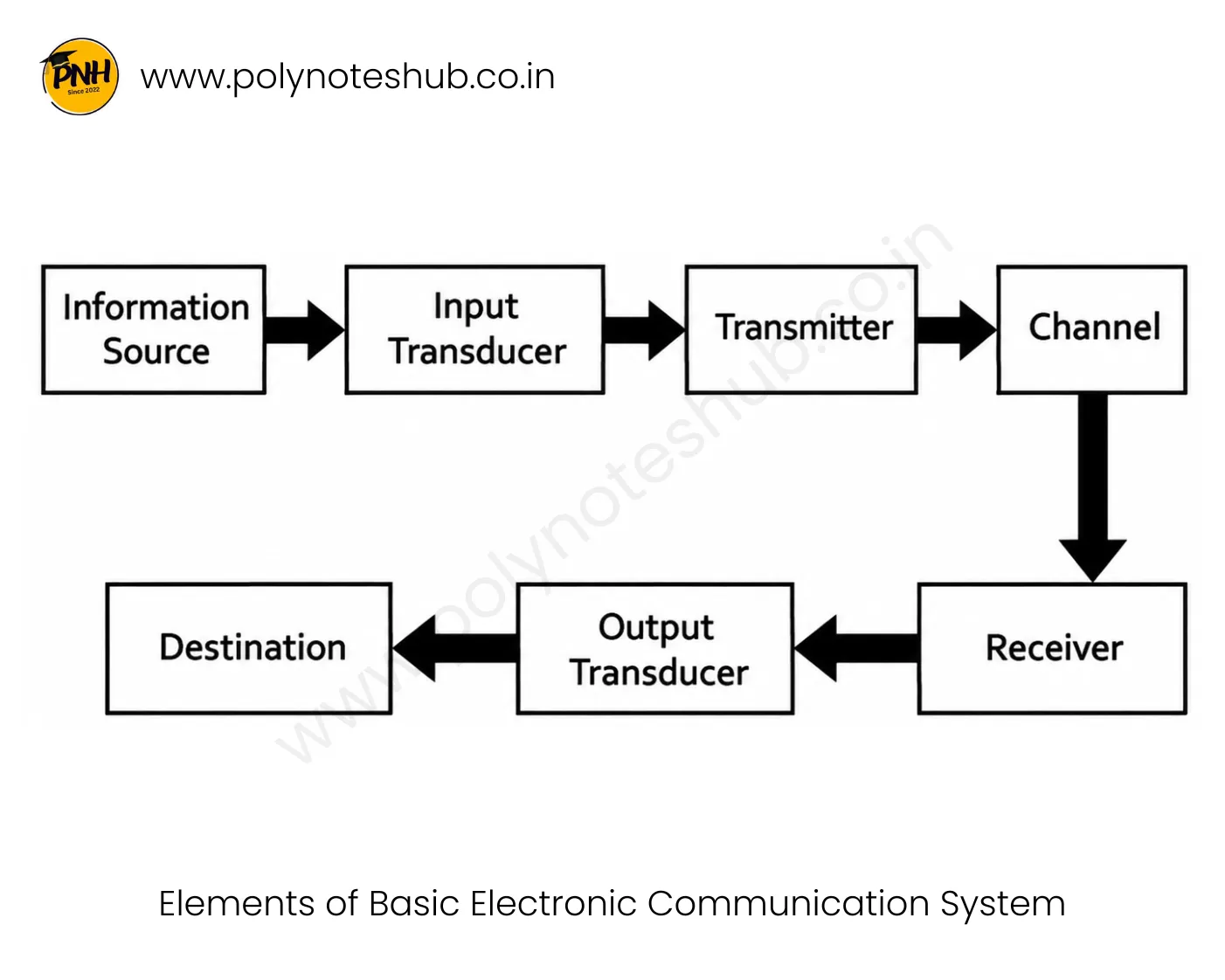
The essential components in a basic connection system are in the following block diagram.
📍 For more such types of notes, visit our official website, www.polynoteshub.co.in
Elements of Basic Electronic Communication System – Block Diagram with an Explanation
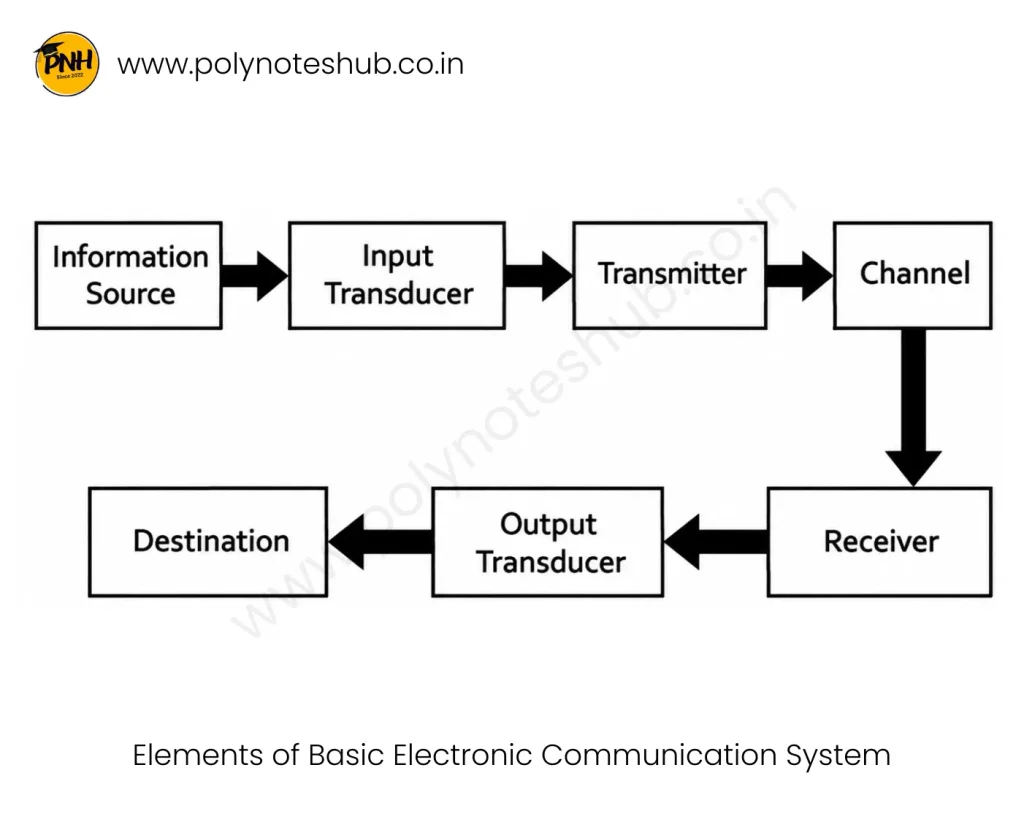
- Source: The message or information is generated in the information source. The information may be voice or related to it.
- Input Transducer: The input Transducer converts the non -non-electrical signal to an electrical one, which is suitable for transmission. The electrical signal is called a baseband or message signal.
- Transmitter: The transmitter modifies the baseband or message signal for efficient transmission. The function of the transmitter is to modulate the signal for long-distance communication. The transmitter consists of a low-pass filter, sampler, coder, and modulator.
- Channel: The channel is the medium through which the baseband signal propagates from the transmitter to the receiver; i.e., the channel provides a physical connection between the transmitter and the receiver. The channels may be wire, coaxial cable, waveguide, optical fibre, radio link, etc.
- Receiver: The receiver recovers the original message signal through demodulation. The receiver consists of a demodulator decoder, filter, and de-emphasizer.
- Output Transducer: Output Transducer converts the electrical signal to the original message.
- Noise: Noise are unwanted signal that interferes with the original signal. A noise is always random.