
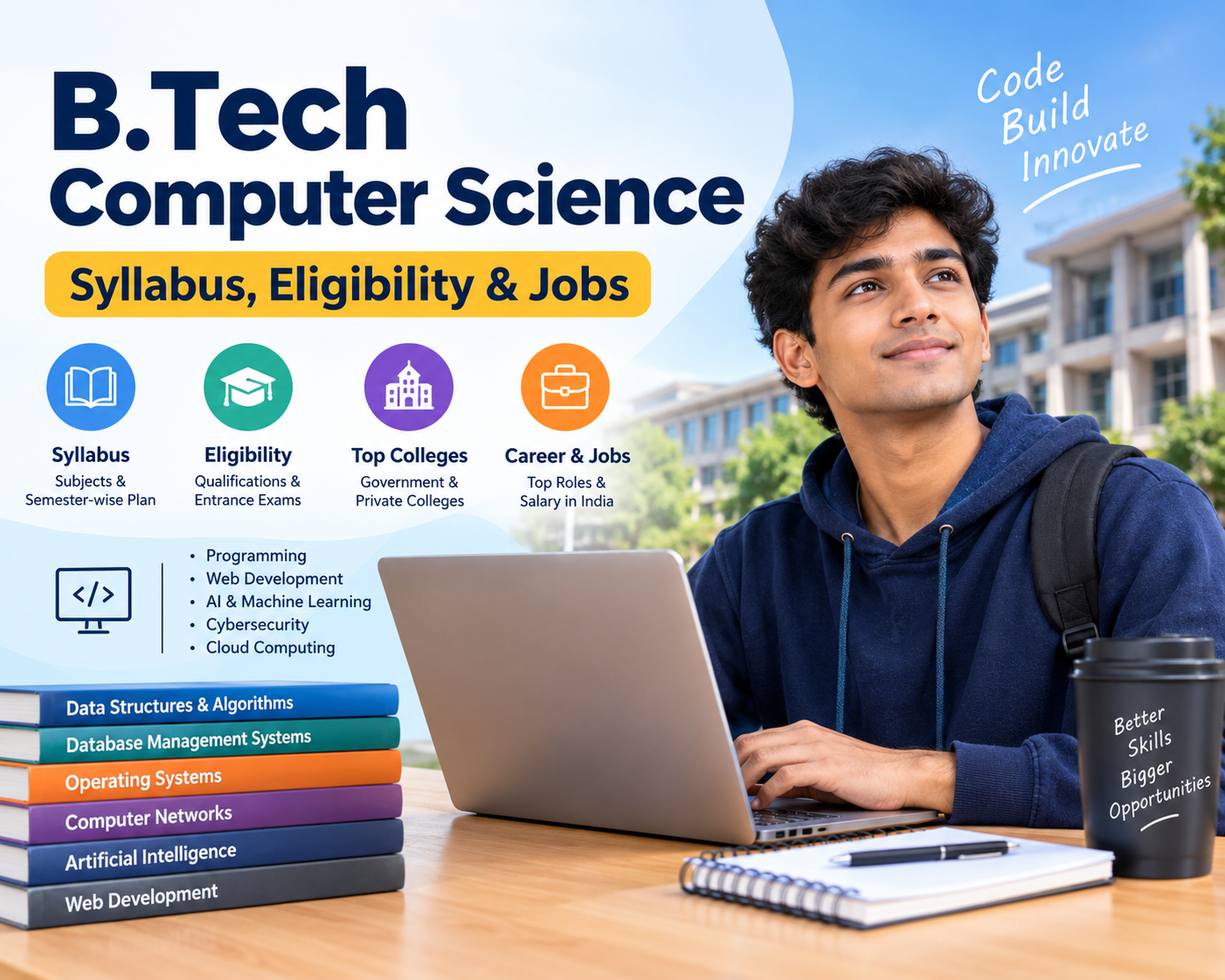
Explore B.Tech Computer Science eligibility, CSE syllabus, subjects, top colleges, admission process, salary in India, and career opportunities after graduation.
Author Name: Arun Paul.
B.Tech Computer Science: Syllabus, Eligibility, Colleges, Salary & Jobs
B.Tech Computer Science is one of the most popular engineering courses for students who want to build a career in software development, artificial intelligence, cybersecurity, data science, and other technology-related fields. With the growing demand for skilled IT professionals, pursuing a B.Tech in Computer Science can open doors to a wide range of career opportunities in India and abroad.
Before choosing this course, students should understand the admission requirements, subjects, syllabus, top colleges, career options, and expected salary after graduation.
In this guide, we will cover everything you need to know about B.Tech Computer Science and Engineering, including eligibility criteria, admission procedures, course duration, and job opportunities.
What Is B.Tech Computer Science?
B.Tech Computer Science, also known as Bachelor of Technology in Computer Science and Engineering (CSE), is a four-year undergraduate engineering programme that focuses on computer systems, programming, software development, algorithms, networking, databases, and emerging technologies.
The course combines theoretical knowledge with practical learning through laboratory sessions, coding assignments, projects, internships, and industrial training.
Students pursuing B.Tech Computer Science and Engineering learn how to design software applications, develop websites, manage databases, solve computational problems, and build technology-based solutions.
Key Highlights of B.Tech Computer Science
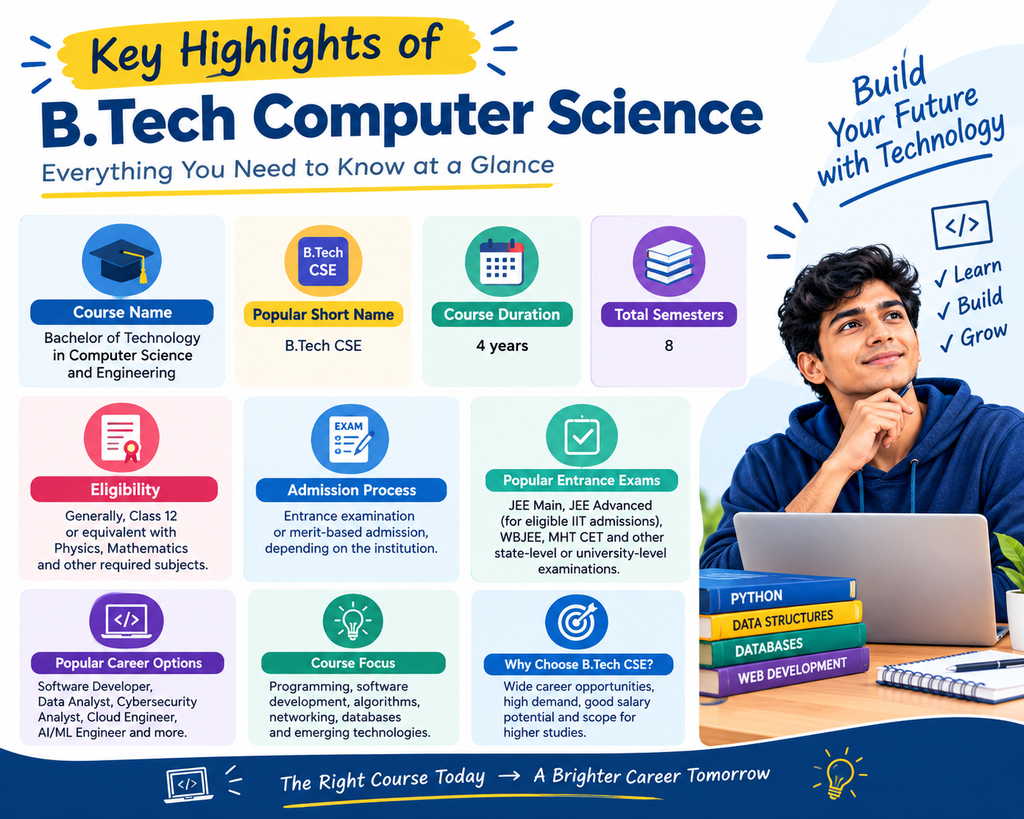
- Course Name: Bachelor of Technology in Computer Science and Engineering
- Popular Short Name: B.Tech CSE
- Course Duration: 4 years
- Total Semesters: 8
- Course Level: Undergraduate
- Eligibility: Generally, Class 12 or equivalent with Physics, Mathematics, and other required subjects
- Admission Process: Entrance examination or merit-based admission, depending on the institution
- Popular Entrance Exams: JEE Main, JEE Advanced for eligible IIT admissions, and various state-level or university-level entrance examinations
- Popular Career Options: Software Developer, Data Analyst, Cybersecurity Analyst, Cloud Engineer, and AI/ML Engineer
B.Tech Computer Science Eligibility Criteria
Understanding the B Tech Computer Science eligibility requirements is essential before applying for admission. The exact eligibility criteria may vary depending on the college, university, entrance examination, and admission category.
1. Educational Qualification
Students generally need to complete Class 12 or an equivalent examination from a recognised board.
Most engineering colleges require Physics and Mathematics as compulsory subjects, along with Chemistry, Computer Science, or another approved subject depending on the institution’s admission rules.
Students from recognised boards such as CBSE, ISC, and state boards can apply if they satisfy the relevant requirements.
2. Minimum Marks Requirement
Many institutions require a minimum aggregate percentage in Class 12. The required percentage may differ between colleges and admission categories.
Some institutions also consider subject-wise marks, particularly in Physics and Mathematics.
Therefore, students should check the official admission notification of their preferred college before applying.
3. Entrance Examination
Admission to B.Tech Computer Science may be based on national-level, state-level, or university-level entrance examinations.
Common options include:
- JEE Main for admission to NITs, IIITs, and other participating institutions.
- JEE Advanced for admission to IITs, subject to the applicable eligibility requirements.
- WBJEE for participating engineering colleges in West Bengal.
- MHT CET for participating engineering colleges in Maharashtra.
- Other state-level and private university entrance examinations.
Some colleges also offer admission through qualifying examination marks or other approved admission processes.
4. Can Students From a Non-Computer Science Background Apply?
Yes. Students generally do not need to study Computer Science in Class 12 to pursue B.Tech CSE.
However, they must meet the required subject combination and admission criteria. Mathematics is particularly important because the course involves programming logic, discrete mathematics, probability, statistics, and algorithms.
B.Tech CSE Admission Process
The admission process for B.Tech Computer Science typically involves the following steps:
- Complete Class 12 with the required subjects.
- Check the eligibility criteria of your preferred colleges.
- Register for the relevant entrance examination, if required.
- Appear for the examination and obtain the required score or rank.
- Participate in counselling or the college admission process.
- Select Computer Science and Engineering based on your rank, preferences, and seat availability.
- Complete document verification and pay the admission fees.
Students should verify important dates, seat allocation rules, and eligibility conditions through official admission portals.
B.Tech CSE Syllabus: Semester-Wise Subjects
The BTech CSE syllabus is designed to develop programming skills, mathematical understanding, computer system knowledge, and practical engineering abilities.
Although the syllabus varies between universities, most institutions cover foundational engineering subjects during the initial semesters and advanced computer science subjects in later semesters.
First Year: Basic Engineering and Programming
The first year generally introduces students to engineering fundamentals, mathematics, programming, and computer systems.
Common subjects include:
- Engineering Mathematics
- Engineering Physics
- Engineering Chemistry
- Basic Electrical or Electronics Engineering
- Programming for Problem Solving
- Programming in C or Python
- Engineering Graphics
- Communication Skills
- Environmental Studies
- Computer Programming Laboratory
The main objective is to build a strong foundation in mathematics, logical thinking, and programming.
Second Year: Core Computer Science Subjects
During the second year, students begin studying fundamental computer science concepts.
Common B Tech Computer Science subjects include:
- Data Structures and Algorithms
- Object-Oriented Programming
- Discrete Mathematics
- Digital Logic Design
- Computer Organisation and Architecture
- Database Management Systems
- Operating Systems
- Computer Networks
- Theory of Computation
- Software Engineering
These subjects help students understand how software applications are designed, how computers process information, and how data is stored and managed.
Third Year: Advanced Computer Science and Specialisations
The third year generally focuses on advanced concepts and practical applications.
Common subjects may include:
- Design and Analysis of Algorithms
- Artificial Intelligence
- Machine Learning
- Web Technologies
- Compiler Design
- Distributed Systems
- Information Security
- Cloud Computing
- Data Mining
- Mobile Application Development
Students may also work on mini-projects, internships, technical assignments, and elective subjects based on their university’s curriculum.
Fourth Year: Electives, Projects, and Industry Preparation
The final year usually focuses on specialisation, project development, and preparation for professional careers.
Common components include:
- Major Project or Final-Year Project
- Internship or Industrial Training
- Cloud Computing or Advanced Computing Electives
- Artificial Intelligence and Machine Learning Electives
- Cybersecurity or Information Security
- Big Data Analytics
- Internet of Things
- Technical Seminars
- Project Reports and Presentations
The exact subjects depend on the university and the electives offered.
B.Tech Computer Science Subjects List
The following table summarises some of the major subjects taught during the course.
| Subject | What Students Learn |
|---|---|
| Programming | Writing code and solving computational problems |
| Data Structures | Organising and managing data efficiently |
| Algorithms | Designing efficient solutions to problems |
| DBMS | Storing, managing, and retrieving data |
| Operating Systems | Managing computer resources and processes |
| Computer Networks | Understanding communication between computer systems |
| Software Engineering | Developing and maintaining software applications |
| Artificial Intelligence | Building systems that perform intelligent tasks |
| Machine Learning | Training models to learn patterns from data |
| Cybersecurity | Protecting computer systems and digital information |
| Cloud Computing | Using remote computing infrastructure and services |
| Web Development | Creating websites and web applications |
Students should consult their university’s official syllabus for the complete subject list, credit structure, practical examinations, and elective options.
Best B.Tech Computer Science Colleges in India
Choosing the right college is an important decision because it can influence the quality of education, internship opportunities, industry exposure, and campus placements.
When comparing B Tech Computer Science colleges, students should consider accreditation, faculty expertise, laboratory facilities, curriculum, placement records, internship support, fees, and location.
Popular Government Engineering Institutions
Some well-known government institutions offering computer science or related engineering programmes include:
- Indian Institutes of Technology (IITs)
- National Institutes of Technology (NITs)
- Indian Institutes of Information Technology (IIITs)
- Jadavpur University, West Bengal
- Other state government engineering colleges
Admission to these institutions is generally competitive, and eligibility requirements differ by institution.
Popular Private Engineering Institutions
Students can also explore private universities and engineering colleges offering B.Tech CSE programmes.
Examples include:
- Vellore Institute of Technology (VIT)
- SRM Institute of Science and Technology
- Manipal Institute of Technology
- Amity University
- Other recognised private engineering institutions
Before selecting a college, compare the total course fees, available specialisations, placement statistics, internship opportunities, and admission requirements.
How to Choose the Right College for B.Tech CSE
Consider the following factors before making a decision:
- Accreditation and recognition: Verify the institution’s recognition and the programme’s applicable approvals.
- Placement opportunities: Review recent placement reports and median salary figures rather than relying only on the highest package.
- Practical learning: Check whether the curriculum includes coding laboratories, real-world projects, and internships.
- Faculty and infrastructure: Evaluate teaching quality, computer laboratories, and access to technical resources.
- Total cost: Compare tuition fees, accommodation, examination fees, and other expenses.
- Location and industry exposure: Consider access to internships, technology companies, and professional networking opportunities.
The best college is not necessarily the one with the highest advertised package. It is the one that offers a good balance of education quality, affordability, practical experience, and career support.
B.Tech Computer Science Fees
The total cost of a B.Tech Computer Science degree varies depending on whether a student chooses a government institution, private college, or private university.
Government engineering colleges generally have lower tuition fees than many private institutions, although costs vary considerably.
The total expenditure may include:
- Tuition fees
- Admission and examination fees
- Hostel and accommodation charges
- Books and study materials
- Laptop and internet expenses
- Transportation and other living costs
Students should check the official fee structure for the current academic session before applying. Scholarships, financial assistance, and education loans may also be available to eligible students.
Career Opportunities After B.Tech Computer Science
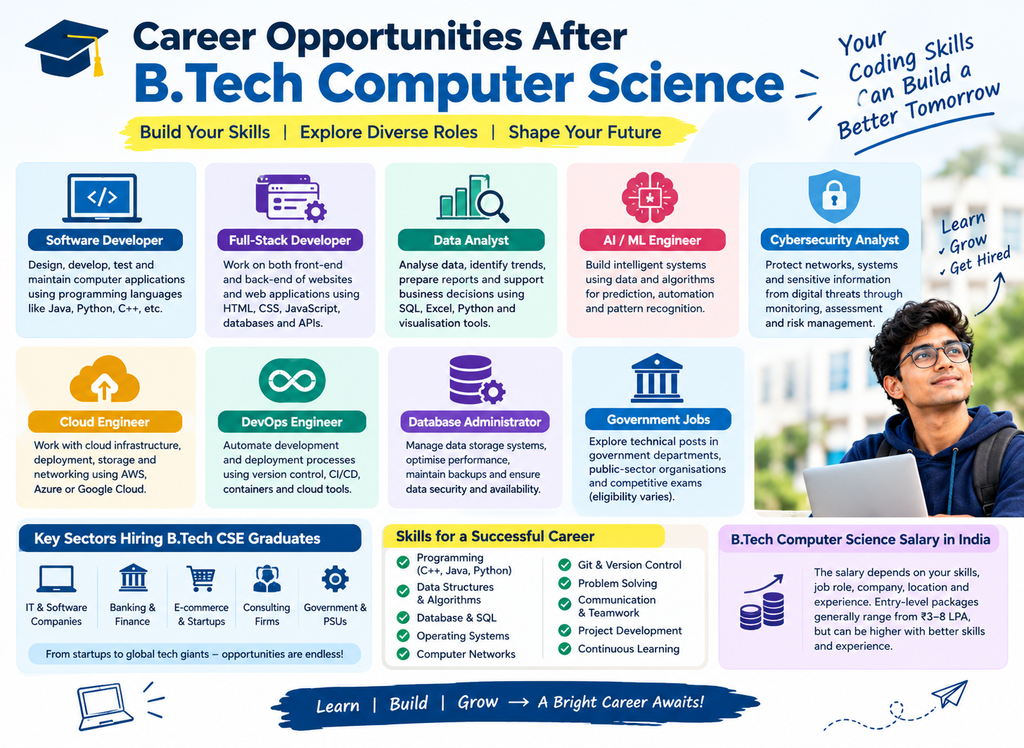
One of the main advantages of pursuing B.Tech CSE is the variety of career paths available after graduation.
Graduates can work in software companies, IT service providers, financial technology firms, startups, consulting companies, government organisations, and other industries that rely on technology.
1. Software Developer
Software developers design, develop, test, and maintain computer applications. They may work with programming languages such as Java, Python, C++, JavaScript, and other technologies.
2. Full-Stack Developer
Full-stack developers work on both the front end and back end of websites and web applications. Their work may involve HTML, CSS, JavaScript, databases, APIs, and server-side programming.
3. Data Analyst
Data analysts examine datasets to identify trends, prepare reports, and support business decisions. Common tools include SQL, Excel, Python, and data visualisation platforms.
4. Artificial Intelligence and Machine Learning Engineer
AI and ML engineers develop systems that use data and algorithms to perform tasks such as prediction, classification, automation, and pattern recognition.
This career path generally requires strong programming, mathematics, statistics, and machine learning knowledge.
5. Cybersecurity Analyst
Cybersecurity analysts help organisations protect their networks, systems, and sensitive information from digital threats. They may work in security monitoring, vulnerability assessment, incident response, and risk management.
6. Cloud Engineer
Cloud engineers work with cloud infrastructure, deployment systems, networking, storage, and automation tools. Knowledge of platforms such as AWS, Microsoft Azure, or Google Cloud can be valuable.
7. DevOps Engineer
DevOps engineers help automate software development and deployment processes. They may work with version control, CI/CD pipelines, containers, infrastructure automation, and cloud services.
8. Database Administrator
Database professionals manage data storage systems, optimise database performance, maintain backups, and help ensure data availability and security.
9. Government Jobs After B.Tech CSE
Computer science graduates may also explore government and public-sector opportunities, subject to the eligibility criteria of individual recruitment notifications.
Potential pathways include:
- Technical posts in government departments
- IT and software-related positions in public-sector organisations
- Scientific and technical recruitment
- Graduate-level competitive examinations open to eligible candidates
- Engineering recruitment examinations where Computer Science is an accepted discipline
Eligibility, age limits, examination requirements, and accepted engineering branches vary by recruitment. Candidates should always check the official notification.
B Tech Computer Science Salary in India
The B Tech Computer Science salary depends on several factors, including technical skills, job role, company, location, internship experience, academic background, and interview performance.
The following figures are illustrative estimates for understanding potential starting salaries. They are not guaranteed pay scales, and actual offers may fall outside these ranges.
| Job Role | Illustrative Annual Salary Range |
|---|---|
| Junior Software Developer | ₹3–8 lakh |
| Web Developer | ₹2.5–6 lakh |
| Data Analyst | ₹3–8 lakh |
| QA / Software Test Engineer | ₹3–7 lakh |
| Cybersecurity Analyst | ₹3.5–9 lakh |
| Cloud Engineer | ₹4–10 lakh |
| Data Engineer | ₹4–10 lakh |
| AI / Machine Learning Engineer | ₹4–12 lakh |
These ranges are broad planning estimates rather than verified current market averages. Some graduates receive lower offers, while candidates with strong skills and experience may receive substantially higher compensation.
Factors That Affect B.Tech CSE Salary
Technical skills: Programming, problem-solving, databases, system design, and software development skills can improve employability.
Practical experience: Internships, personal projects, open-source contributions, and relevant work experience help demonstrate your abilities.
College and placement support: The quality of recruitment opportunities and employer networks may influence available offers.
Specialisation: Fields such as AI, cloud computing, data engineering, and cybersecurity can offer attractive opportunities, depending on the role and candidate’s expertise.
Communication skills: The ability to explain technical solutions, collaborate with teams, and communicate clearly is valuable in professional environments.
Students should also distinguish between annual cost-to-company (CTC), fixed salary, variable pay, bonuses, and take-home salary when comparing job offers.
Skills Required for a Successful Career in Computer Science
A B.Tech degree provides a foundation, but continuous learning and practical experience are important for building a successful career.
Students should focus on developing the following skills:
- Programming in at least one language, such as C++, Java, or Python
- Data Structures and Algorithms
- Object-Oriented Programming
- Database Management Systems and SQL
- Operating Systems and Computer Networks
- Git and version control
- Problem-solving and logical reasoning
- Communication and teamwork
- Project development and debugging
- Interview preparation and coding practice
Students should also choose additional skills according to their career goals. For example, aspiring web developers can learn front-end and back-end technologies, while students interested in data science can focus on Python, statistics, SQL, and machine learning.
Is B.Tech Computer Science a Good Career Choice?
B.Tech Computer Science can be a good choice for students who enjoy technology, programming, logical thinking, and solving practical problems.
The degree offers opportunities across multiple industries, and students can choose different career paths based on their interests.
However, success is not guaranteed by the degree alone. The technology industry changes rapidly, so graduates need to update their skills, gain practical experience, and develop the ability to learn new tools and technologies.
Before choosing the course, students should consider their interest in mathematics, programming, problem-solving, and long-term professional development.
Higher Studies After B.Tech Computer Science
Students who want to continue their education can consider several postgraduate and professional options.
M.Tech in Computer Science and Engineering
M.Tech allows students to specialise in areas such as computer science, artificial intelligence, data science, cybersecurity, or other advanced computing fields.
Master of Computer Applications (MCA)
Eligible graduates may pursue MCA to develop further expertise in computer applications, software development, and related areas. Admission rules vary by institution.
MBA in Information Technology
An MBA in IT or a related specialisation can be suitable for students interested in technology management, consulting, product management, and business leadership.
Research and Specialised Certifications
Students may also explore research programmes or professional certifications in cloud computing, cybersecurity, networking, data analytics, and other technology domains.
The right option depends on career objectives, academic interests, eligibility, and financial considerations.
Frequently Asked Questions About B.Tech Computer Science
1. What is the duration of B.Tech Computer Science?
B.Tech Computer Science is generally a four-year undergraduate degree divided into eight semesters.
2. What is the eligibility for B.Tech CSE?
Students generally need to pass Class 12 with Physics, Mathematics, and other subjects required by the institution. Minimum marks and entrance examination requirements vary by college.
3. Is Mathematics compulsory for B.Tech Computer Science?
Mathematics is generally a compulsory subject for regular B.Tech CSE admission. Students should check the eligibility rules of the relevant institution and entrance examination.
4. Which subjects are taught in B.Tech Computer Science?
Major subjects include Programming, Data Structures and Algorithms, Database Management Systems, Operating Systems, Computer Networks, Software Engineering, Artificial Intelligence, and Machine Learning.
5. What is the starting salary after B.Tech Computer Science?
Starting salaries vary by employer, role, location, and skills. Many entry-level positions may offer approximately ₹3–8 lakh per year, but actual offers can be lower or higher.
6. Which entrance exams are required for B.Tech CSE?
Depending on the institution, students may need JEE Main, JEE Advanced, WBJEE, MHT CET, or another state-level or university-level examination. Some colleges offer alternative admission routes.
7. Can I get a job after B.Tech Computer Science?
Yes. Graduates can apply for roles such as Software Developer, Web Developer, Data Analyst, QA Engineer, Cloud Engineer, and Cybersecurity Analyst. Selection depends on the employer’s requirements, skills, and interview performance.
8. Is B.Tech Computer Science better than other engineering branches?
There is no universally best engineering branch. Computer Science may suit students interested in programming and computing, while other branches may be more appropriate for students interested in mechanical, electrical, civil, or other engineering disciplines.
9. Which programming language should I learn first?
Python is often a beginner-friendly choice because of its readable syntax. C++ and Java are also useful for learning programming fundamentals, data structures, and algorithms. The best starting language depends on your learning goals and curriculum.
10. What is the difference between B.Tech CSE and B.Tech IT?
B.Tech CSE generally covers a broad range of computer science foundations, including algorithms, computer architecture, operating systems, and software development. B.Tech IT often places greater emphasis on information systems, software applications, networks, and IT infrastructure. However, the subjects can overlap considerably, so students should compare the actual curricula.
Conclusion
B.Tech Computer Science and Engineering is a popular undergraduate programme for students who want to build a career in software development, data science, artificial intelligence, cybersecurity, cloud computing, and other technology fields.
Before applying, students should carefully review the B.Tech Computer Science eligibility criteria, entrance examination requirements, semester-wise syllabus, college fees, placement records, and available career opportunities.
Choosing the right college and developing strong programming skills, practical project experience, and problem-solving abilities can help graduates prepare for the competitive technology job market.
If you are interested in computers, logical reasoning, and developing technology-based solutions, B.Tech Computer Science may be a worthwhile option to consider for your future.