
In this note, we are going to explain De Morgan’s Theorem in Digital Electronics. We are explain the De Morgan’s First Theorem and De Morgan’s Second Theorem as well. Welcome to Poly Notes Hub, a leading site for engineering notes.
Author Name: Arun Paul.
Explain De Morgan’s Theorem in Digital Electronics
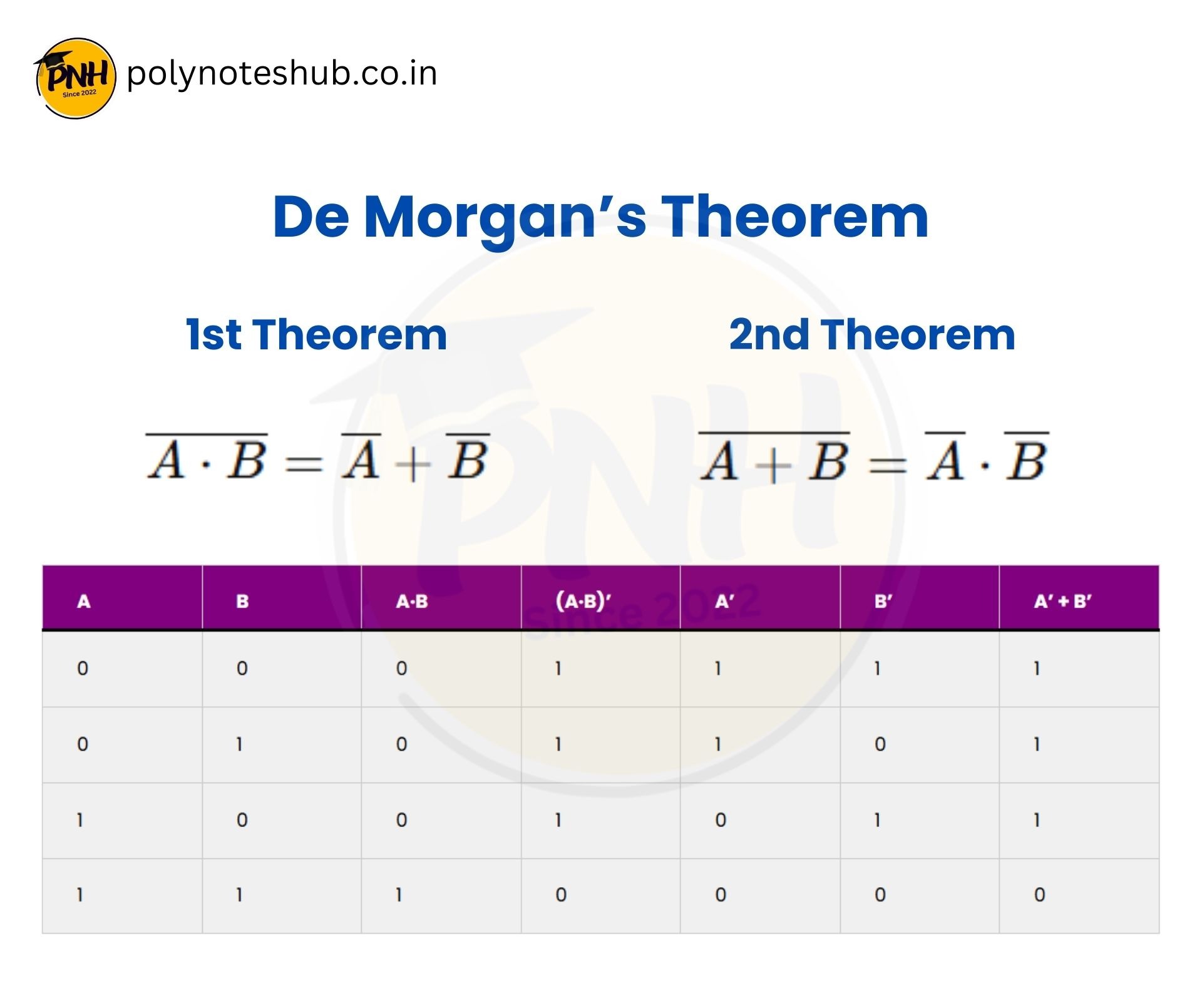
De Morgan’s Theorem in Digital Electronics is a fundamental Boolean Algebra principle that describes how the NOT operation (complement) impacts the AND and OR operations. It claims that the complement of a product equals the sum of the complements, while the complement of a sum equals the product of the complements.

Before going to De Morgan’s Theorem, 1st you have to know about the basic primary logic gates, which are NOT, AND, and OR Gates. So, below we have attached the images of each primary logic gate with animated images by which anyone can understand how those gates work.
NOT Gate

OR Gate

AND Gate

📌 Click Here to learn about Different Types of Logic Gates in Digital Electronics
1. De Morgan’s First Theorem
Statement: The complement of a product is equal to the sum of the complements.
Boolean Expression

Truth Table of De Morgan’s 1st Theorem
| A | B | A·B | (A·B)’ | A’ | B’ | A’ + B’ |
|---|---|---|---|---|---|---|
| 0 | 0 | 0 | 1 | 1 | 1 | 1 |
| 0 | 1 | 0 | 1 | 1 | 0 | 1 |
| 1 | 0 | 0 | 1 | 0 | 1 | 1 |
| 1 | 1 | 1 | 0 | 0 | 0 | 0 |
2. De Morgan’s Second Theorem
Statement: The complement of a sum is equal to the product of the complements.
Boolean Expression

Table of De Morgan’s 2nd Theorem
| A | B | A+B | (A+B)’ | A’ | B’ | A’·B’ |
|---|---|---|---|---|---|---|
| 0 | 0 | 0 | 1 | 1 | 1 | 1 |
| 0 | 1 | 1 | 0 | 1 | 0 | 0 |
| 1 | 0 | 1 | 0 | 0 | 1 | 0 |
| 1 | 1 | 1 | 0 | 0 | 0 | 0 |