
In this note, we are going to learn about Types of Turbines in Hydro Power Plant. Welcome to Poly Notes Hub, a leading destination for engineering notes for diploma and degree engineering students.
Author Name: Arun Paul.
Types of Turbines in Hydro Power Plant
There are many types of water turbines that are used in Hydro Power Plants. Here we have listed 6 types of water turbines that are commonly used in Hydro Power Plants –

- Pelton Turbine: The Pelton turbine is built with one or more water jets that strike the buckets (blades) attached to the turbine’s wheel (runner). The kinetic energy of the high-speed water jet is turned into mechanical energy when it impacts and deflects off the buckets.
- Application: It is ideal for high head (over 300 meters) and low flow applications. Commonly utilized in mountainous areas where water cascades from enormous heights.
- Francis Turbine: The Francis turbine uses pressure and velocity changes to extract energy. Water enters radially and departs axially through the turbine. The runner is enclosed in a spiral casing, and the flow is regulated by wicket gates.
- Application: It is adaptable and ideal for medium head (20 to 300 meters) and medium flow operations. Widely utilized in large-scale hydropower projects around the world.
- Kaplan Turbine: This turbine resembles a ship’s propeller, with movable blades that can alter pitch to match different water flow conditions, hence increasing efficiency. The water moves axially through the turbine.
- Application: Suitable for low head (less than 30 meters) and high flow applications. Used in tidal power plants and low-head hydroelectric units.
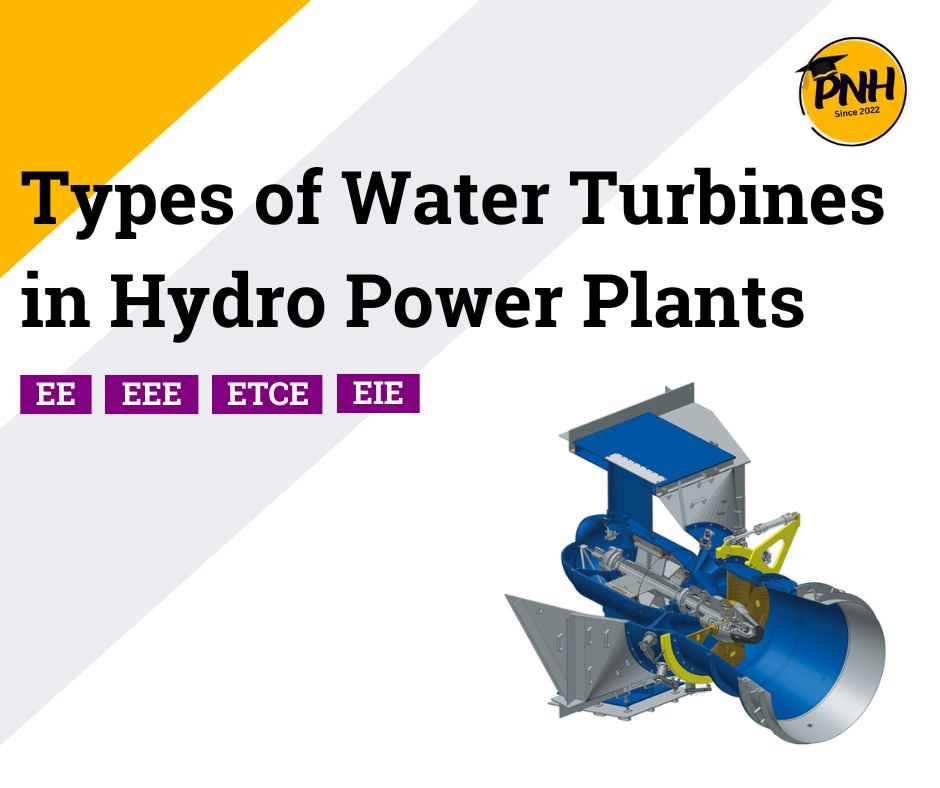
- Bulb Turbine: A variation of the Kaplan turbine in which the generator is contained in a streamlined bulb submerged in the water flow. The design allows the generator to be driven directly without the need for a separate housing.
- Application: Suitable for very low head applications (less than 20 meters). Frequently used in run-of-river hydropower projects.
- Propeller Turbine: Similar to a Kaplan turbine, but with fixed blades. It performs well under a continuous load where water flow and head are reasonably stable.
- Application: Suitable for low head (less than 30 meters) and high flow conditions. Frequently used in irrigation and water management projects.
- Cross-flow Turbine: The cross-flow turbine has a drum-shaped rotor with curved blades positioned radially. Water enters the turbine, travels through the blades, then exits on the other side, impacting the blades twice, resulting in increased energy extraction.
- Application: Suitable for a variety of heads (10 to 100 meters) and flows. Frequently utilized in small to medium-sized hydropower projects and community-based hydro systems.