
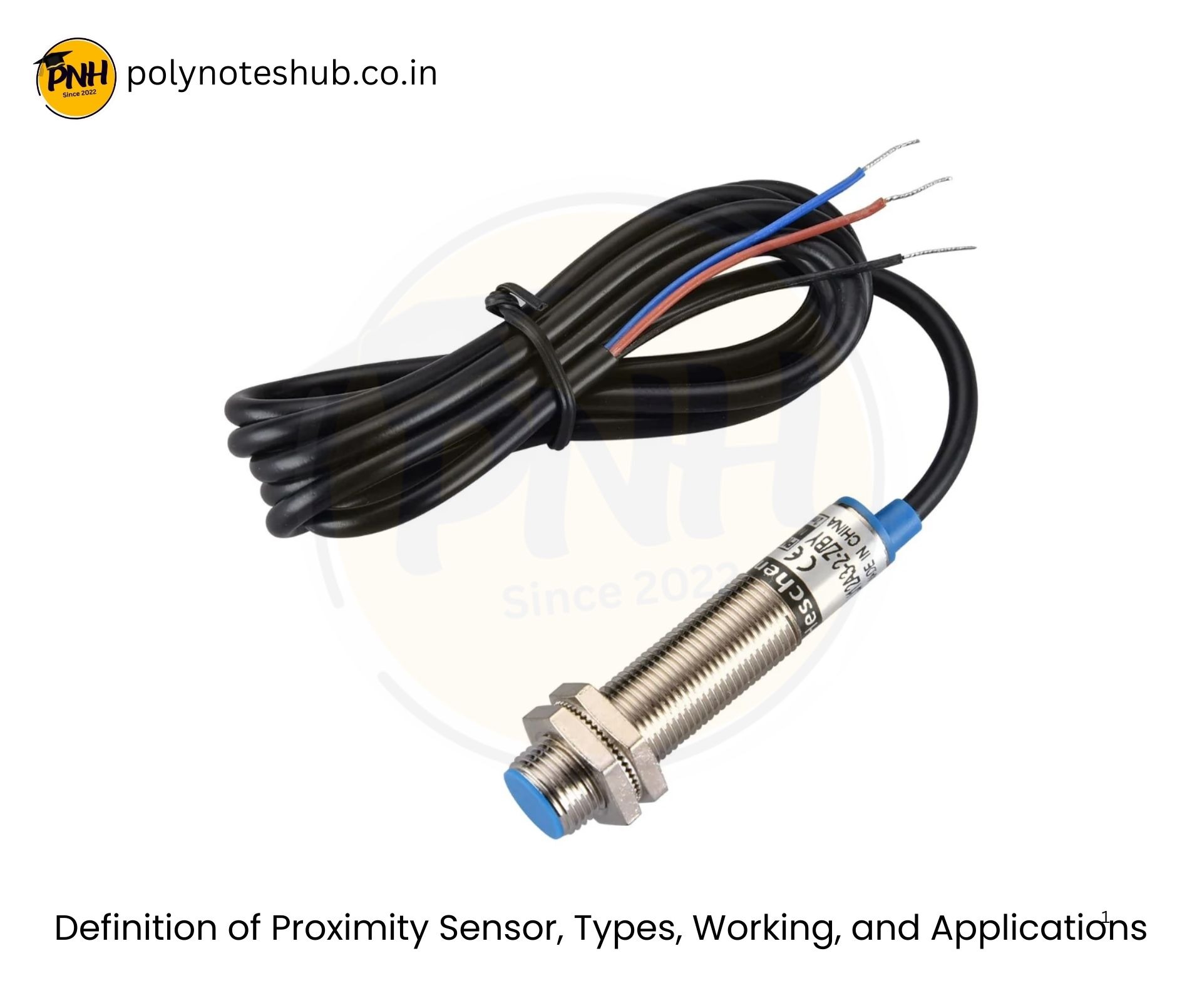
In this note, we are going to discuss a topic called “What is Proximity Sensor? and Its Applications. Welcome to Poly Notes Hub, a leading destination for Electronics and Instrumentation Engineering Notes.
Author Name: Arun Paul.
What is Proximity Sensor?
A proximity sensor is a device that detects the presence or absence of an object without requiring physical touch. It detects changes in physical qualities such as electromagnetic fields, infrared radiation, capacitance, and ultrasonic waves as an item approaches the sensor.
In the instrumentation industry, proximity sensors are commonly used for location detection, object counting, level sensing, and automation control in industrial operations.
Types of Proximity Sensors
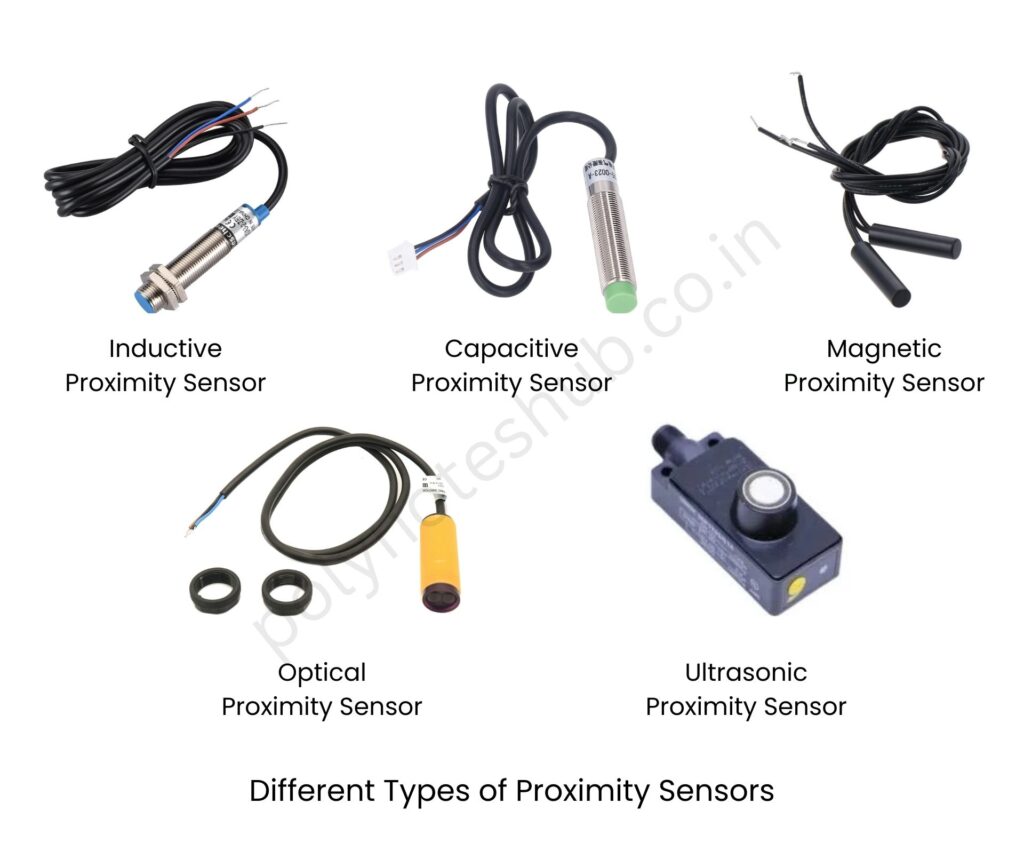
There are different types of proximity sensors, like –
- Inductive Types
- Capacitive Types
- Magnetic Types
- Optical Types
- and Ultrasonic Types
Working Principle of Proximity Sensors
A proximity sensor detects changes in a physical field (such as electromagnetic, electric, light, or sound waves) as an object approaches the sensor. The sensor transforms this change into an electrical signal that is utilized to initiate a control action.
Basic Working Steps
- Generation of a Field or Signal: The proximity sensor generates a sensing field such as an electromagnetic field, infrared light, capacitive field, or ultrasonic waves around its sensing area.
- Interaction with the Object: When an object enters this sensing field, it disturbs or reflects the generated signal depending on the sensor type.
- Detection of Change: The sensor detects this change in the signal (such as variation in frequency, amplitude, capacitance, or reflected wave).
- Signal Processing: The internal electronic circuit processes this change and converts it into an electrical output signal.
- Output Action: The output signal is sent to a controller, relay, or automation system, which performs an action such as turning a device ON/OFF, counting objects, or controlling machinery.
Applications of Proximity Sensors in the Instrumentation Field
- Object Detection: Proximity sensors detect the presence of things on conveyor belts in enterprises. They assist in the automatic sorting, counting, and monitoring of items.
- Position Sensing: They are used to determine the position of machine parts, valves, and moving components in automated systems and industrial machinery.
- Level Measurement: In tanks and containers, proximity sensors help detect liquid or solid levels without direct contact with the material.
- Speed Detection: They detect the movement of surrounding metallic components to determine the speed of rotating shafts, motors, or gears.
- Safety Systems: Proximity sensors are employed in safety devices to halt equipment when a person or item approaches hazardous regions.
- Automatic Doors and Smart Devices: They are used in automatic doors, smartphones, and touchless systems to detect the presence of users or objects.
- Robotics and Automation: Proximity sensors in robotic systems enable robots to sense obstacles and move safely in automated environments.