
In this note, we will learn what is the electromagnetic spectrum and its different regions. Welcome to Poly Notes Hub, a leading destination for engineering notes for diploma and degree engineering students.
Author Name: Arun Paul.
What is the Electromagnetic Spectrum?
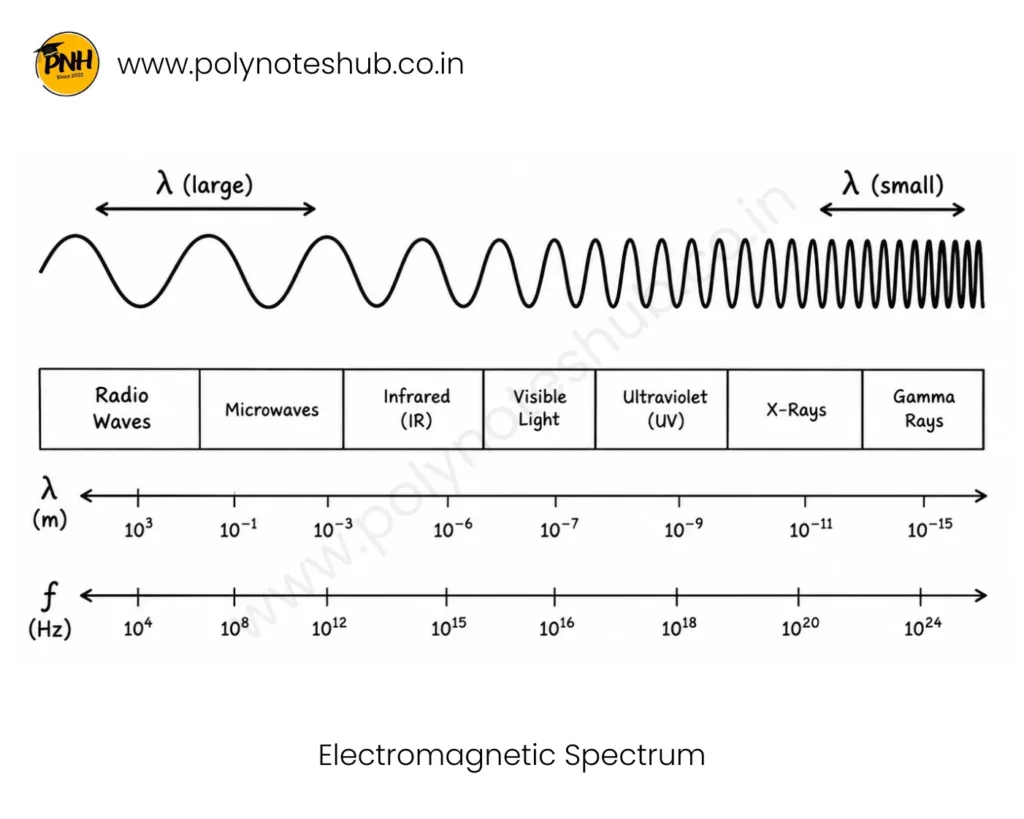
It includes all forms of electromagnetic radiation, which are waves of electric and magnetic fields that flow through space. These waves differ in wavelength and frequency, and the electromagnetic spectrum includes the complete range of wavelengths and frequencies.
Different Regions of Electromagnetic Spectrum
Here we have listed the different regions of the electromagnetic spectrum with their Wavelength, Frequency, and uses.
| Wave | Wavelength | Frequency | Uses |
|---|---|---|---|
| 1. Radio Wave | > 1 mm ( upto km ) | <300 GHz | Communication (radio, television, cell phones), radar |
| 2. Microwaves | 1 mm−1 cm | 300 MHz−300 GHz | Microwave ovens, Wi-Fi, radar, satellite communications |
| 3. Infrared | 700 nm−1 mm | 300 GHz−430 THz | Remote controls, thermal imaging, night vision, heating |
| 4. Visible Light | 400 nm−700 nm | 430 THz−770 THz | Human vision, photography, illumination |
| 5. Ultraviolet | 10 nm−400 nm | 770 THz−30 PHz | Sterilization, fluorescent lights, tanning |
| 6. X-Rays | 0.01 nm−10 nm | 30 PHz−30 EHz | Medical imaging, security scanning, material analysis |
| 7. Gamma Rays | < 0.01 nm | > 30 EHz | Cancer treatment, sterilization, astrophysical observations |
📍 Please visit our official website www.polynoteshub.co.in for more such types of notes.
Uses of the Electromagnetic Spectrum in Communication Engineering
- Radio Waves – Radio broadcasting and wireless communication.
- Microwaves – Satellite communication, radar, and mobile networks.
- Infrared Waves – Remote controls and short-range communication.
- Visible Light – Optical communication and Li-Fi.
- Ultraviolet Waves – Specialized optical and satellite communication.
- X-Rays – High-frequency imaging and specialized communication applications.
- Gamma Rays – Specialized space and deep-space communication research.