

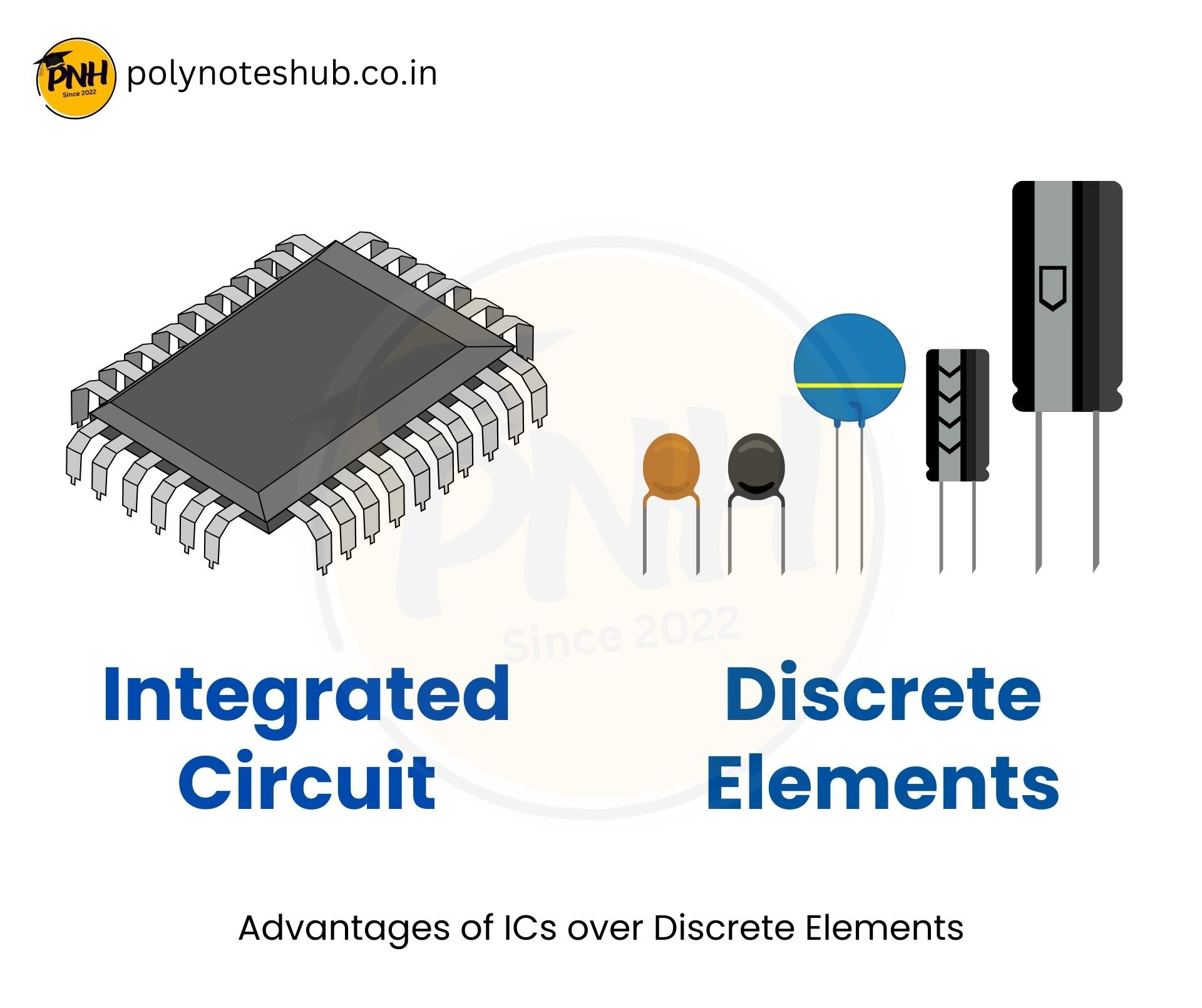
In this note, we are going to know about the advantages of integrated circuits over discrete components. Welcome to Poly Notes Hub, a leading destination for diploma and degree engineering notes.
Author Name: Arun Paul.
Advantages of Integrated Circuits Over Discrete Components or Elements
Here we listed some advantages of integrated circuits or ICs over discrete components or elements –
- Smaller Size and Compactness: ICs consolidate thousands to billions of components (transistors, resistors, and capacitors) onto a single chip, significantly reducing circuit size and conserving space.
- Lower Cost (Mass Production): Once designed, ICs can be produced in huge quantities at a very low per-unit cost when compared to assembling many discrete components.
- Higher Reliability: Fewer solder junctions and interconnections equal fewer failures. Loose connections and mechanical flaws have less effect on integrated circuits.
- Lower Power Consumption: ICs use lower voltages and currents, making them more energy efficient than equivalent discrete circuits.
- Better Performance (High Speed): Shorter internal connections lower parasitic capacitance and inductance, allowing for faster switching rates and higher frequency performance.
- Consistency & Repeatability: An integrated circuit’s components are all produced together, resulting in homogeneous electrical characteristics and predictable performance.
- Ease of Design & Maintenance: Designers can employ integrated circuits (ICs) as functional blocks (op amps, microcontrollers, logic gates) to ease circuit design, testing, and troubleshooting.
- Reduced Weight: Because of their tiny size and fewer external components, integrated circuit-based systems are substantially lighter than discrete-component systems.
- Improved Noise Immunity: Short internal connections reduce EMI and noise pickup.
- High Functional Density: Complex functionalities (CPU, memory, and communication interfaces) can be implemented on a single chip, making distinct components unfeasible.
Disadvantages of Discrete Elements over ICs or Integrated Circuits
- Large size and bulky circuits
- Higher cost
- Lower reliability
- Higher power consumption
- Slower operation
- More heat generation
- Complex wiring and maintenance
Difference Between Discrete Elements and Integrated Circuits
| Aspect | Discrete Elements | Integrated Circuits (ICs) |
|---|---|---|
| Size | Bulky | Very compact |
| Cost | High | Low |
| Reliability | Less reliable | Highly reliable |
| Power Use | High | Low |
| Speed | Slow | Fast |
| Heat | More heat | Less heat |
| Maintenance | Difficult | Easy |