
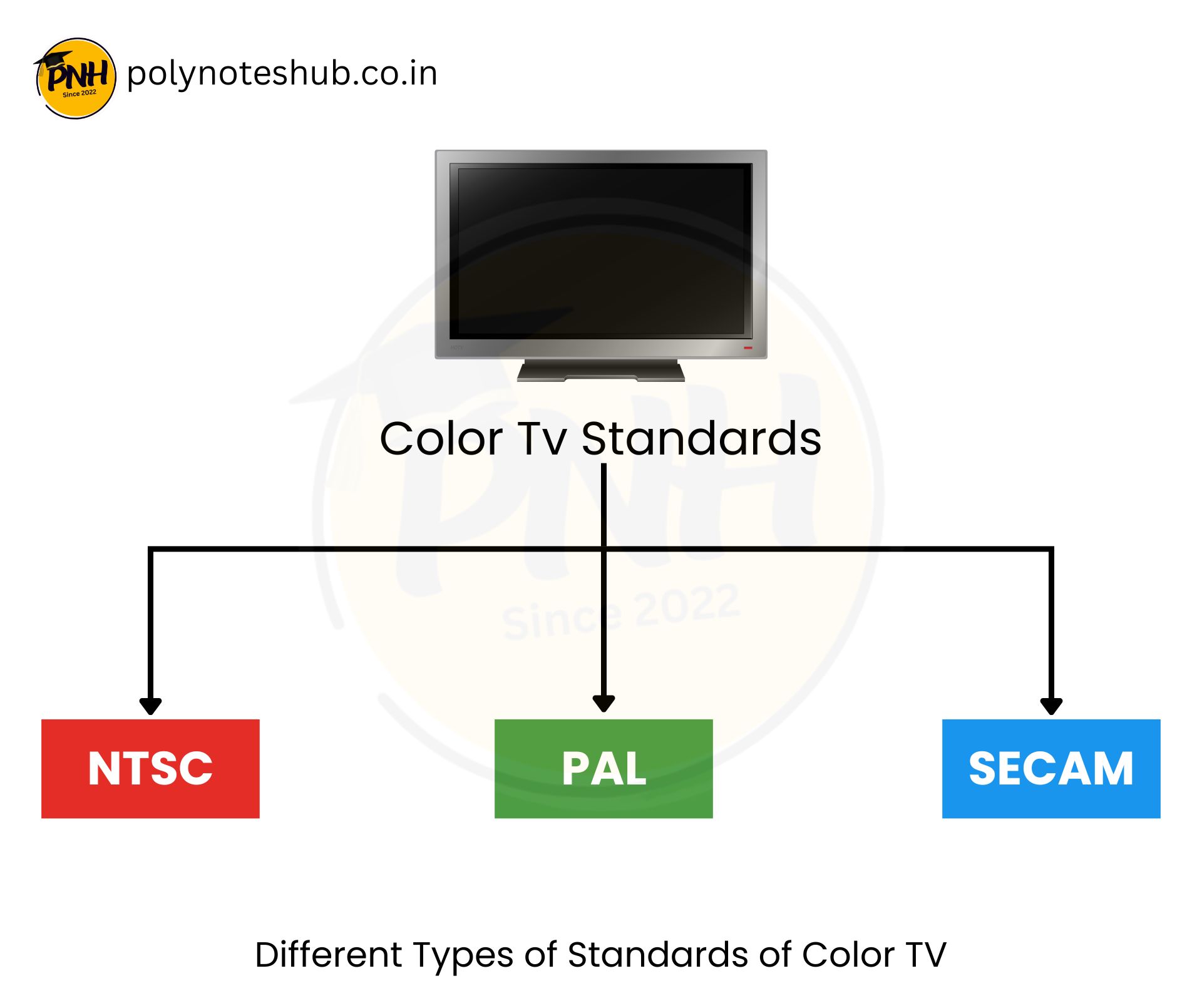
In this note, we are going to know about Color TV Standards like NTSC, PAL, and SECAM. Welcome to Poly Notes Hub, a leading destination for engineering notes for diploma and degree engineering students.
Author Name: Arun Paul.
What is TV Standards?
TV Standards are the technical requirements and principles that regulate how television signals are sent, received, and displayed. These standards ensure that broadcasting systems and televisions work together.
Types of TV Standards
- Broadcast Standards: CCIR, ATSC, DVB, ISDB, NTSC, PAL, SECAM
- Color TV Standards: NTSC, PAL, SECAM
- Video Format Standards: SD (Standard Definition), HD (High Definition), 4K, 8K
- Digital TV Standards: DVB (Europe), ATSC (USA), ISDB (Japan), DMB-T (China)
Different Types of Color TV Standards – NTSC, PAL, SECAM
Here we have listed different types of color TV standards –
| Standard Name | Usage | Frame Rate | Resolution | Color Subcarrier Frequency | Property |
|---|---|---|---|---|---|
| NTSC or National Television System Committee | Used in North America, Japan, and some parts of South America. | 30 fps | 525 lines | 3.58 MHz | Susceptible to color distortion due to phase shifts. |
| PAL or Phase Alternating Line | Used in most of Europe, Asia, Africa, and Australia. | 25 fps | 625 lines | 4.43 MHz | More accurate color reproduction compared to NTSC. |
| SECAM or Séquentiel Couleur à Mémoire | Used in France, Russia, and some parts of Africa. | 25 fps | 625 lines | Color is transmitted sequentially rather than simultaneously. | More resistant to signal degradation over long distances. |