
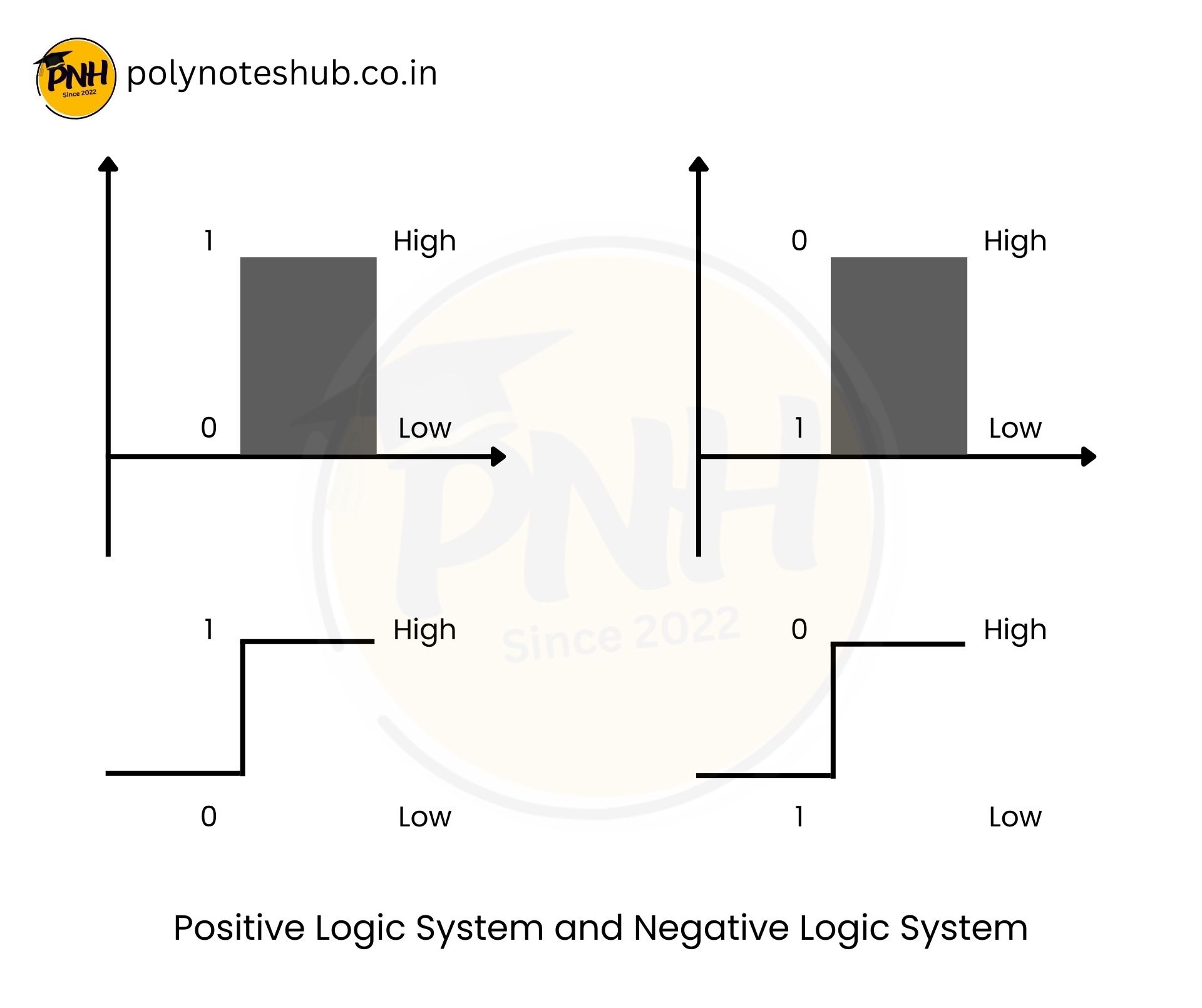
In this note, we are explaining the positive logic and negative logic with examples and diagrams. Welcome to Poly Notes Hub, a leading destination for diploma or polytechnic study materials.
Author Name: Arun Paul.
Explaining the Positive Logic and Negative Logic with Example and Diagram
Below we have discussed about positive logic system and negative logic system with example, features, and diagram. Also, we have add the difference table in between positive and negative logic system –
What is Positive Logic System?
Positive Logic is a logic system in which higher voltage represents logic 1 (TRUE) and lower voltage represents logic 0 (FALSE).
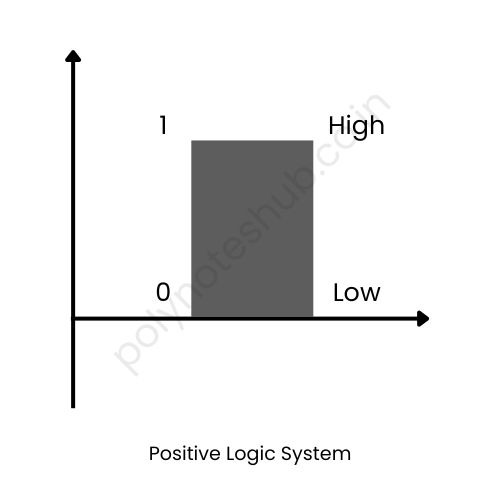
Example: If a circuit uses:
- 0V → Logic 0
- +5V → Logic 1
This is positive logic.
Features of the Positive Logic System
- Most commonly used in digital circuits.
- Simple to understand and implement.
- Follows natural high = TRUE convention.
What is Negative Logic System?
Negative logic is a logic system in which lower voltage represents Logic 1 (TRUE) and higher voltage represents Logic 0 (FALSE).
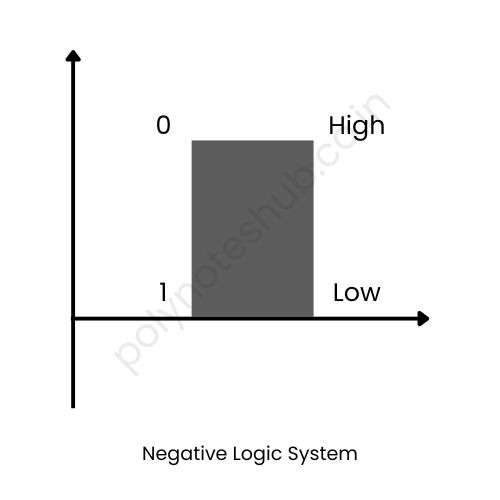
Example: If a circuit uses:
- 0V → Logic 1
- +5V → Logic 0
This is negative logic.
Features of Negative Logic System
- Used in special applications like noise-sensitive circuits.
- Useful in circuits where active-low signals are required.
- Control signals like RESET̅, EN̅, WRITE̅ are negative logic.
Difference Between Positive Logic and Negative Logic Systems
| Feature | Positive Logic System | Negative Logic System |
|---|---|---|
| Logic 1 | Higher voltage | Lower voltage |
| Logic 0 | Lower voltage | Higher voltage |
| Common Usage | Most digital circuits | Active-low control signals |
| Interpretation | High = TRUE | Low = TRUE |
| Simplicity | Easier to design | Slightly complex |