
Dead Weight Tester Diagram: Working Principle, Calibration, Advantages, Disadvantages | New Topic - Poly Notes Hub
Diploma 1st Semester Notes Diploma 2nd Semester Notes Electrical Engineering Notes Electrical and Electronics Engineering Notes Electronics and Telecommunication Engineering Notes Electronics and Instrumentation Engineering Notes Diploma 1st Semester Notes Diploma 2nd Semester Notes Electrical Engineering Notes Electrical and Electronics Engineering Notes Electronics and Telecommunication Engineering Notes Electronics and Instrumentation Engineering Notes Diploma 1st Semester Notes Diploma 2nd Semester Notes Electrical Engineering Notes Electrical and Electronics Engineering Notes Electronics and Telecommunication Engineering Notes Electronics and Instrumentation Engineering Notes Diploma 1st Semester Notes Diploma 2nd Semester Notes Electrical Engineering Notes Electrical and Electronics Engineering Notes Electronics and Telecommunication Engineering Notes Electronics and Instrumentation Engineering Notes Diploma 1st Semester Notes Diploma 2nd Semester Notes Electrical Engineering Notes Electrical and Electronics Engineering Notes Electronics and Telecommunication Engineering Notes Electronics and Instrumentation Engineering Notes Diploma 1st Semester Notes Diploma 2nd Semester Notes Electrical Engineering Notes Electrical and Electronics Engineering Notes Electronics and Telecommunication Engineering Notes Electronics and Instrumentation Engineering Notes Diploma 1st Semester Notes Diploma 2nd Semester Notes Electrical Engineering Notes Electrical and Electronics Engineering Notes Electronics and Telecommunication Engineering Notes Electronics and Instrumentation Engineering Notes Diploma 1st Semester Notes Diploma 2nd Semester Notes Electrical Engineering Notes Electrical and Electronics Engineering Notes Electronics and Telecommunication Engineering Notes Electronics and Instrumentation Engineering Notes Diploma 1st Semester Notes Diploma 2nd Semester Notes Electrical Engineering Notes Electrical and Electronics Engineering Notes Electronics and Telecommunication Engineering Notes Electronics and Instrumentation Engineering Notes Diploma 1st Semester Notes Diploma 2nd Semester Notes Electrical Engineering Notes Electrical and Electronics Engineering Notes Electronics and Telecommunication Engineering Notes Electronics and Instrumentation Engineering Notes Diploma 1st Semester Notes Diploma 2nd Semester Notes Electrical Engineering Notes Electrical and Electronics Engineering Notes Electronics and Telecommunication Engineering Notes Electronics and Instrumentation Engineering Notes Diploma 1st Semester Notes Diploma 2nd Semester Notes Electrical Engineering Notes Electrical and Electronics Engineering Notes Electronics and Telecommunication Engineering Notes Electronics and Instrumentation Engineering Notes

Our Notes Categories


Dead Weight Tester Diagram: Working Principle, Calibration, Advantages, Disadvantages | New Topic

In this note, we are going to know about the Dead Weight Tester Diagram, Working Principle, Advantages, Disadvantages, and Calibration using the Dead Weight Tester. Welcome to Poly Notes Hub, a leading destination for polytechnic engineering notes.

Author Name: Arun Paul.

What is Dead Weight Tester?

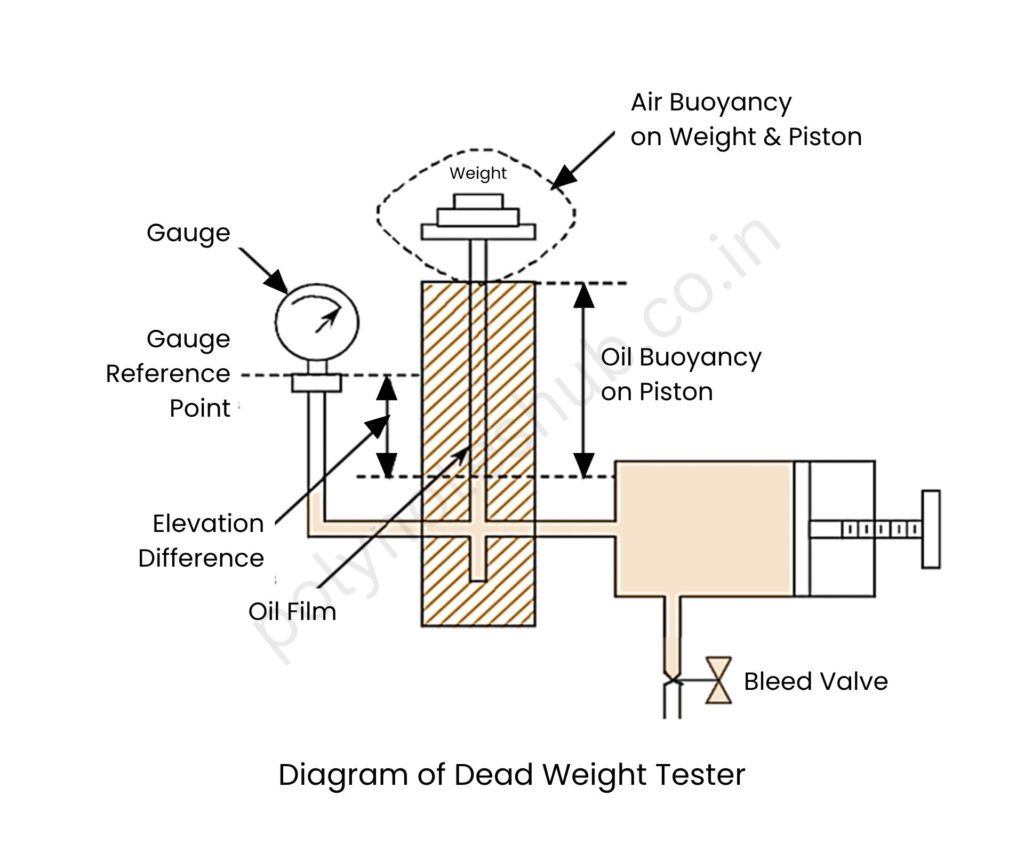
A Dead Weight Tester is a key pressure standard equipment that calibrates pressure measuring devices such as pressure gauges, transmitters, and sensors. It operates by balancing an unknown pressure with a known force generated by standard weights put on a piston with a known area.

Dead Weight Tester Diagram
dead weight tester diagram - poly notes hub

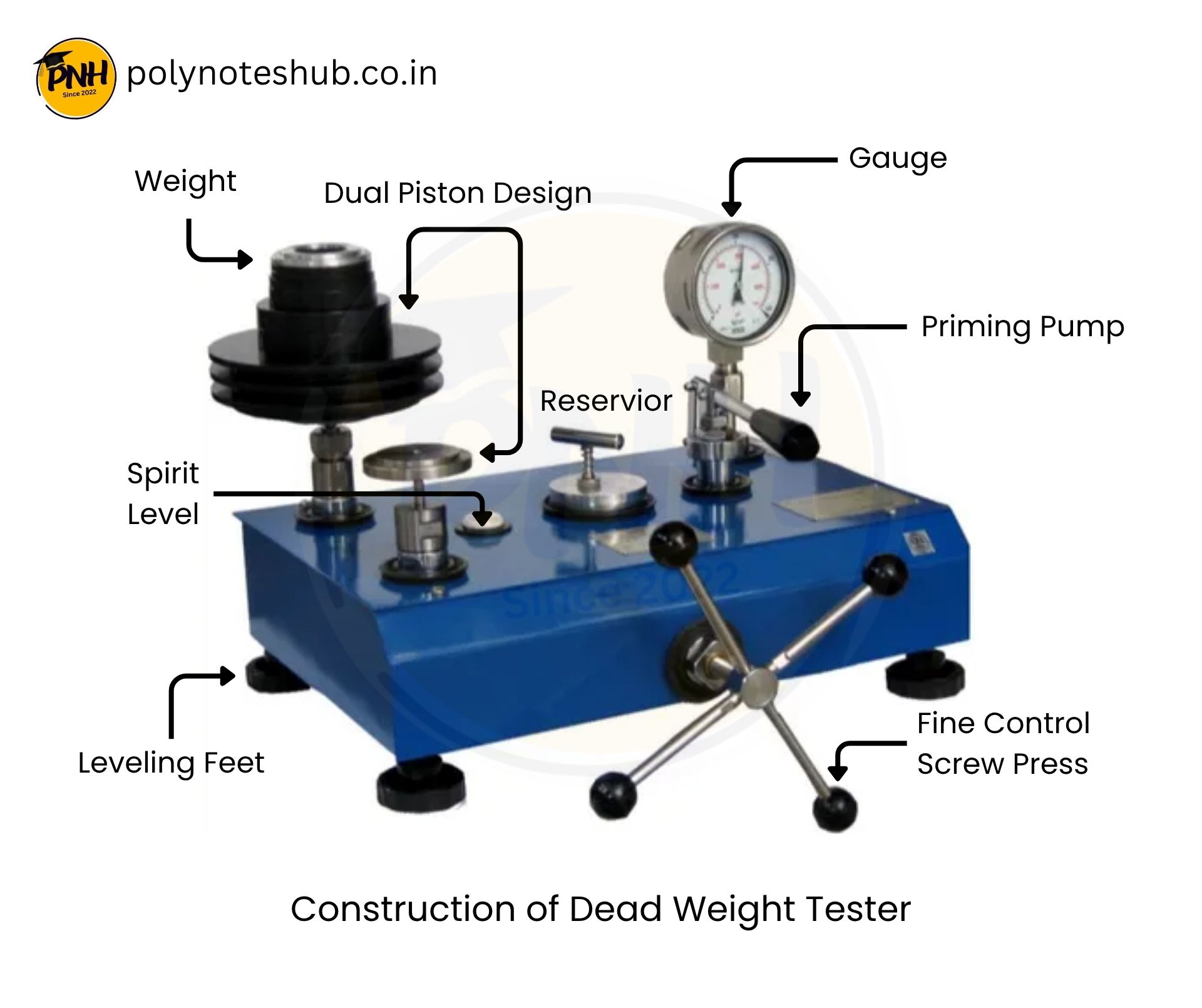
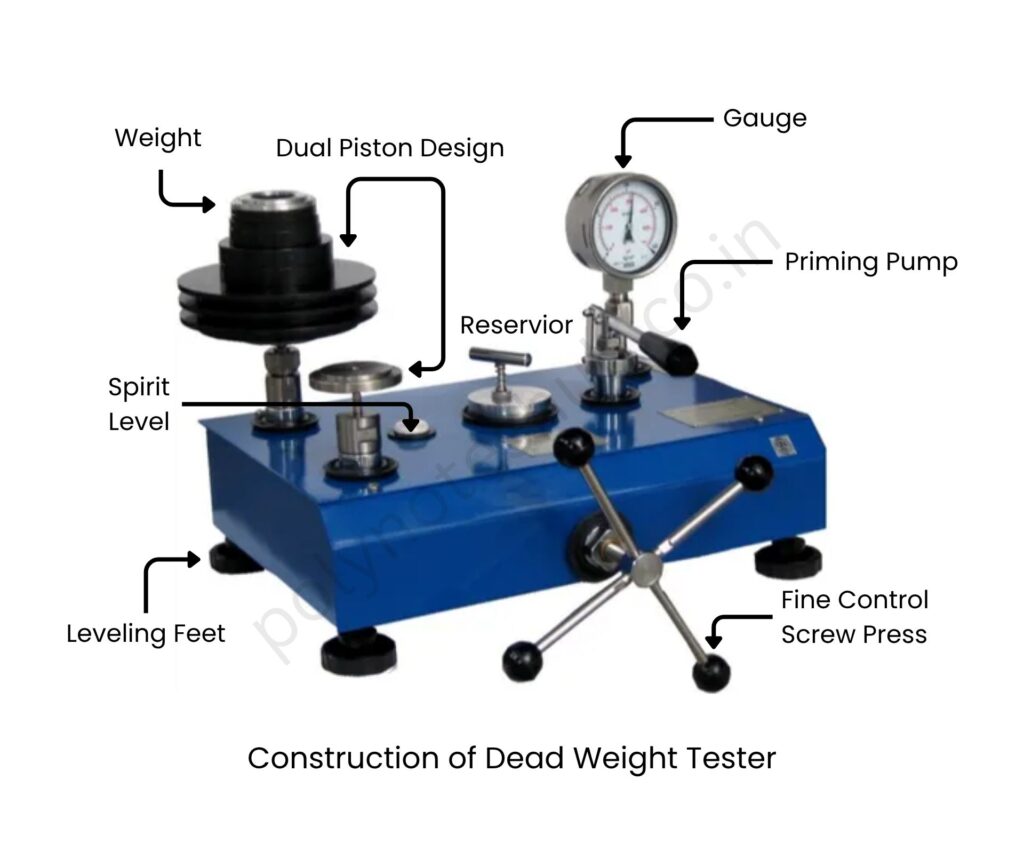
Construction of Dead Weight Tester

A Dead Weight Tester is a precise tool used to calibrate pressure gauges and measuring instruments. The structure is made up of numerous key components that are mounted on a sturdy foundation to generate and measure precise pressure.
dead weight tester working principle with construction - poly notes hub
  • Standard Weights: Calibrated weights are put on the piston platform to produce a predetermined force. These weights are made with exceptional accuracy, resulting in accurate pressure.
  • Dual Piston Design: The tester has a precise piston-cylinder layout. When weights are applied, the piston moves within the oil-filled cylinder, generating pressure. The dual piston design improves the stability and accuracy of pressure generation.
  • Reservoir: The reservoir holds hydraulic oil, the pressure-transmitting medium. When pressure is delivered through the pump, oil distributes the pressure evenly to the piston and the equipment under test.
  • Pressure Gauge (Device Under Test): The pressure gauge or transmitter that requires calibration is attached to the connecting port. The reading from this gauge is compared to the standard pressure generated by the tester.
  • Priming Pump: This pump is used to fill the system with oil and eliminate any air bubbles. Proper priming promotes a smooth and accurate pressure transmission.
  • Fine Control Screw Press: A hand-operated screw press is used to gently raise or regulate the pressure. It aids in achieving precise pressure balance, allowing the piston to float freely.
  • Spirit Level: It maintains the instrument in a perfect horizontal position. Proper leveling is required to ensure accurate pressure measurement and eliminate piston friction problems.
  • Levelling Feet: Adjustable leveling feet are provided at the base to keep the instrument steady and aligned on the working area.
See also  Fissile Materials - Characteristics, Examples, Uses | New Topic [2024]

Dead Weight Tester Working Principle

  • The pressure gauge or device to be calibrated is first connected to the tester.
  • The system is filled with hydraulic oil using the priming pump to remove air bubbles.
  • Standard calibrated weights are placed on the piston platform.
  • Pressure is gradually generated by operating the screw press or hand pump.
  • As pressure increases, the piston starts rising and rotates freely (floating condition).
  • At this floating condition, the pressure produced by the oil becomes equal to the pressure due to the applied weights.
  • The reading shown by the pressure gauge is noted and compared with the standard pressure value.
  • The difference between the observed reading and the standard pressure gives the calibration error.

Calibration Using Dead Weight Tester

Calibration with a Dead Weight Tester is the process of comparing the reading of a pressure measuring equipment (such as a pressure gauge or transmitter) to a known standard pressure produced by placing calibrated weights on a piston with a specified area.

The calibration is based on the pressure relation:P=WAP = \frac{W}{A}where

  • PP = Applied standard pressure
  • WW = Total weight applied (including piston weight)
  • AA = Effective area of the piston

Thus, by applying known weights, an accurate standard pressure is produced for calibration.

Calibration Procedure (Step-by-Step)

  1. The pressure gauge or device under test is connected to the Dead Weight Tester at the connection port.
  2. The reservoir is filled with clean hydraulic oil and the system is primed to remove air bubbles.
  3. The instrument is properly leveled using leveling screws and the spirit level.
  4. Required standard weights are placed on the piston platform according to the pressure value to be generated.
  5. Pressure is gradually applied using the screw pump or hand pump.
  6. When the piston floats freely and rotates, pressure balance is achieved. This indicates that the generated pressure is equal to the standard pressure due to the weights.
  7. The reading shown by the pressure gauge is noted and compared with the calculated standard pressure.
  8. The difference between the two readings gives the error, and necessary adjustment or correction is made.
  9. The same procedure is repeated for different pressure values (increasing and decreasing pressure) to complete the calibration.
See also  Basic Techniques in Capital Budgeting | New Topic [2024]

Result of Calibration

  • If the gauge reading matches the standard pressure → Instrument is accurate.
  • If there is deviation → Error is determined and calibration correction is applied.

Range and Accuracy of Dead Weight Tester

Pressure Range

  • Hydraulic Dead Weight Tester: Approximately 1 bar to 1000 bar (or higher in advanced models)
  • Pneumatic Dead Weight Tester: Approximately 0.01 bar to 40 bar

Accuracy

  • Typical accuracy is about ±0.015% to ±0.05% of reading
  • Laboratory standard testers may provide even higher accuracy.

Advantages of Dead Weight Tester

  • Very high accuracy (Primary pressure standard)
  • Simple and reliable working principle
  • Does not require electrical power
  • Suitable for calibration over a wide pressure range
  • Long service life and stable performance
  • Direct pressure generation using known standard weights

Disadvantages of Dead Weight Tester

  • Bulky and heavy instrument
  • Not suitable for very low pressure measurement
  • Requires proper leveling and clean hydraulic oil
  • Calibration process is time-consuming
  • Not convenient for portable or field applications

Share This Post

Leave a Reply

Your email address will not be published. Required fields are marked *

Dead Weight Tester Diagram: Working Principle, Calibration, Advantages, Disadvantages | New Topic - Poly Notes Hub

Our Notes Categories

Dead Weight Tester Diagram: Working Principle, Calibration, Advantages, Disadvantages | New Topic - Poly Notes Hub

Our Notes Categories


Dead Weight Tester Diagram: Working Principle, Calibration, Advantages, Disadvantages | New Topic - Poly Notes Hub
1st Year 1st SEM Notes ✭ 1st Year 2nd SEM Notes ✭ EE 2nd & 3rd Year Notes ✭ EEE 2nd & 3rd Year Notes ✭ ETCE 2nd & 3rd Year Notes ✭ EIE 2nd & 3rd Year Notes ✭ 1st Year 1st SEM Notes ✭ 1st Year 2nd SEM Notes ✭ EE 2nd & 3rd Year Notes ✭ EEE 2nd & 3rd Year Notes ✭ ETCE 2nd & 3rd Year Notes ✭ EIE 2nd & 3rd Year Notes ✭ 1st Year 1st SEM Notes ✭ 1st Year 2nd SEM Notes ✭ EE 2nd & 3rd Year Notes ✭ EEE 2nd & 3rd Year Notes ✭ ETCE 2nd & 3rd Year Notes ✭ EIE 2nd & 3rd Year Notes ✭ 1st Year 1st SEM Notes ✭ 1st Year 2nd SEM Notes ✭ EE 2nd & 3rd Year Notes ✭ EEE 2nd & 3rd Year Notes ✭ ETCE 2nd & 3rd Year Notes ✭ EIE 2nd & 3rd Year Notes ✭ 1st Year 1st SEM Notes ✭ 1st Year 2nd SEM Notes ✭ EE 2nd & 3rd Year Notes ✭ EEE 2nd & 3rd Year Notes ✭ ETCE 2nd & 3rd Year Notes ✭ EIE 2nd & 3rd Year Notes ✭ 1st Year 1st SEM Notes ✭ 1st Year 2nd SEM Notes ✭ EE 2nd & 3rd Year Notes ✭ EEE 2nd & 3rd Year Notes ✭ ETCE 2nd & 3rd Year Notes ✭ EIE 2nd & 3rd Year Notes ✭ 1st Year 1st SEM Notes ✭ 1st Year 2nd SEM Notes ✭ EE 2nd & 3rd Year Notes ✭ EEE 2nd & 3rd Year Notes ✭ ETCE 2nd & 3rd Year Notes ✭ EIE 2nd & 3rd Year Notes ✭ 1st Year 1st SEM Notes ✭ 1st Year 2nd SEM Notes ✭ EE 2nd & 3rd Year Notes ✭ EEE 2nd & 3rd Year Notes ✭ ETCE 2nd & 3rd Year Notes ✭ EIE 2nd & 3rd Year Notes ✭ 1st Year 1st SEM Notes ✭ 1st Year 2nd SEM Notes ✭ EE 2nd & 3rd Year Notes ✭ EEE 2nd & 3rd Year Notes ✭ ETCE 2nd & 3rd Year Notes ✭ EIE 2nd & 3rd Year Notes ✭ 1st Year 1st SEM Notes ✭ 1st Year 2nd SEM Notes ✭ EE 2nd & 3rd Year Notes ✭ EEE 2nd & 3rd Year Notes ✭ ETCE 2nd & 3rd Year Notes ✭ EIE 2nd & 3rd Year Notes ✭ 1st Year 1st SEM Notes ✭ 1st Year 2nd SEM Notes ✭ EE 2nd & 3rd Year Notes ✭ EEE 2nd & 3rd Year Notes ✭ ETCE 2nd & 3rd Year Notes ✭ EIE 2nd & 3rd Year Notes ✭ 1st Year 1st SEM Notes ✭ 1st Year 2nd SEM Notes ✭ EE 2nd & 3rd Year Notes ✭ EEE 2nd & 3rd Year Notes ✭ ETCE 2nd & 3rd Year Notes ✭ EIE 2nd & 3rd Year Notes ✭ 1st Year 1st SEM Notes ✭ 1st Year 2nd SEM Notes ✭ EE 2nd & 3rd Year Notes ✭ EEE 2nd & 3rd Year Notes ✭ ETCE 2nd & 3rd Year Notes ✭ EIE 2nd & 3rd Year Notes ✭ 1st Year 1st SEM Notes ✭ 1st Year 2nd SEM Notes ✭ EE 2nd & 3rd Year Notes ✭ EEE 2nd & 3rd Year Notes ✭ ETCE 2nd & 3rd Year Notes ✭ EIE 2nd & 3rd Year Notes ✭ 1st Year 1st SEM Notes ✭ 1st Year 2nd SEM Notes ✭ EE 2nd & 3rd Year Notes ✭ EEE 2nd & 3rd Year Notes ✭ ETCE 2nd & 3rd Year Notes ✭ EIE 2nd & 3rd Year Notes ✭ 1st Year 1st SEM Notes ✭ 1st Year 2nd SEM Notes ✭ EE 2nd & 3rd Year Notes ✭ EEE 2nd & 3rd Year Notes ✭ ETCE 2nd & 3rd Year Notes ✭ EIE 2nd & 3rd Year Notes ✭ 1st Year 1st SEM Notes ✭ 1st Year 2nd SEM Notes ✭ EE 2nd & 3rd Year Notes ✭ EEE 2nd & 3rd Year Notes ✭ ETCE 2nd & 3rd Year Notes ✭ EIE 2nd & 3rd Year Notes ✭ 1st Year 1st SEM Notes ✭ 1st Year 2nd SEM Notes ✭ EE 2nd & 3rd Year Notes ✭ EEE 2nd & 3rd Year Notes ✭ ETCE 2nd & 3rd Year Notes ✭ EIE 2nd & 3rd Year Notes ✭ 1st Year 1st SEM Notes ✭ 1st Year 2nd SEM Notes ✭ EE 2nd & 3rd Year Notes ✭ EEE 2nd & 3rd Year Notes ✭ ETCE 2nd & 3rd Year Notes ✭ EIE 2nd & 3rd Year Notes ✭ 1st Year 1st SEM Notes ✭ 1st Year 2nd SEM Notes ✭ EE 2nd & 3rd Year Notes ✭ EEE 2nd & 3rd Year Notes ✭ ETCE 2nd & 3rd Year Notes ✭ EIE 2nd & 3rd Year Notes ✭ 1st Year 1st SEM Notes ✭ 1st Year 2nd SEM Notes ✭ EE 2nd & 3rd Year Notes ✭ EEE 2nd & 3rd Year Notes ✭ ETCE 2nd & 3rd Year Notes ✭ EIE 2nd & 3rd Year Notes ✭ 1st Year 1st SEM Notes ✭ 1st Year 2nd SEM Notes ✭ EE 2nd & 3rd Year Notes ✭ EEE 2nd & 3rd Year Notes ✭ ETCE 2nd & 3rd Year Notes ✭ EIE 2nd & 3rd Year Notes ✭ 1st Year 1st SEM Notes ✭ 1st Year 2nd SEM Notes ✭ EE 2nd & 3rd Year Notes ✭ EEE 2nd & 3rd Year Notes ✭ ETCE 2nd & 3rd Year Notes ✭ EIE 2nd & 3rd Year Notes ✭ 1st Year 1st SEM Notes ✭ 1st Year 2nd SEM Notes ✭ EE 2nd & 3rd Year Notes ✭ EEE 2nd & 3rd Year Notes ✭ ETCE 2nd & 3rd Year Notes ✭ EIE 2nd & 3rd Year Notes ✭ 1st Year 1st SEM Notes ✭ 1st Year 2nd SEM Notes ✭ EE 2nd & 3rd Year Notes ✭ EEE 2nd & 3rd Year Notes ✭ ETCE 2nd & 3rd Year Notes ✭ EIE 2nd & 3rd Year Notes ✭ 1st Year 1st SEM Notes ✭ 1st Year 2nd SEM Notes ✭ EE 2nd & 3rd Year Notes ✭ EEE 2nd & 3rd Year Notes ✭ ETCE 2nd & 3rd Year Notes ✭ EIE 2nd & 3rd Year Notes ✭ 1st Year 1st SEM Notes ✭ 1st Year 2nd SEM Notes ✭ EE 2nd & 3rd Year Notes ✭ EEE 2nd & 3rd Year Notes ✭ ETCE 2nd & 3rd Year Notes ✭ EIE 2nd & 3rd Year Notes ✭ 1st Year 1st SEM Notes ✭ 1st Year 2nd SEM Notes ✭ EE 2nd & 3rd Year Notes ✭ EEE 2nd & 3rd Year Notes ✭ ETCE 2nd & 3rd Year Notes ✭ EIE 2nd & 3rd Year Notes

Our Notes Categories

Our Notes Categories