
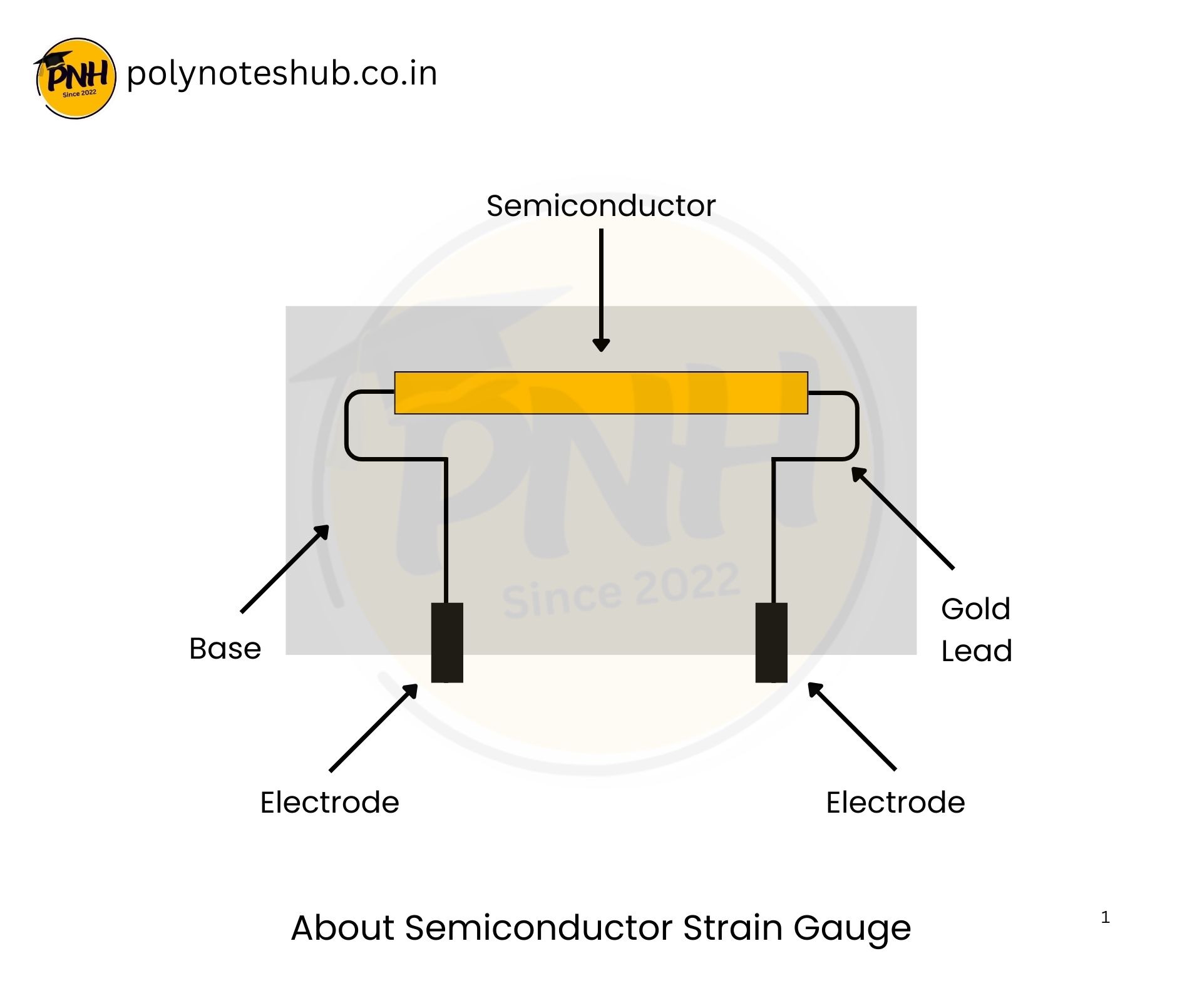
In this note, we are going to learn about the Semiconductor Strain Gauge, its diagram, advantages, disadvantages, and applications. Welcome to Poly Notes Hub, a leading destination for polytechnic engineering notes.
Author Name: Arun Paul.
What is Semiconductor Strain Gauge?
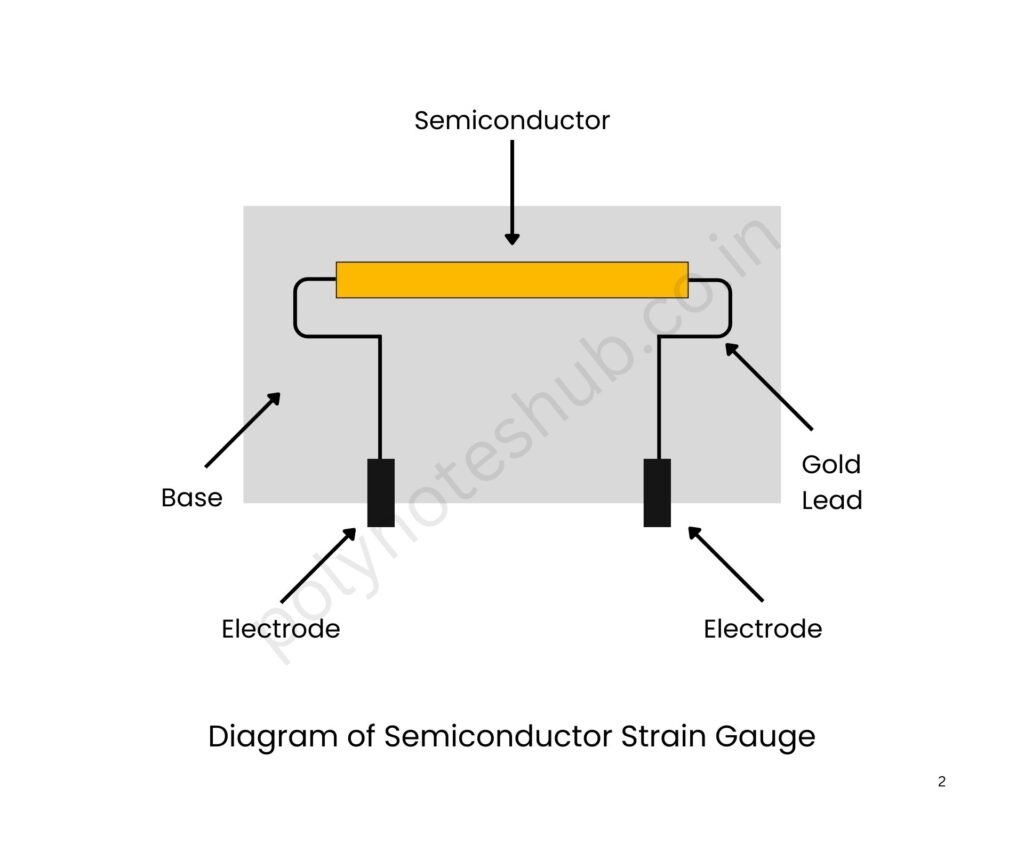
A semiconductor strain gauge is a strain gauge constructed from semiconductor materials such as silicon or germanium. It detects strain via the piezoresistive effect, which occurs when mechanical stress or strain causes a significant change in the electrical resistance of a semiconductor.
When a semiconductor material is stretched or compressed, its resistance changes dramatically, and this difference is used to calculate the amount of strain. Semiconductor strain gauges have much higher sensitivity than metallic strain gauges.
Diagram of a Semiconductor Strain Gauge
Semiconductor Strain Gauge Working Principle
The semiconductor strain gauge is based on the piezoresistive effect. When mechanical strain (tension or compression) is applied to a semiconductor material such as silicon or germanium, the material’s electrical resistance varies dramatically. The change in resistance is proportional to the strain applied.
Semiconductor strain gauges have a very high gauge factor (about 50-200), making them far more sensitive than metallic strain gauges.
Advantages of Semiconductor Strain Gauge
- High Sensitivity: They have a very high gauge factor (50–200), making them much more sensitive than metal strain gauges.
- Small Size: They are very compact, which allows them to be used in small instruments and devices.
- Good Frequency Response: They can measure rapid changes in strain.
- Suitable for Micro Measurements: Useful for detecting very small strains.
Disadvantages of Semiconductor Strain Gauges
- High Temperature Sensitivity: Their resistance changes significantly with temperature, which can cause measurement errors.
- Fragile Material: Semiconductor materials are brittle and easily damaged.
- Higher Cost: They are generally more expensive than metallic strain gauges.
- Complex Circuit Requirements: They often require temperature compensation circuits.
Applications of Semiconductor Strain Gauges
- Load Cells: Used to measure force and weight in weighing systems.
- Pressure Sensors: Used in pressure transducers.
- Accelerometers: Used to measure acceleration and vibration.
- Microelectromechanical Systems (MEMS): Used in miniature sensing devices.
- Aerospace and Automotive Industries: Used for stress and structural analysis.