
In this note, we are going to learn about a topic called What is Load Cell? and also learn about its Diagram, Working Principle, Types, and Applications as well. Welcome to Poly Notes Hub, a leading destination for polytechnic engineering notes.
Author Name: Arun Paul.
What is Load Cell?
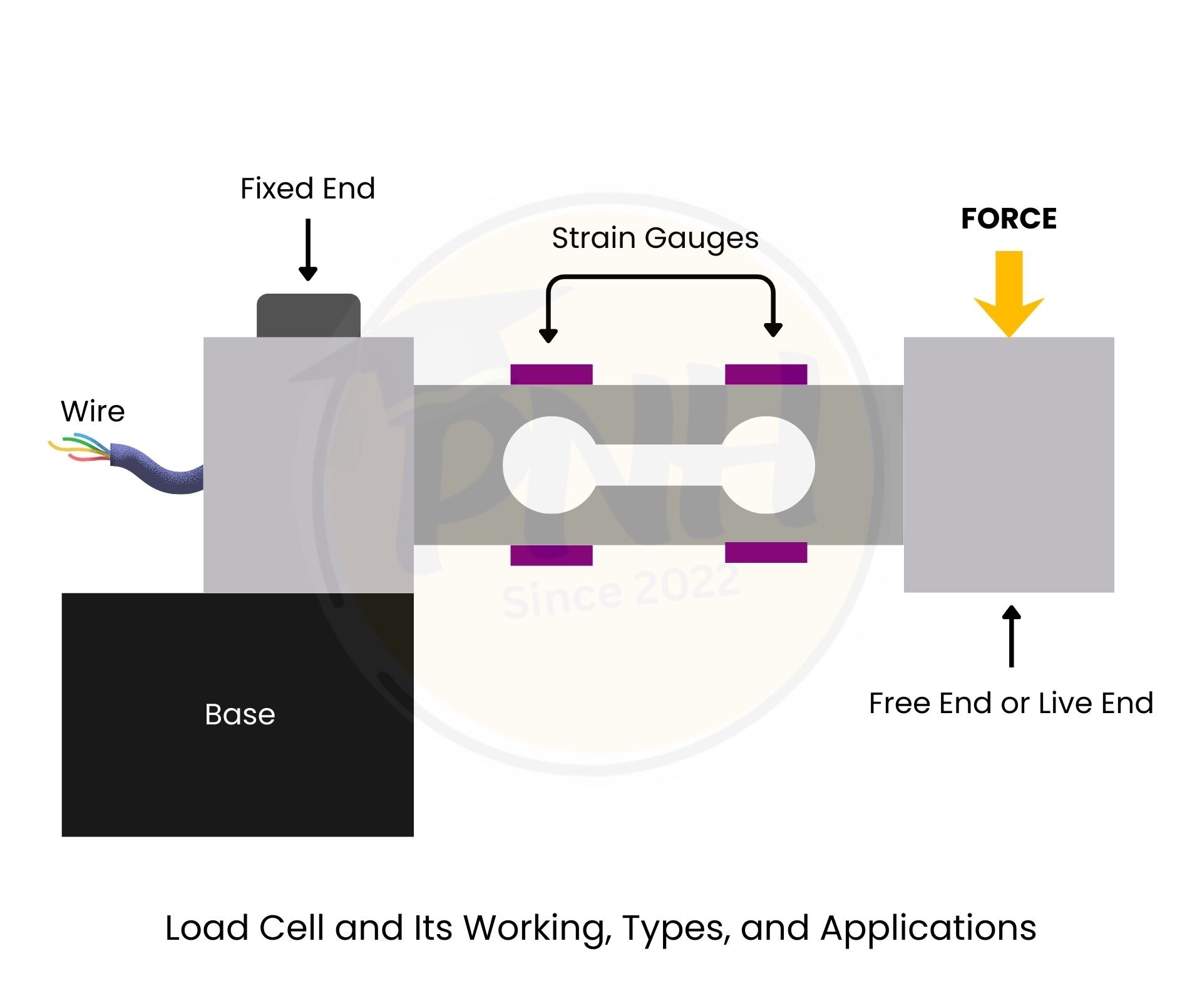
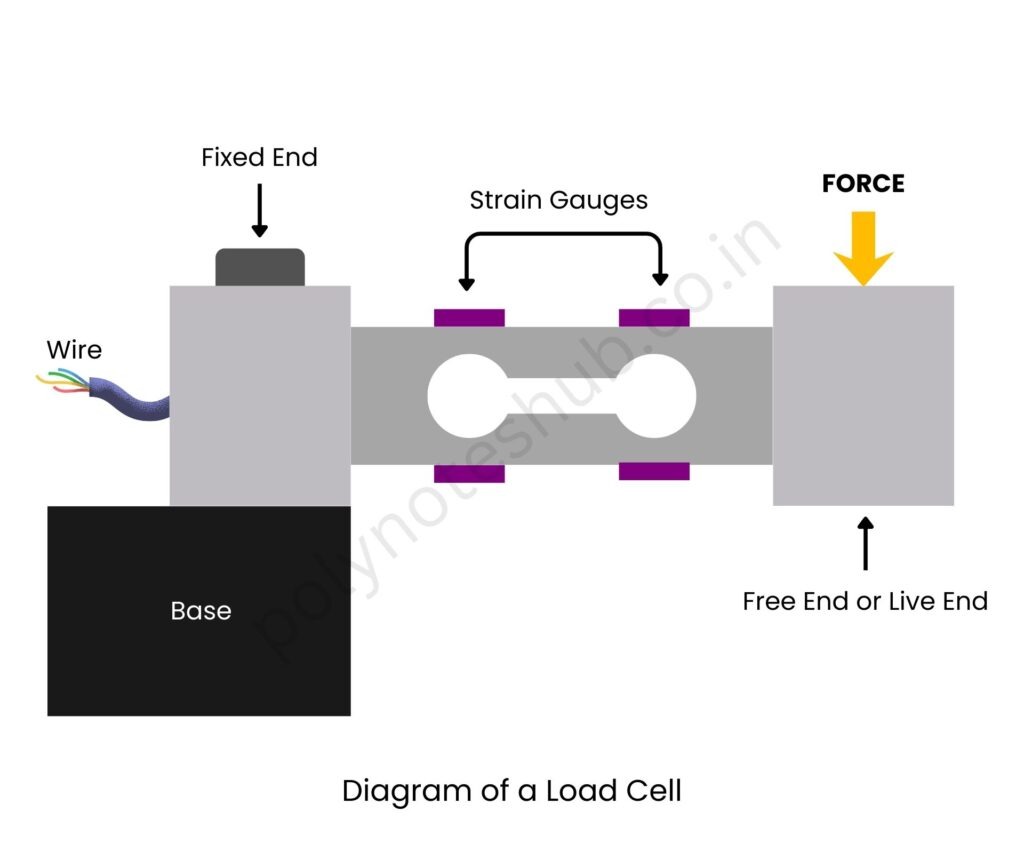
A load cell is a transducer that uses mechanical force or weight to generate an electrical signal. It is commonly employed in weighing and force measurement devices. Most load cells use strain gauges to measure deformation when a load is applied.
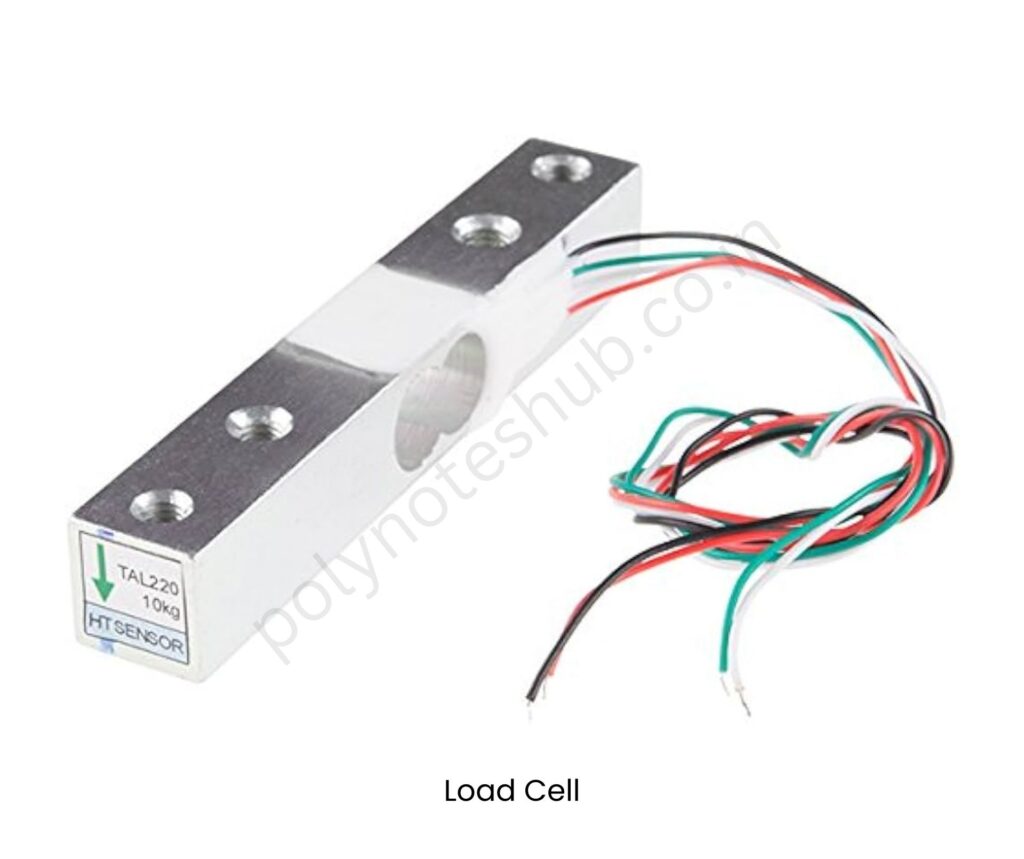
Diagram of a Load Cell
Working Principle of Load Cell
The working of a load cell is based on the strain gauge principle.
- Application of Load: When a force or weight is applied to the load cell, the elastic element inside the load cell deforms slightly.
- Strain Gauge Deformation: Strain gauges attached to the elastic element stretch or compress along with the material.
- Change in Resistance: The deformation causes a change in electrical resistance of the strain gauges.
- Wheatstone Bridge Circuit: The strain gauges are connected in a Wheatstone bridge circuit, which converts the resistance change into a voltage signal.
- Output Signal: The output voltage is proportional to the applied load, and it is displayed on a measuring device or digital indicator.
Types of Load Cells
Load cells are classified based on their structure and working principle.
- Hydraulic Load Cell: Uses liquid pressure to measure load. The applied force increases the pressure of a liquid inside the cell.
- Pneumatic Load Cell: Measures load using air pressure. It balances the load by regulating compressed air pressure.
- Strain Gauge Load Cell: The most common type. It uses strain gauges to detect deformation when load is applied.
- Column Type Load Cell: Designed like a cylindrical column and mainly used for heavy loads.
- Shear Beam Load Cell: Measures load using shear stress in the beam when force is applied.
Applications of Load Cell
Load cells are widely used in different industries.
- Used in digital weighing scales and platform scales.
- Used to measure weight of materials in tanks and silos.
- Used for measuring material flow on conveyor belts.
- Used for measuring tensile and compressive forces.
- Used in vehicle testing and force measurement systems.
- Used for accurate product weighing and automatic filling.