
In this note, we are going to learn about the Difference Between Metal and Semiconductor Strain Gauges. Welcome to Poly Notes Hub, a leading destination for polytechnic engineering notes.
Author Name: Arun Paul.
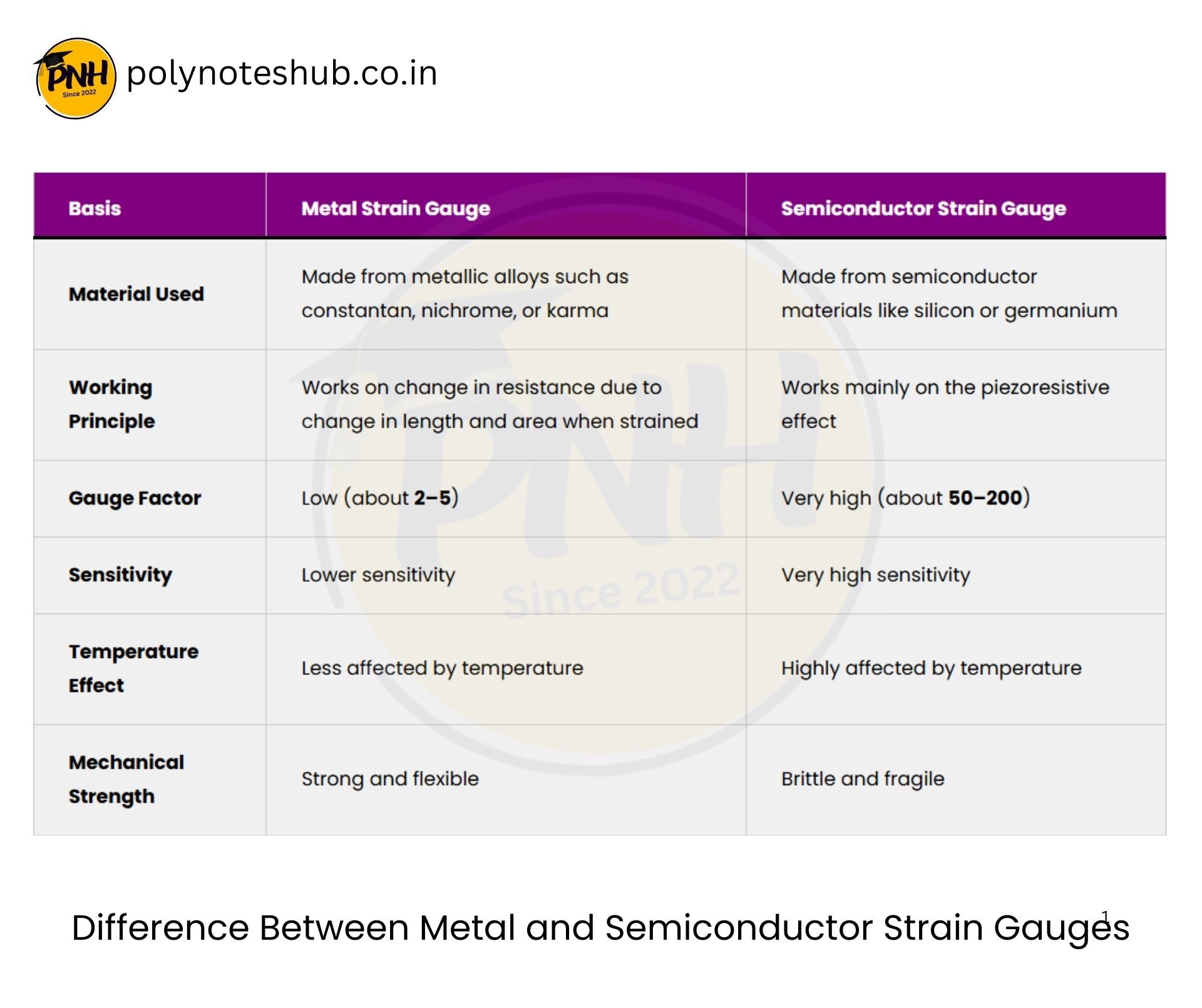
Difference Between Metal and Semiconductor Strain Gauges
| Basis | Metal Strain Gauge | Semiconductor Strain Gauge |
|---|---|---|
| Material Used | Made from metallic alloys such as constantan, nichrome, or karma | Made from semiconductor materials like silicon or germanium |
| Working Principle | Works on change in resistance due to change in length and area when strained | Works mainly on the piezoresistive effect |
| Gauge Factor | Low (about 2–5) | Very high (about 50–200) |
| Sensitivity | Lower sensitivity | Very high sensitivity |
| Temperature Effect | Less affected by temperature | Highly affected by temperature |
| Mechanical Strength | Strong and flexible | Brittle and fragile |
| Cost | Less expensive | More expensive |
| Applications | Used in general strain measurement, load cells, stress analysis | Used in high-precision sensors, pressure sensors, MEMS devices |