
In this note, we are going to learn about Boolean Algebra Laws and Rules in Digital Electronics. Welcome to Poly Notes Hub, a leading destination for diploma or polytechnic engineering notes.
Author Name: Arun Paul.
Introduction
Boolean algebra is an area of mathematics that analyzes and simplifies digital (logic) circuits. It handles binary numbers 0 and 1 and defines rules for processing logical expressions.
These laws contribute to simplifying complex logic circuits. If you want to download this note PDF, then click on Printer Icon Below.
Basic Boolean Operators
| Symbol | Meaning | Type |
|---|---|---|
| · | AND | Boolean AND Operator |
| + | OR | Boolean OR Operator |
| ‘ | NOT | Boolean NOT Operator |
Different Types of Boolean Algebra Laws and Rules in Digital Electronics
There are 11 types of Boolean Algebra Laws, those are –
- Commutative Laws
- Associative Laws
- Distributive Laws
- Identity Laws
- Null / Dominance Laws
- Idempotent Laws
- Complement Laws
- Involution Law
- Absorption Laws
- Consensus Theorem
- De Morgan’s Theorem
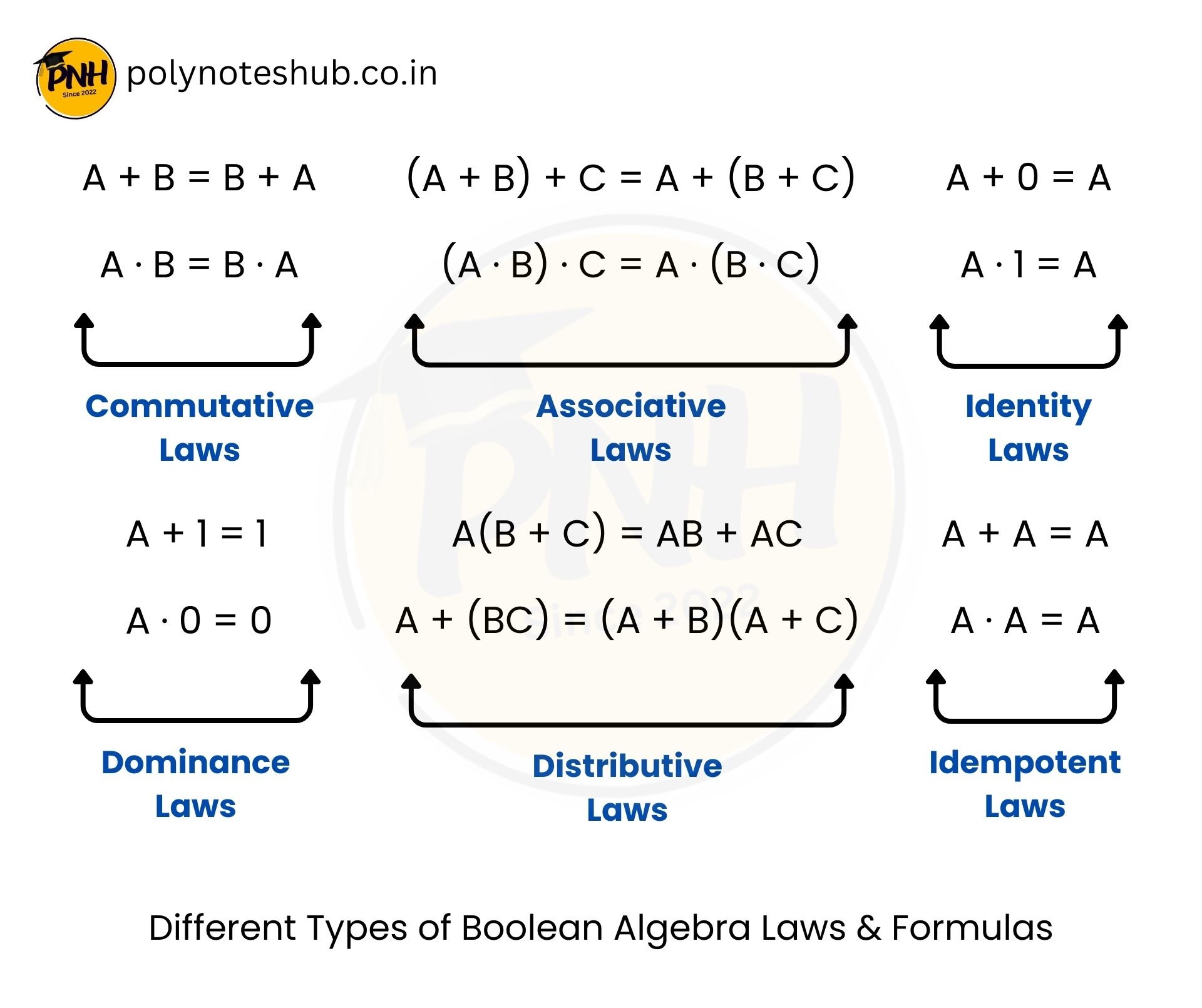
Formulas of Different Laws of Boolean Algebra
Here we have listed all the expressions or formulas of Boolean Algebra of Digital Electronics –
| Category | Law / Formula | Expression |
|---|---|---|
| Commutative Laws | OR Commutative | A + B = B + A |
| AND Commutative | A · B = B · A | |
| Associative Laws | OR Associative | (A + B) + C = A + (B + C) |
| AND Associative | (A · B) · C = A · (B · C) | |
| Distributive Laws | AND over OR | A(B + C) = AB + AC |
| OR over AND | A + (BC) = (A + B)(A + C) | |
| Identity Laws | OR Identity | A + 0 = A |
| AND Identity | A · 1 = A | |
| Null / Dominance Laws | OR Null | A + 1 = 1 |
| AND Null | A · 0 = 0 | |
| Idempotent Laws | OR Idempotent | A + A = A |
| AND Idempotent | A · A = A | |
| Complement Laws | OR Complement | A + A’ = 1 |
| AND Complement | A · A’ = 0 | |
| Involution Law | Double Complement | (A’)’ = A |
| Absorption Laws | Absorption 1 | A + AB = A |
| Absorption 2 | A(A + B) = A | |
| Consensus Theorem | Consensus 1 | AB + A’C + BC = AB + A’C |
| Consensus 2 | (A + B)(A’ + C)(B + C) = (A + B)(A’ + C) | |
| De Morgan’s Theorem | First Theorem | (A · B)’ = A’ + B’ |
| Second Theorem | (A + B)’ = A’ · B’ | |
| Useful Simplification Rules | Rule 1 | A + A’B = A + B |
| Rule 2 | A’ + AB = A’ + B | |
| Rule 3 | A + AB = A | |
| Rule 4 | A(A + B) = A | |
| Rule 5 | (A + B)(A + B’) = A |