
In this note, we are going to learn about the difference between foster seeley and ratio detector or foster seeley vs ratio detector. Welcome to Poly Notes Hub, a leading destination for engineering notes for diploma and degree engineering students.
Author Name: Arun Paul.
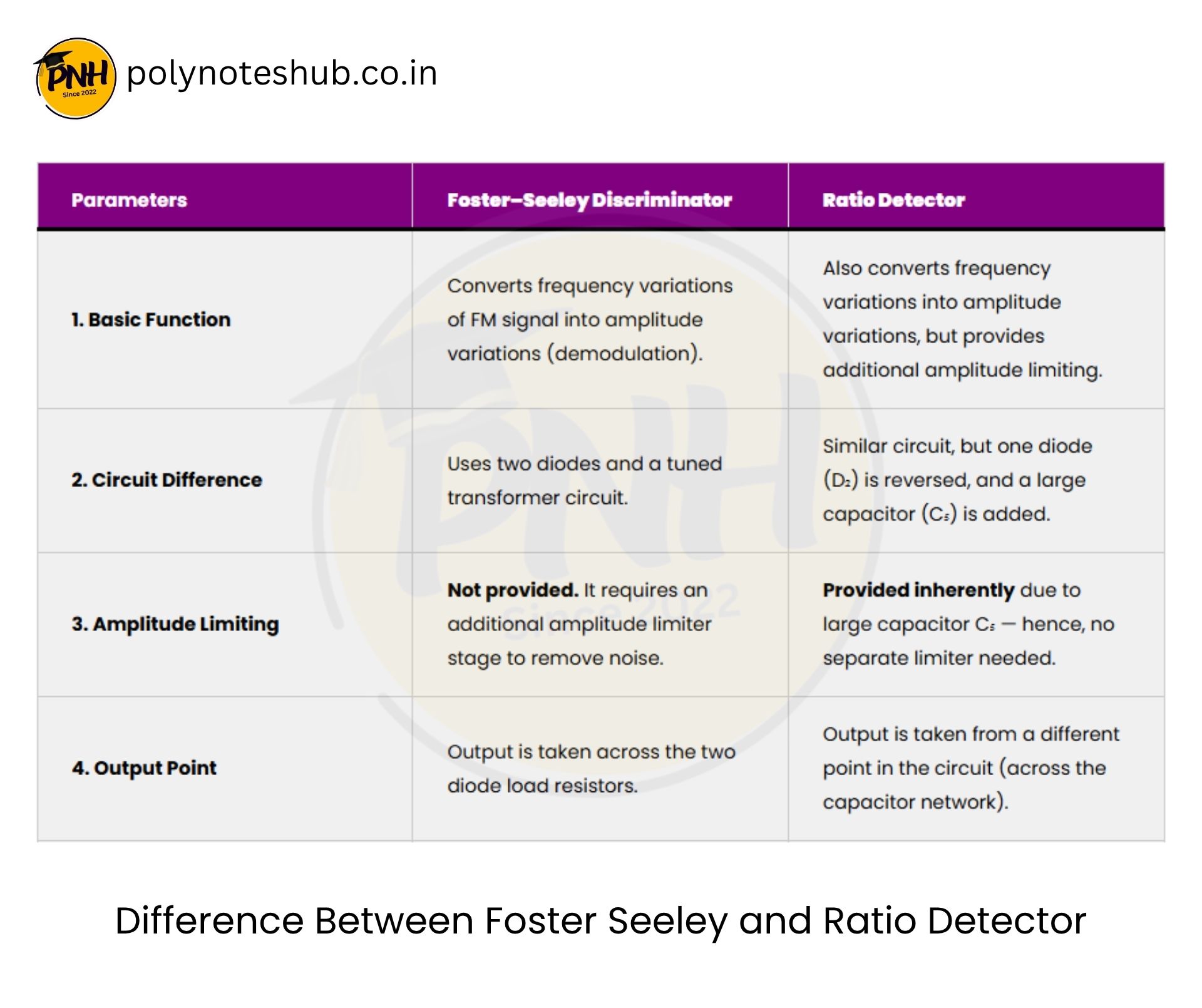
Difference Between Foster Seeley and Ratio Detector
Here we have listed some differences between the Foster Seeley discriminator or phase discriminator and the ratio detector circuit –
Before going through the difference table, if you want to learn about the Foster Seeley Discriminator and Ratio Detector then click on the links below –
- Ratio Detector for FM Demodulation and Its Circuit Diagram
- Explanation of Foster Seeley Discriminator with Circuit Diagram
Fooster Seeley Discriminator Vs Ratio Detector
| Parameters | Foster–Seeley Discriminator | Ratio Detector |
|---|---|---|
| 1. Basic Function | Converts frequency variations of FM signal into amplitude variations (demodulation). | Also converts frequency variations into amplitude variations, but provides additional amplitude limiting. |
| 2. Circuit Difference | Uses two diodes and a tuned transformer circuit. | Similar circuit, but one diode (D₂) is reversed, and a large capacitor (C₅) is added. |
| 3. Amplitude Limiting | Not provided. It requires an additional amplitude limiter stage to remove noise. | Provided inherently due to large capacitor C₅ — hence, no separate limiter needed. |
| 4. Output Point | Output is taken across the two diode load resistors. | Output is taken from a different point in the circuit (across the capacitor network). |
| 5. Sensitivity to Amplitude Variations | Sensitive to amplitude variations — noise or interference can affect output. | Less sensitive to amplitude variations — built-in amplitude limiting reduces noise. |
| 6. Linearity | Linearity is good but can be affected by amplitude changes. | Provides better linearity because amplitude variations are suppressed. |
| 7. Complexity | Slightly simpler circuit. | Slightly more complex due to added capacitor and altered diode direction. |
| 8. Use of Large Capacitor | No large capacitor used for amplitude limiting. | Includes a large capacitor (C₅) for amplitude limiting action. |
| 9. Output Voltage Relation | Output voltage is proportional to the difference of diode voltages. | Output voltage is proportional to the ratio of diode voltages (hence the name “ratio detector”). |
| 10. Noise Immunity | Poor noise immunity. | Better noise immunity due to amplitude limiting. |