
In this note, we are going to learn about the Envelope Detector for Demodulation of AM Signal – Introduction, Circuit Diagram, and Operation as well. Welcome to Poly Notes Hub, a leading destination for diploma and degree engineering notes for polytechnic and degree engineering students.
Author Name: Arun Paul.
Introduction
Amplitude Modulation (AM) is a technique that changes the amplitude of a high-frequency carrier signal in response to the instantaneous amplitude of the message (or modulating) signal. At the receiving end, the original message signal must be extracted from the modified carrier. This procedure is known as demodulation or detection. The envelope detector is a simple and frequently used method for AM demodulation.
What is Envelope Detector Circuit for Demodulation of an AM Signal?
An envelope detector is a circuit that extracts the envelope (outline) of an AM signal and compares it to the original message signal. The envelope detector is an important and useful tool for demodulating conventional AM signals. By rectifying the signal and tracking the envelope with an RC network, it efficiently recovers the original message signal with minimum equipment.
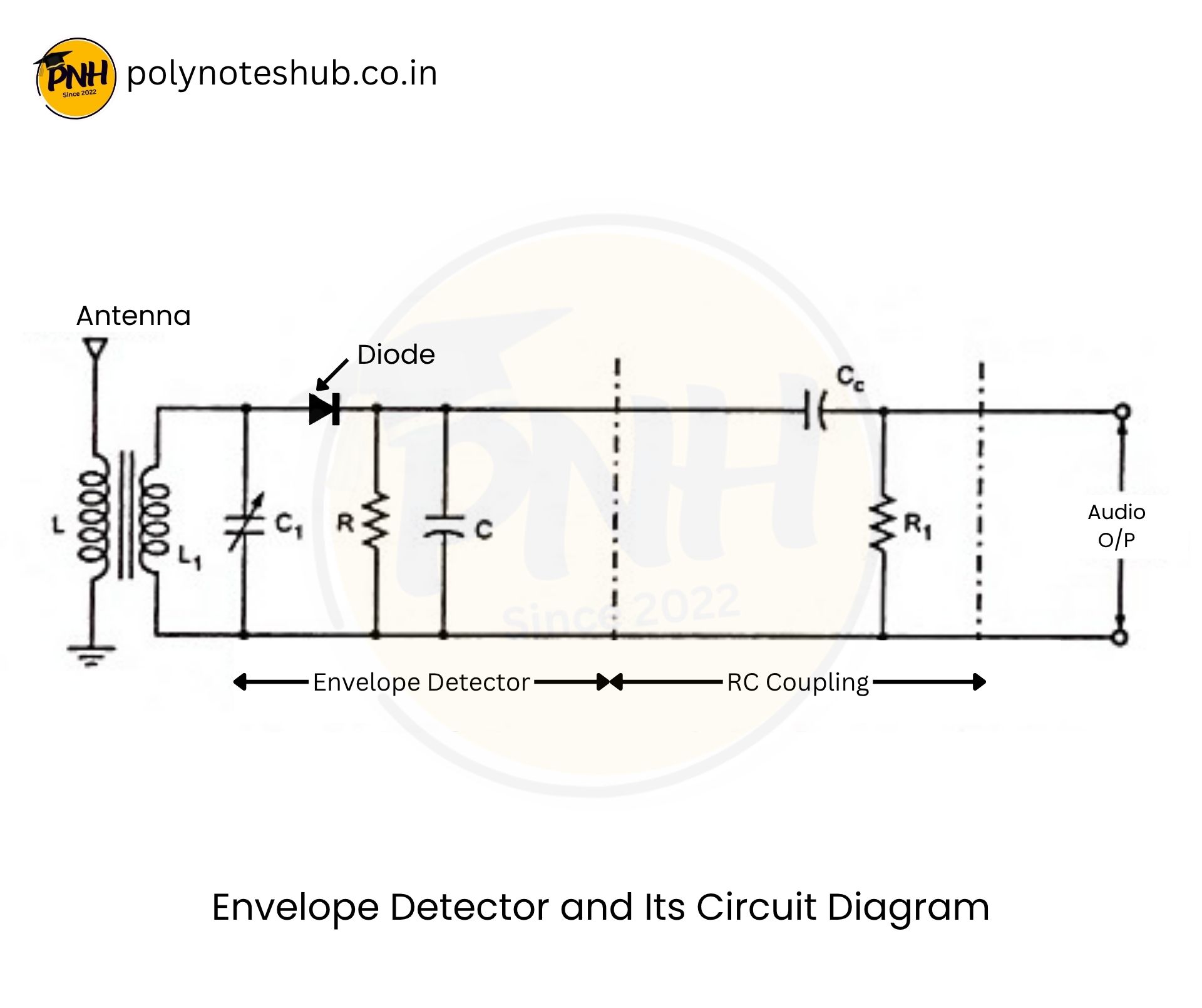
Circuit Diagram of Envelope Detector
It includes of three major components:
- Diode – It rectifies an incoming AM signal, allowing just one half of the waveform to pass.
- Capacitor – It charges to the signal’s peak voltage and maintains it over the interval between peaks.
- Resistor – It provides a path for the capacitor to discharge gradually, smoothing the waveform.

Working Principle of Envelope Detector for Demodulation of Am Signal
Here we are writing how does an envelope detector works –
- The incoming AM signal is sent to the diode. The diode conducts during the carrier’s positive half-cycles, resulting in a rectified waveform.
- The capacitor quickly charges to the peak voltage of each positive half-cycle. When the input voltage falls below the capacitor voltage, the diode becomes reverse-biased, allowing the capacitor to slowly discharge through the resistor.
- The capacitor’s charging and discharging allow it to track the changes in the envelope of the AM wave while filtering out the high-frequency carrier.
- The voltage across the capacitor and resistor represents the original modulating signal, which can be amplified or applied directly.
Some important points on the envelope detector
- The RC time constant must be carefully selected: it should be tiny enough to follow the envelope while large enough to filter out the carrier.
- Envelope detectors are simple, inexpensive, and effective for conventional AM signals.
- This strategy is effective for large carrier AM broadcasts but is not appropriate for suppressed-carrier or single-sideband AM signals.