
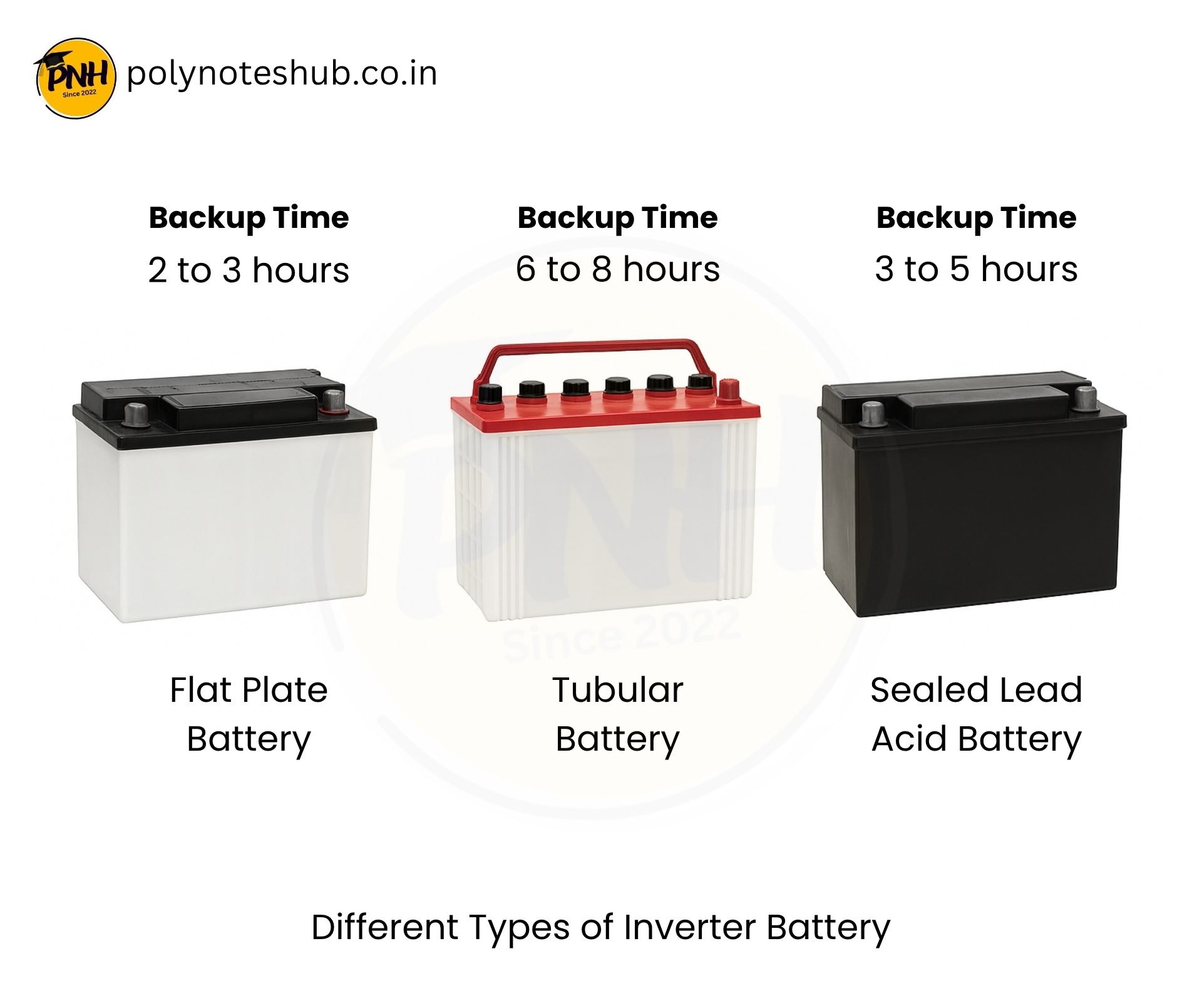
In this blog, we are going to learn about different types of inverter battery or batteries like, flat plat battery, tubular battery, and Maintenance-Free (SMF) Battery or Sealed Lead Acid Battery. Welcome to Poly Notes Hub, a leading destination for engineering notes for diploma and degree engineering students.
Author Name: Arun Paul.
What is an Inverter Battery?
An inverter battery stores electrical energy in the form of chemical energy and converts it back into electricity after a power outage. It is specifically designed for deep discharge cycles, allowing it to offer a stable power source for extended periods.
The sort of battery you employ has a significant impact on your inverter‘s efficiency and lifespan.
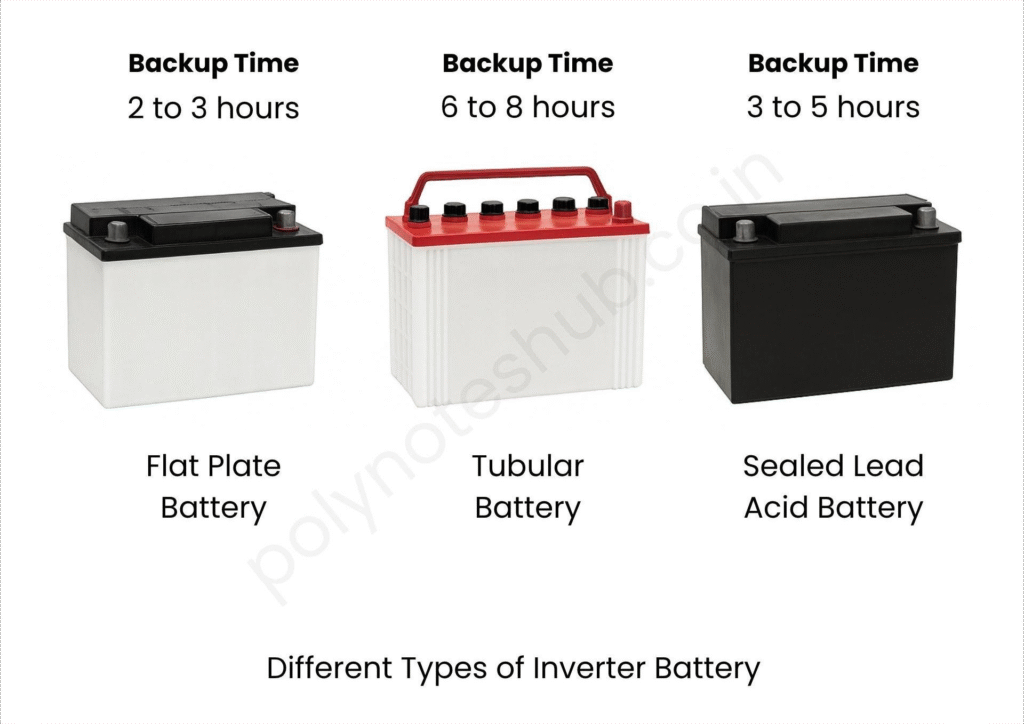
Different Types of Inverter Battery
There are mainly three different types of inverter battery commonly used in homes and offices –
1. Flat Plate Battery
Overview:
Flat plate batteries are the most common and affordable type of inverter batteries. They consist of two plates – positive and negative – that are flat and arranged in a grid structure.
Features:
- Suitable for areas with short and frequent power cuts.
- Requires regular maintenance and topping up with distilled water.
- Compact in size and charges faster.
Advantages:
- Economical and easily available.
- Ideal for low-duration power backup.
- Quick charging capability.
Disadvantages:
- Shorter lifespan compared to other types.
- Needs frequent maintenance.
Best For: Homes or offices in cities with short but frequent power cuts.
2. Tubular Battery
Overview:
Tubular batteries are larger and more efficient than flat plate batteries. They use tubular positive plates, which allow for better performance and longer life.
Features:
- Suitable for areas with long and frequent power cuts.
- Requires less maintenance compared to flat plate batteries.
- High charge retention and deep discharge capability.
Advantages:
- Long lifespan (up to 5–7 years).
- Consistent power supply for longer durations.
- Better efficiency and reliability.
Disadvantages:
- Higher initial cost.
- Larger and heavier in size.
Best For: Homes, offices, and shops in areas with extended power cuts.
3. Maintenance-Free (SMF) Battery / Sealed Lead Acid Battery
Overview:
As the name suggests, maintenance-free batteries don’t require any water topping. They are sealed units that prevent leakage and corrosion.
Features:
- Completely sealed and doesn’t emit harmful gases.
- Compact, clean, and easy to install.
- Ideal for indoor usage.
Advantages:
- Zero maintenance.
- Safe and environment-friendly.
- No acid spills or corrosion.
Disadvantages:
- Shorter lifespan than tubular batteries.
- Cannot be repaired once damaged.
Best For: Offices, apartments, and areas where maintenance is difficult.
Comparison Table of Different Types of Inverter Batteries
| Feature | Flat Plate | Tubular | Maintenance-Free |
|---|---|---|---|
| Cost | Low | Moderate to High | High |
| Lifespan | 3–4 years | 5–7 years | 3–4 years |
| Maintenance | High | Low | Nil |
| Backup Time | Short | Long | Medium |
| Ideal For | Short outages | Long outages | Indoor use |