
In this note, we are going to learn about Noise in Communication Systems and Types of Noise in Communication System. Welcome to Poly Notes Hub, a leading destination for engineering notes for diploma and degree engineering students.
Author Name: Arun Paul.
What is Noise in Communication?
In communication engineering, “Noise” is defined as any undesirable or random disruption that disrupts signal transmission and reception. Noise can reduce signal quality, causing inaccuracies in the information being sent.
Types of Noise in Communication Systems
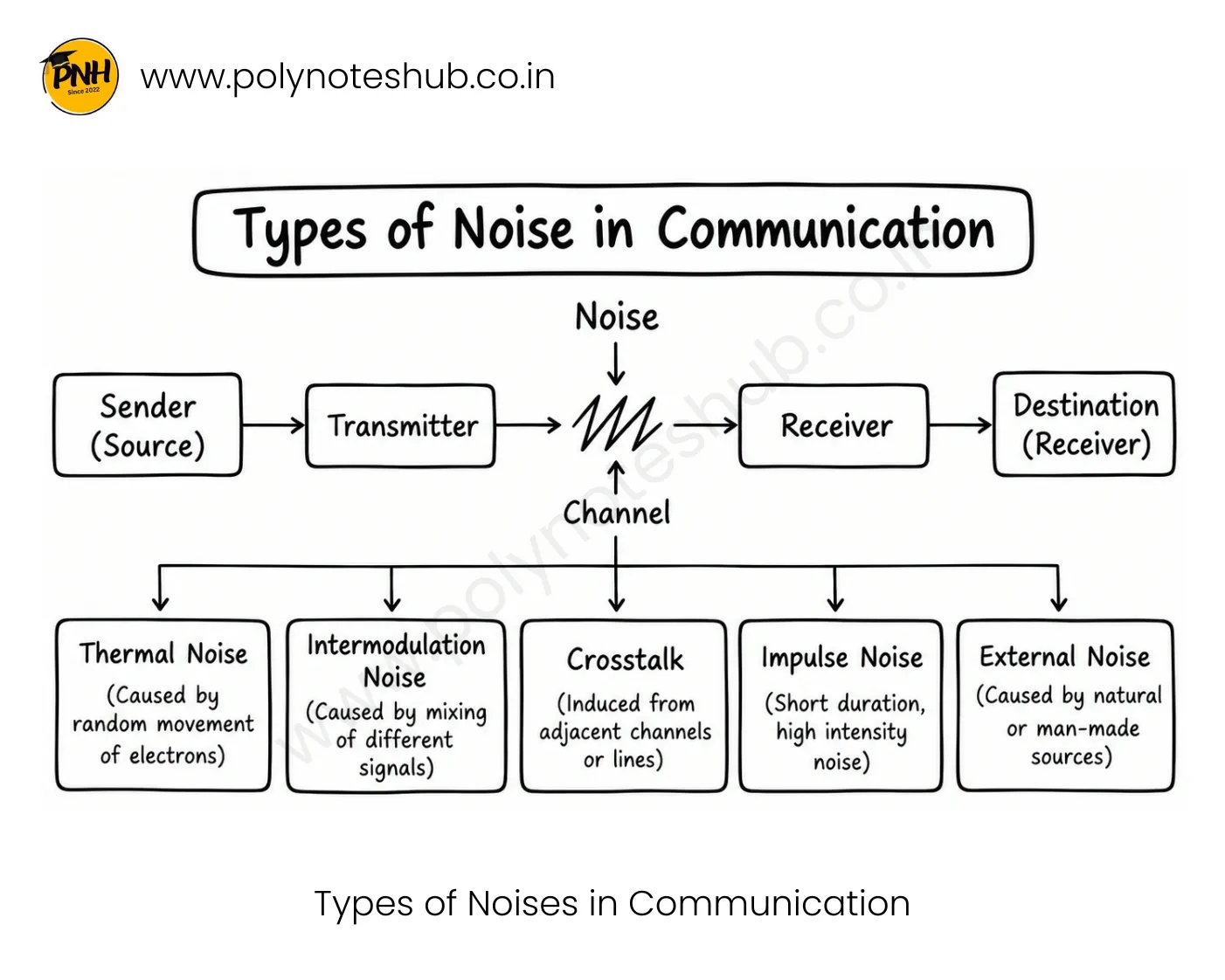
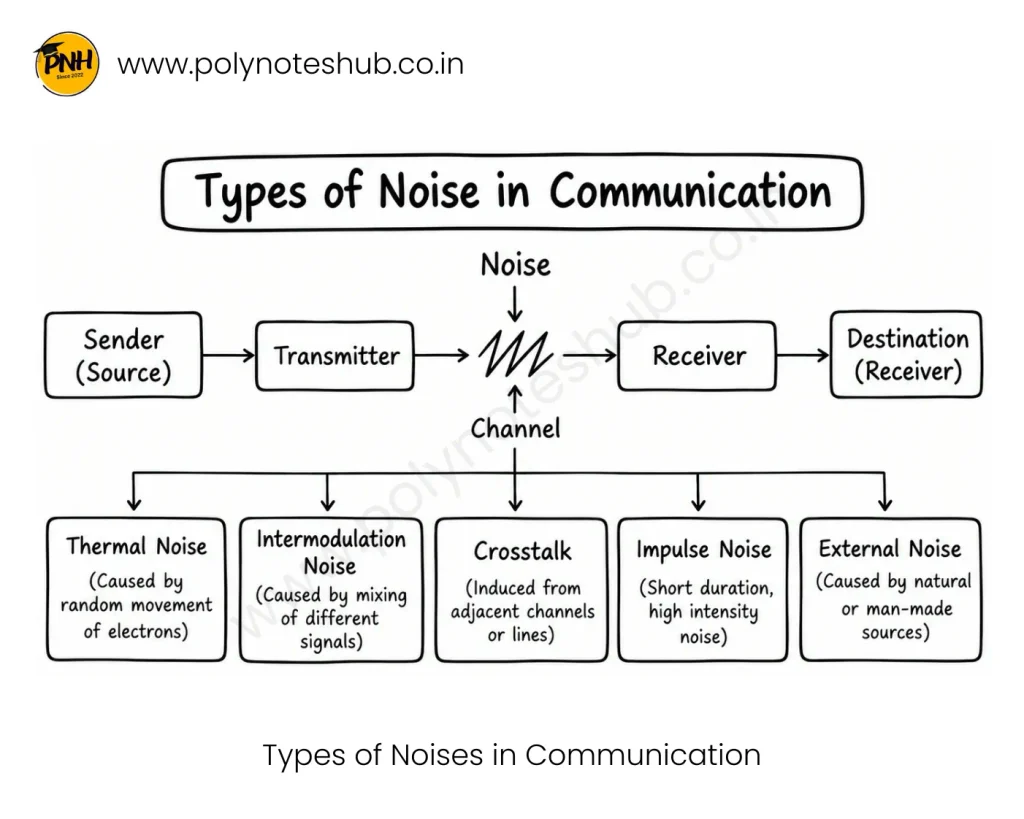
Here we have listed different types of noise in communication systems that occur during signal transmission and reception-
- Thermal Noise: Caused by the random migration of electrons in a conductor due to thermal agitation. Thermal noise is created by the random movement of electrons within electronic components owing to temperature. It is found in every electronic circuit and communication system. Thermal noise, also called Johnson or Nyquist noise, increases with temperature and bandwidth.
- Shot Noise: Caused by the discontinuous character of electric charge (for example, electrons) as it crosses junctions in electronic circuits. Shot noise develops when charge carriers flow randomly across connections in electrical devices like diodes and transistors. It is mostly connected with semiconductor devices and gains significance as the current flowing through the device increases.
- Intermodulation Noise: It results from the nonlinear mixing of signals in a circuit or device. Intermodulation noise develops when two or more signals with different frequencies combine due to the nonlinear nature of electrical components. This mixing generates undesired frequencies known as intermodulation products, which can interfere with other signals and impair communication quality.
- Crosstalk: This happens when a signal from one channel or circuit mistakenly interferes with a signal in another channel. Crosstalk noise occurs when a signal from one communication channel unintentionally interferes with or is connected to another neighboring channel. It is typically induced by electromagnetic or electrical interaction between cables or circuits. Crosstalk can degrade signal quality and produce undesired interference in communication systems.
- Impulse Noise: Lightning, switching transients, and electrical failures are all examples of sudden, short-duration disruptions. Impulse noise is made up of short-duration, high-amplitude unwanted signals that can unexpectedly disrupt a communication system. It could be caused by lightning, electrical switching, power-line problems, or other brief disturbances. Impulse noise can cause errors and momentarily reduce the quality of delivered data.
- Phase Noise: Associated with signal phase changes, which are frequently caused by oscillator or other component instabilities. Phase noise is an undesirable, random variation in the phase of a signal, especially in oscillators and carrier signals. It causes the signal frequency to fluctuate around its optimal value, which can impair the accuracy and effectiveness of communication systems, particularly at high frequencies.
- Quantization Noise: Originates from the process of transforming an analog signal to a digital signal. Quantization noise is an undesired inaccuracy that occurs when a continuous or analog signal is transformed to a finite number of digital values. It occurs during Analog-to-Digital Conversion (ADC), when the actual signal value is rounded to the nearest possible quantization level.
📍 For more such types of communication engineering notes, visit www.polynoteshub.co.in