
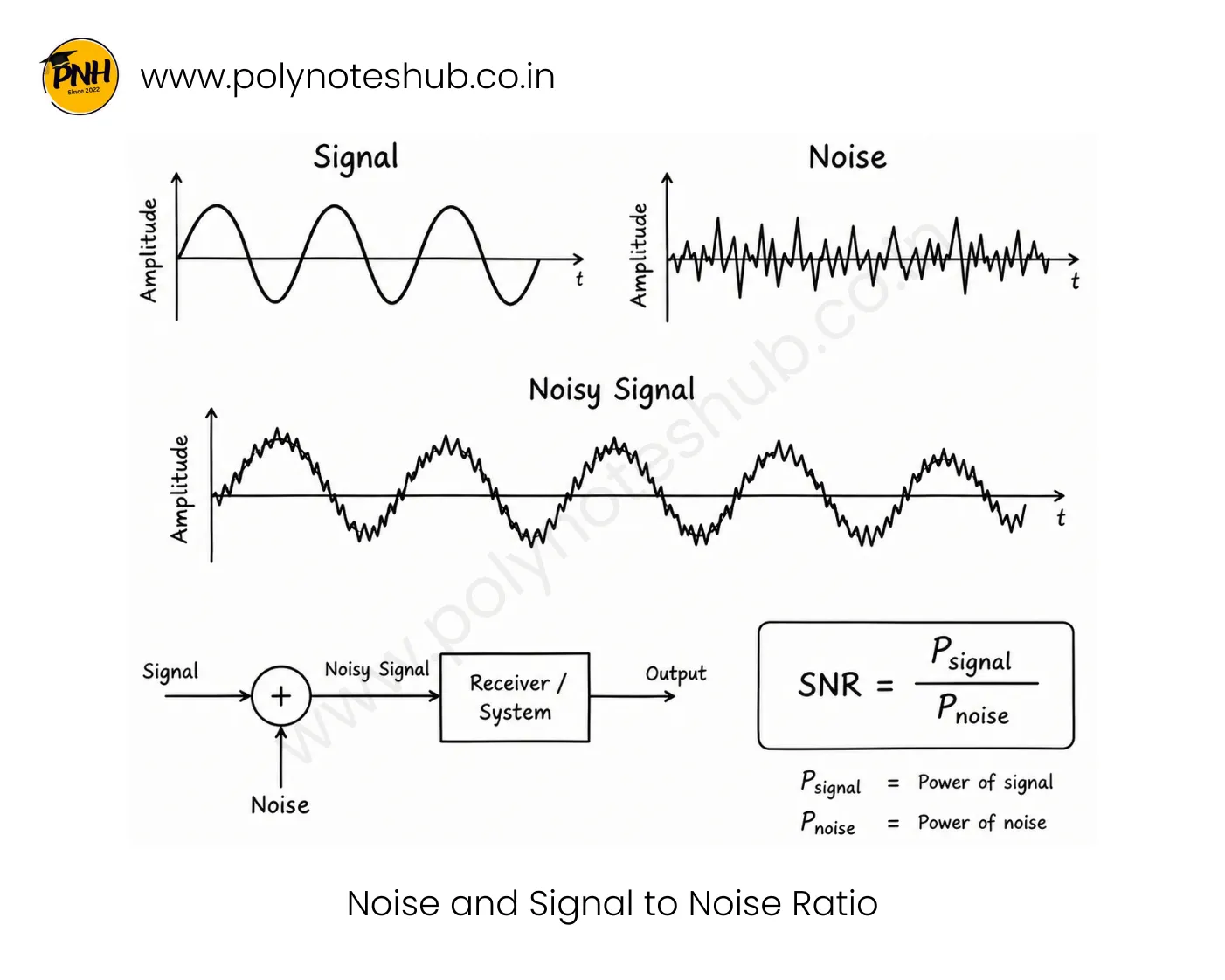
In this note, we are going to learn about a topic called What is Signal to Noise Ratio?, and its formula and applications as well. Welcome to Poly Notes Hub, a leading destination for engineering notes for diploma and degree engineering students.
Author Name: Arun Paul.
What is Signal to Noise Ratio?
The Signal to Noise Ratio or SNR is a measurement used in science and engineering to determine how much noise has damaged a signal. It is defined as the power of a signal (meaningful information) divided by the power of background noise (unwanted signal). A greater SNR suggests that the signal is cleaner and less distorted by noise.
Formula of Signal to Noise Ratio
Mathematically, Signal to Noise Ratio formula is expressed as:
SNR = (Psignal/Pnoise)
where,
- Psignal = Average power of the signal
- Pnoise = Average power of the noise.
The SNR also can be represented in decibel or dB by using the formula –
SNRdB=10log10(Psignal/Pnoise)
📍 For more such types of notes, please visit www.polynoteshub.co.in
Applications of Signal to Noise Ratio or SNR
Here we list some uses of SNR:
- Used in audio engineering.
- Used in communication systems.
- Used in scientific measurements.
- Used in medical imaging, astronomy, and photography.