
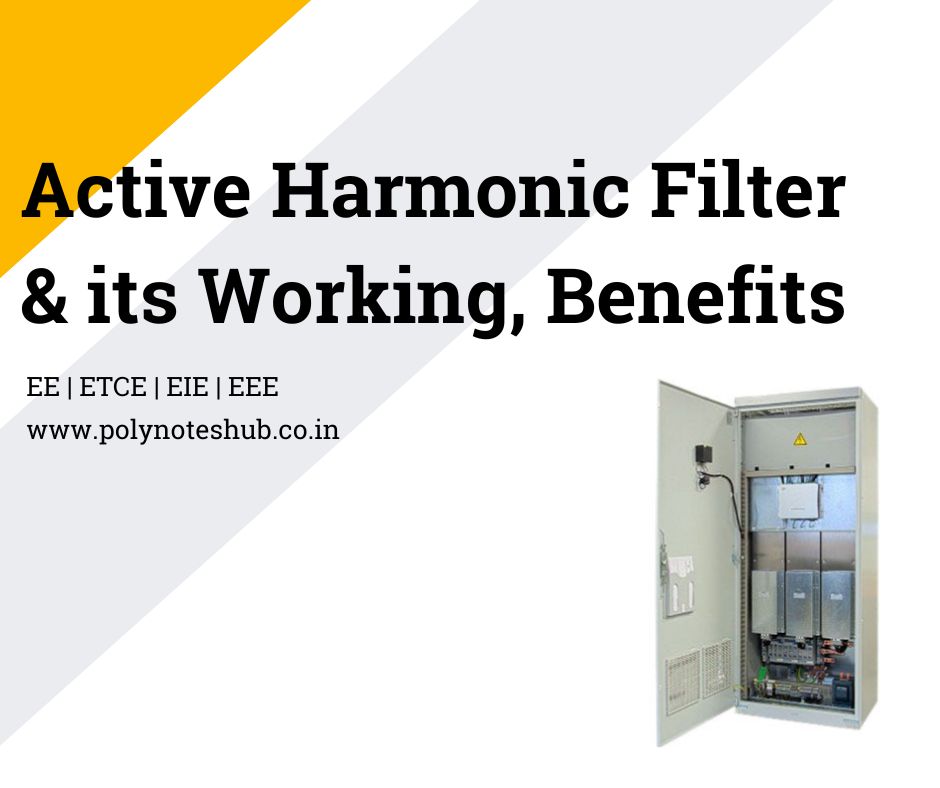
In this note, we are going to learn about a topic called “What is Active Harmonic Filter?“, also about its working, benefits, and applications. Welcome to Poly Notes Hub, a leading destination for engineering notes for diploma and degree engineering students.
Author Name: Arun Paul.
What is Active Harmonic Filter?
An Active Harmonic Filter (AHF) is a device in electrical power systems that reduces harmonic distortions generated by non-linear loads like variable frequency drives, computers, and other electronic equipment. These distortions can cause a range of problems, including equipment failure, overheating, and decreased efficiency.
Active Harmonic Filter Working
Here is an overview of an active harmonic filter and how its works –
- Detection: The AHF continuously monitors the electrical system to detect harmonics.
- Analysis: It analyzes the harmonic content and determines the magnitude and phase of the harmonic currents.
- Generation: The AHF generates compensating currents that are equal in magnitude but opposite in phase to the detected harmonics.
- Injection: These compensating currents are injected back into the electrical system to cancel out the harmonics.
Benefits of Active Harmonic Filter
Below we listed some advantages of active harmonic filter –
- Improved Power Quality: By eliminating harmonics, AHFs improve the overall power quality of the system, leading to more reliable operation of electrical equipment.
- Increased Efficiency: Reducing harmonics decreases losses in electrical systems, leading to improved energy efficiency.
- Extended Equipment Life: Less harmonic distortion reduces stress on electrical components, thus extending their operational life.
- Compliance with Standards: AHFs help meet regulatory standards for power quality, which is increasingly required in many industries.
- Flexible and Adaptive: Unlike passive filters, AHFs can adapt to changing load conditions and provide targeted harmonic mitigation.
Applications of Active Harmonic Filter
Here are some uses of Active Harmonic Filter –
- Industrial plants with heavy use of variable frequency drives and other non-linear loads.
- Commercial buildings with significant electronic equipment.
- Data centers and telecommunications facilities.
- Renewable energy installations where power electronics are prevalent.