
U-Tube Manometer: Construction, Working, Advantages, Disadvantages, and Applications | New Topic - Poly Notes Hub
Diploma 1st Semester Notes Diploma 2nd Semester Notes Electrical Engineering Notes Electrical and Electronics Engineering Notes Electronics and Telecommunication Engineering Notes Electronics and Instrumentation Engineering Notes Diploma 1st Semester Notes Diploma 2nd Semester Notes Electrical Engineering Notes Electrical and Electronics Engineering Notes Electronics and Telecommunication Engineering Notes Electronics and Instrumentation Engineering Notes Diploma 1st Semester Notes Diploma 2nd Semester Notes Electrical Engineering Notes Electrical and Electronics Engineering Notes Electronics and Telecommunication Engineering Notes Electronics and Instrumentation Engineering Notes Diploma 1st Semester Notes Diploma 2nd Semester Notes Electrical Engineering Notes Electrical and Electronics Engineering Notes Electronics and Telecommunication Engineering Notes Electronics and Instrumentation Engineering Notes Diploma 1st Semester Notes Diploma 2nd Semester Notes Electrical Engineering Notes Electrical and Electronics Engineering Notes Electronics and Telecommunication Engineering Notes Electronics and Instrumentation Engineering Notes Diploma 1st Semester Notes Diploma 2nd Semester Notes Electrical Engineering Notes Electrical and Electronics Engineering Notes Electronics and Telecommunication Engineering Notes Electronics and Instrumentation Engineering Notes Diploma 1st Semester Notes Diploma 2nd Semester Notes Electrical Engineering Notes Electrical and Electronics Engineering Notes Electronics and Telecommunication Engineering Notes Electronics and Instrumentation Engineering Notes Diploma 1st Semester Notes Diploma 2nd Semester Notes Electrical Engineering Notes Electrical and Electronics Engineering Notes Electronics and Telecommunication Engineering Notes Electronics and Instrumentation Engineering Notes Diploma 1st Semester Notes Diploma 2nd Semester Notes Electrical Engineering Notes Electrical and Electronics Engineering Notes Electronics and Telecommunication Engineering Notes Electronics and Instrumentation Engineering Notes Diploma 1st Semester Notes Diploma 2nd Semester Notes Electrical Engineering Notes Electrical and Electronics Engineering Notes Electronics and Telecommunication Engineering Notes Electronics and Instrumentation Engineering Notes Diploma 1st Semester Notes Diploma 2nd Semester Notes Electrical Engineering Notes Electrical and Electronics Engineering Notes Electronics and Telecommunication Engineering Notes Electronics and Instrumentation Engineering Notes Diploma 1st Semester Notes Diploma 2nd Semester Notes Electrical Engineering Notes Electrical and Electronics Engineering Notes Electronics and Telecommunication Engineering Notes Electronics and Instrumentation Engineering Notes

Our Notes Categories


U-Tube Manometer: Construction, Working, Advantages, Disadvantages, and Applications | New Topic

In this note, we are going to learn about the U-Tube Manometer and Its construction, working principle, advantages, disadvantages, and applications of U-tube manometer. Welcome to Poly Notes Hub, a leading destination for engineering notes.

Author Name: Arun Paul.

What is a Manometer?

A manometer is a device that measures the pressure or pressure difference between liquids and gases. It operates on the premise that pressure can be balanced by the height of a column of liquid.

A manometer contains a manometric fluid such as mercury, water, or oil in a tube. When pressure is applied, the liquid level rises or lowers, and the pressure is calculated by measuring the difference in height of the liquid column.

Manometers are simple, accurate, and widely utilized in laboratories, industrial systems, flow measurement, and calibration. They are most suited to measuring low and moderate pressures, as well as differential pressure.

The basic pressure relation used in manometers is:P=ρghP = \rho g h

where;

  • PP = Pressure
  • ρ\rho = Density of manometric fluid
  • gg = Acceleration due to gravity
  • hh = Height difference of liquid column

Types of Manometer

There are three types of manometer,

  • U-Tube Type Manometer
  • Wall Type Manometer
  • Micromanometer

Typical Range of U-Tube Manometer

  • With Water as Manometric Fluid: 0 to 10 kPa (approx.)
  • With Mercury as Manometric Fluid: 0 to 100 kPa (approx.)
  • Differential Pressure Measurement: A few mm of water column (≈ 10 Pa) up to about 100 kPa
See also  Project Report - Concept, Features, and Components | New Topic [2024]

Range of U-tube manometer ≈ 10 Pa to 100 kPa (depending on manometric fluid).

Construction of U-Tube Manometer

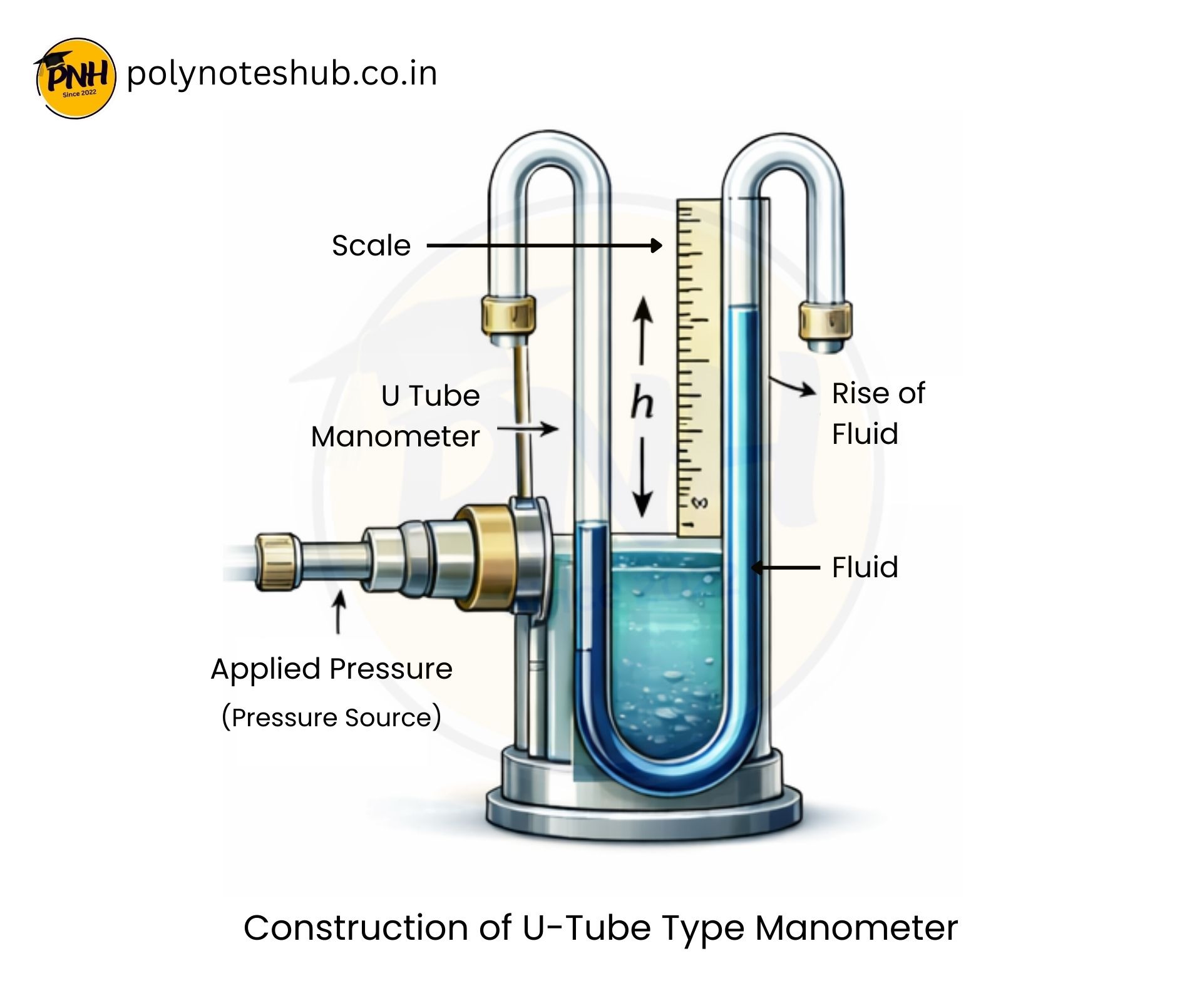
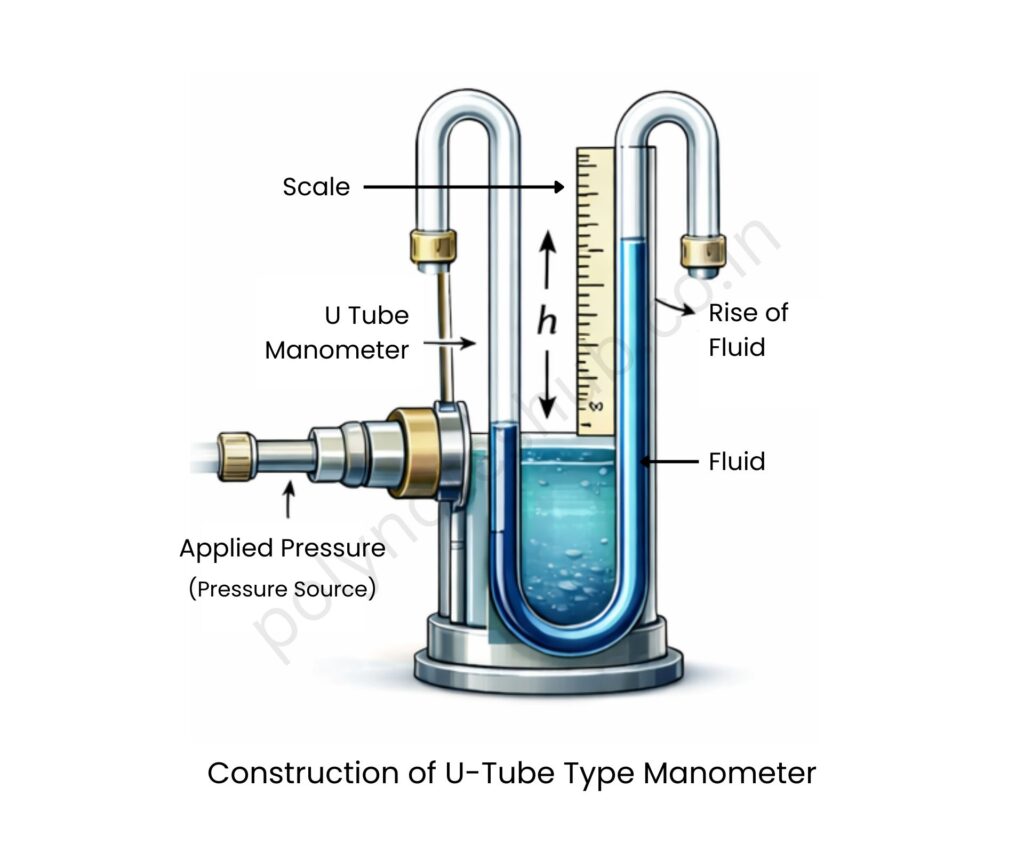
A U-tube manometer is made of a transparent glass tube twisted into a U shape and vertically fixed on a suitable support frame. The tube is partially filled with a manometric liquid, such as mercury, water, or light oil, depending on the pressure range being monitored. One leg of the tube is attached to the pressure source (pipe, vessel, or gas line), while the other is normally open to the atmosphere or connected to another pressure point. A graduated scale is placed alongside the tube to properly measure the change in liquid levels. The entire setup is designed to keep the tube absolutely vertical for accurate readings.

Diagram of U-Tube Manometer
construction or diagram of u-tube manometer - poly notes hub

Working Principle of U-Tube Manometer

The hydrostatic pressure balance concept governs how the U-tube manometer operates. When pressure is applied to one limb, the manometric liquid is moved, causing the level to fall in the limb with the greater pressure and rise in the other. This causes a difference in height (h) between the two liquid columns. The pressure difference is then calculated by measuring the height difference and applying the following relation:

P=ρgh

In this equation, 𝜌 represents the density of the manometric fluid, 𝑔 represents gravity’s acceleration, and ℎ represents the liquid level difference. Thus, the applied pressure is directly proportional to the height of the fluid column, allowing for precise detection of low to moderate pressures or pressure variations.

Advantages of U-Tube Manometer

  • It has a simple construction.
  • This manometer has high accuracy.
  • Does not need any calibration on this manometer.
  • It is a low-cost device as well.
See also  Electrical Engineering Salary in 2024 | Best Website | New Topic [2024]

Disadvantages of U-Tube Manometer

  • It is not suitable for fluctuating pressure.
  • It is Bulky and fragile.
  • The response is slow of this manometer.

Application of the U-Tube Manometer

  • Used in Laboratory pressure measurement.
  • Used for the Calibration of gauges.
  • Used for the measurement of gas pressure.

Share This Post

Leave a Reply

Your email address will not be published. Required fields are marked *

U-Tube Manometer: Construction, Working, Advantages, Disadvantages, and Applications | New Topic - Poly Notes Hub

Our Notes Categories

U-Tube Manometer: Construction, Working, Advantages, Disadvantages, and Applications | New Topic - Poly Notes Hub

Our Notes Categories


U-Tube Manometer: Construction, Working, Advantages, Disadvantages, and Applications | New Topic - Poly Notes Hub
1st Year 1st SEM Notes ✭ 1st Year 2nd SEM Notes ✭ EE 2nd & 3rd Year Notes ✭ EEE 2nd & 3rd Year Notes ✭ ETCE 2nd & 3rd Year Notes ✭ EIE 2nd & 3rd Year Notes ✭ 1st Year 1st SEM Notes ✭ 1st Year 2nd SEM Notes ✭ EE 2nd & 3rd Year Notes ✭ EEE 2nd & 3rd Year Notes ✭ ETCE 2nd & 3rd Year Notes ✭ EIE 2nd & 3rd Year Notes ✭ 1st Year 1st SEM Notes ✭ 1st Year 2nd SEM Notes ✭ EE 2nd & 3rd Year Notes ✭ EEE 2nd & 3rd Year Notes ✭ ETCE 2nd & 3rd Year Notes ✭ EIE 2nd & 3rd Year Notes ✭ 1st Year 1st SEM Notes ✭ 1st Year 2nd SEM Notes ✭ EE 2nd & 3rd Year Notes ✭ EEE 2nd & 3rd Year Notes ✭ ETCE 2nd & 3rd Year Notes ✭ EIE 2nd & 3rd Year Notes ✭ 1st Year 1st SEM Notes ✭ 1st Year 2nd SEM Notes ✭ EE 2nd & 3rd Year Notes ✭ EEE 2nd & 3rd Year Notes ✭ ETCE 2nd & 3rd Year Notes ✭ EIE 2nd & 3rd Year Notes ✭ 1st Year 1st SEM Notes ✭ 1st Year 2nd SEM Notes ✭ EE 2nd & 3rd Year Notes ✭ EEE 2nd & 3rd Year Notes ✭ ETCE 2nd & 3rd Year Notes ✭ EIE 2nd & 3rd Year Notes ✭ 1st Year 1st SEM Notes ✭ 1st Year 2nd SEM Notes ✭ EE 2nd & 3rd Year Notes ✭ EEE 2nd & 3rd Year Notes ✭ ETCE 2nd & 3rd Year Notes ✭ EIE 2nd & 3rd Year Notes ✭ 1st Year 1st SEM Notes ✭ 1st Year 2nd SEM Notes ✭ EE 2nd & 3rd Year Notes ✭ EEE 2nd & 3rd Year Notes ✭ ETCE 2nd & 3rd Year Notes ✭ EIE 2nd & 3rd Year Notes ✭ 1st Year 1st SEM Notes ✭ 1st Year 2nd SEM Notes ✭ EE 2nd & 3rd Year Notes ✭ EEE 2nd & 3rd Year Notes ✭ ETCE 2nd & 3rd Year Notes ✭ EIE 2nd & 3rd Year Notes ✭ 1st Year 1st SEM Notes ✭ 1st Year 2nd SEM Notes ✭ EE 2nd & 3rd Year Notes ✭ EEE 2nd & 3rd Year Notes ✭ ETCE 2nd & 3rd Year Notes ✭ EIE 2nd & 3rd Year Notes ✭ 1st Year 1st SEM Notes ✭ 1st Year 2nd SEM Notes ✭ EE 2nd & 3rd Year Notes ✭ EEE 2nd & 3rd Year Notes ✭ ETCE 2nd & 3rd Year Notes ✭ EIE 2nd & 3rd Year Notes ✭ 1st Year 1st SEM Notes ✭ 1st Year 2nd SEM Notes ✭ EE 2nd & 3rd Year Notes ✭ EEE 2nd & 3rd Year Notes ✭ ETCE 2nd & 3rd Year Notes ✭ EIE 2nd & 3rd Year Notes ✭ 1st Year 1st SEM Notes ✭ 1st Year 2nd SEM Notes ✭ EE 2nd & 3rd Year Notes ✭ EEE 2nd & 3rd Year Notes ✭ ETCE 2nd & 3rd Year Notes ✭ EIE 2nd & 3rd Year Notes ✭ 1st Year 1st SEM Notes ✭ 1st Year 2nd SEM Notes ✭ EE 2nd & 3rd Year Notes ✭ EEE 2nd & 3rd Year Notes ✭ ETCE 2nd & 3rd Year Notes ✭ EIE 2nd & 3rd Year Notes ✭ 1st Year 1st SEM Notes ✭ 1st Year 2nd SEM Notes ✭ EE 2nd & 3rd Year Notes ✭ EEE 2nd & 3rd Year Notes ✭ ETCE 2nd & 3rd Year Notes ✭ EIE 2nd & 3rd Year Notes ✭ 1st Year 1st SEM Notes ✭ 1st Year 2nd SEM Notes ✭ EE 2nd & 3rd Year Notes ✭ EEE 2nd & 3rd Year Notes ✭ ETCE 2nd & 3rd Year Notes ✭ EIE 2nd & 3rd Year Notes ✭ 1st Year 1st SEM Notes ✭ 1st Year 2nd SEM Notes ✭ EE 2nd & 3rd Year Notes ✭ EEE 2nd & 3rd Year Notes ✭ ETCE 2nd & 3rd Year Notes ✭ EIE 2nd & 3rd Year Notes ✭ 1st Year 1st SEM Notes ✭ 1st Year 2nd SEM Notes ✭ EE 2nd & 3rd Year Notes ✭ EEE 2nd & 3rd Year Notes ✭ ETCE 2nd & 3rd Year Notes ✭ EIE 2nd & 3rd Year Notes ✭ 1st Year 1st SEM Notes ✭ 1st Year 2nd SEM Notes ✭ EE 2nd & 3rd Year Notes ✭ EEE 2nd & 3rd Year Notes ✭ ETCE 2nd & 3rd Year Notes ✭ EIE 2nd & 3rd Year Notes ✭ 1st Year 1st SEM Notes ✭ 1st Year 2nd SEM Notes ✭ EE 2nd & 3rd Year Notes ✭ EEE 2nd & 3rd Year Notes ✭ ETCE 2nd & 3rd Year Notes ✭ EIE 2nd & 3rd Year Notes ✭ 1st Year 1st SEM Notes ✭ 1st Year 2nd SEM Notes ✭ EE 2nd & 3rd Year Notes ✭ EEE 2nd & 3rd Year Notes ✭ ETCE 2nd & 3rd Year Notes ✭ EIE 2nd & 3rd Year Notes ✭ 1st Year 1st SEM Notes ✭ 1st Year 2nd SEM Notes ✭ EE 2nd & 3rd Year Notes ✭ EEE 2nd & 3rd Year Notes ✭ ETCE 2nd & 3rd Year Notes ✭ EIE 2nd & 3rd Year Notes ✭ 1st Year 1st SEM Notes ✭ 1st Year 2nd SEM Notes ✭ EE 2nd & 3rd Year Notes ✭ EEE 2nd & 3rd Year Notes ✭ ETCE 2nd & 3rd Year Notes ✭ EIE 2nd & 3rd Year Notes ✭ 1st Year 1st SEM Notes ✭ 1st Year 2nd SEM Notes ✭ EE 2nd & 3rd Year Notes ✭ EEE 2nd & 3rd Year Notes ✭ ETCE 2nd & 3rd Year Notes ✭ EIE 2nd & 3rd Year Notes ✭ 1st Year 1st SEM Notes ✭ 1st Year 2nd SEM Notes ✭ EE 2nd & 3rd Year Notes ✭ EEE 2nd & 3rd Year Notes ✭ ETCE 2nd & 3rd Year Notes ✭ EIE 2nd & 3rd Year Notes ✭ 1st Year 1st SEM Notes ✭ 1st Year 2nd SEM Notes ✭ EE 2nd & 3rd Year Notes ✭ EEE 2nd & 3rd Year Notes ✭ ETCE 2nd & 3rd Year Notes ✭ EIE 2nd & 3rd Year Notes ✭ 1st Year 1st SEM Notes ✭ 1st Year 2nd SEM Notes ✭ EE 2nd & 3rd Year Notes ✭ EEE 2nd & 3rd Year Notes ✭ ETCE 2nd & 3rd Year Notes ✭ EIE 2nd & 3rd Year Notes ✭ 1st Year 1st SEM Notes ✭ 1st Year 2nd SEM Notes ✭ EE 2nd & 3rd Year Notes ✭ EEE 2nd & 3rd Year Notes ✭ ETCE 2nd & 3rd Year Notes ✭ EIE 2nd & 3rd Year Notes

Our Notes Categories

Our Notes Categories