

In this note, we will learn about the Micromanometer (Micrometer Manometer) and its Diagram, Working Principle, Advantages, Disadvantages, and Applications. Welcome to Poly Notes Hub, a leading destination for polytechnic engineering notes.
Author Name: Arun Paul.
Definition of Micromanometer
A Micrometer Manometer is a highly sensitive form of manometer designed to measure very small pressure differences. Micromanometer is used to measure very low pressure or differential pressure in the range of about 1 Pa to 1000 Pa.
Diagram of Micromanometer
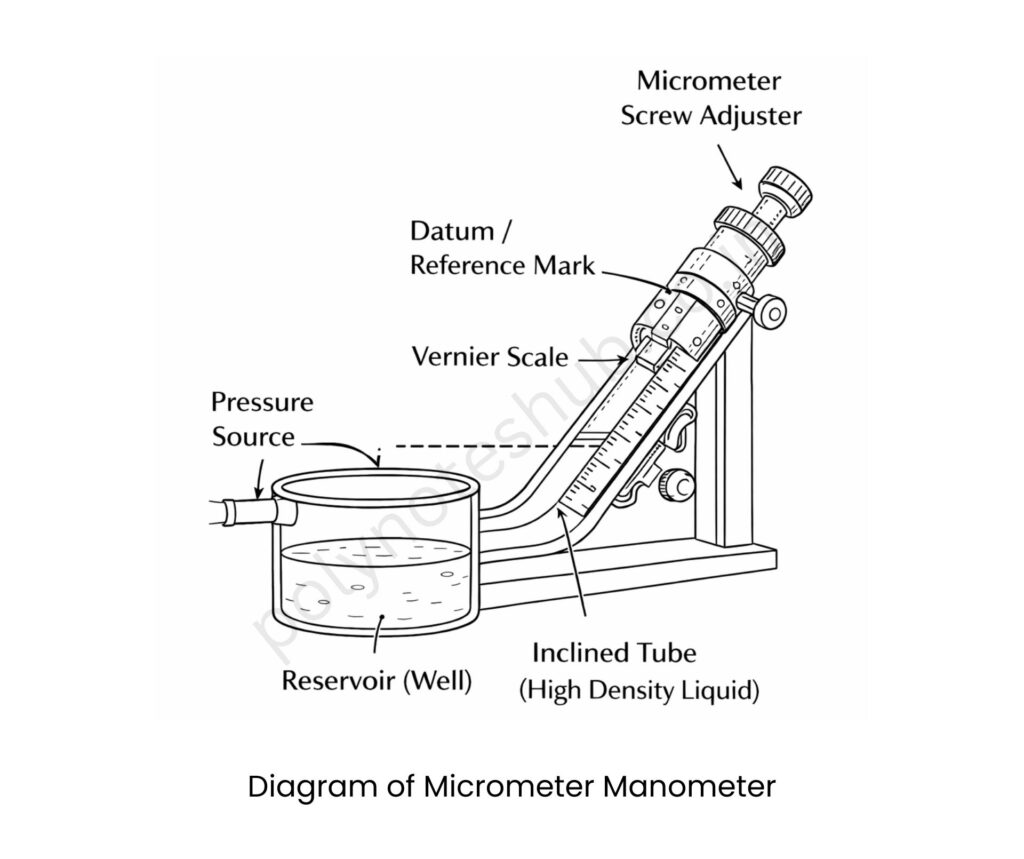
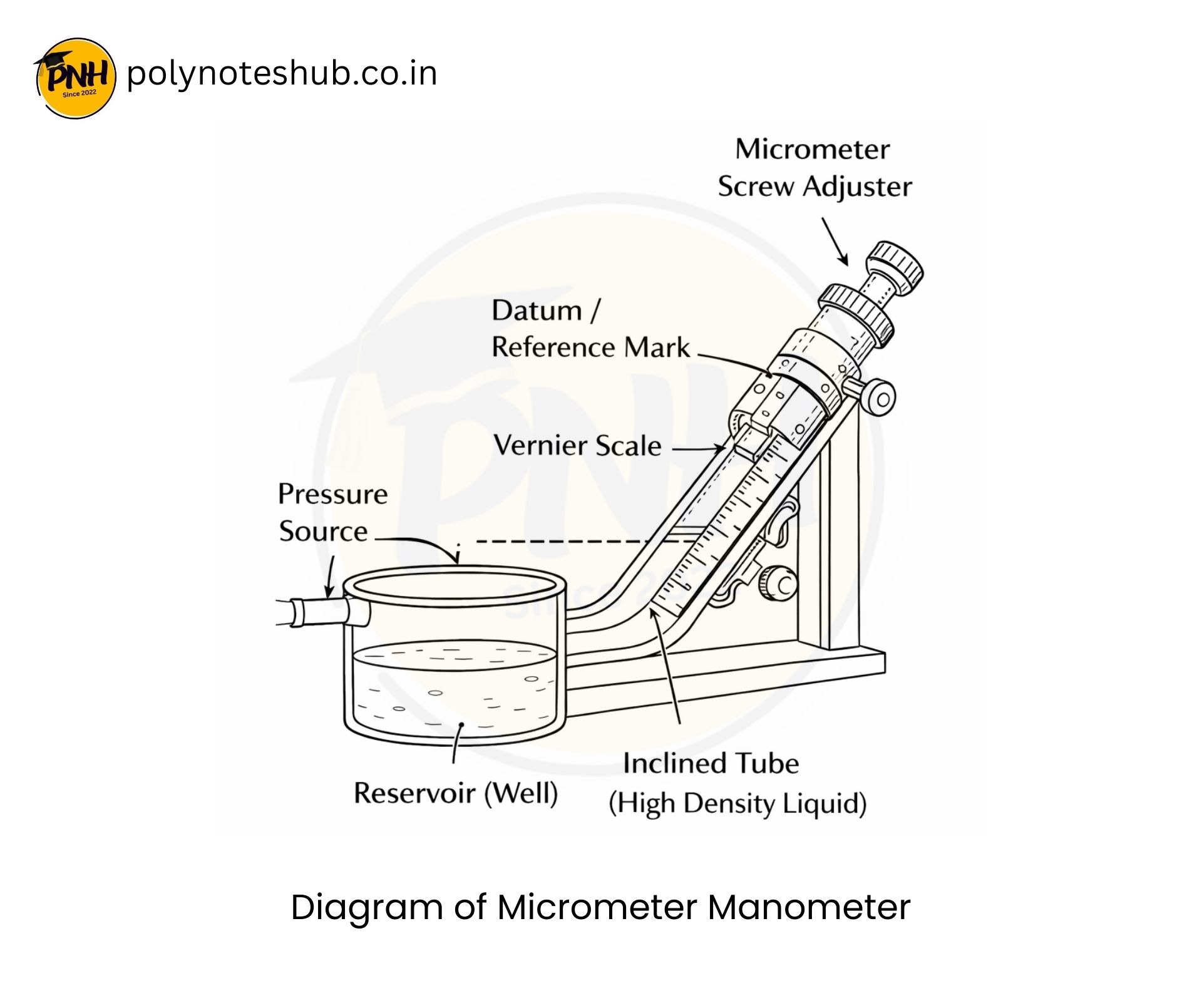
It is made up of a big reservoir (well), a fine bore glass tube (often slanted), and a micrometer screw arrangement. The micrometer screw is attached to a movable pointer or reference tip that can be accurately adjusted. A vernier scale or magnifying arrangement is also included to acquire extremely accurate readings. A suitable high-density manometric liquid is employed inside the instrument.
Working Principle of Micromanometer
When a tiny pressure differential is applied, the manometric liquid within the tube moves somewhat. The micrometer screw is then turned to return the liquid meniscus to a predetermined reference position. The amount of screw rotation determines the precise displacement of the liquid column, which is utilized to calculate the pressure differential. Because displacement can be detected precisely, the micrometer manometer can accurately measure very low and differential pressures.
Advantages of Micrometer Manometer
- It is has very high accuracy.
- It is suitable for very small pressure difference.
- It does precise reading.
Disadvantages of Micrometer Manometer
- It is Costly.
- It has a complex construction.
- It is requires skilled handling.
Applications of Micrometer Manometer
The micromanometer is used in different industrial works, like –
- Used in Research laboratories.
- Used in Wind tunnel experiments.
- Used for Calibration work.